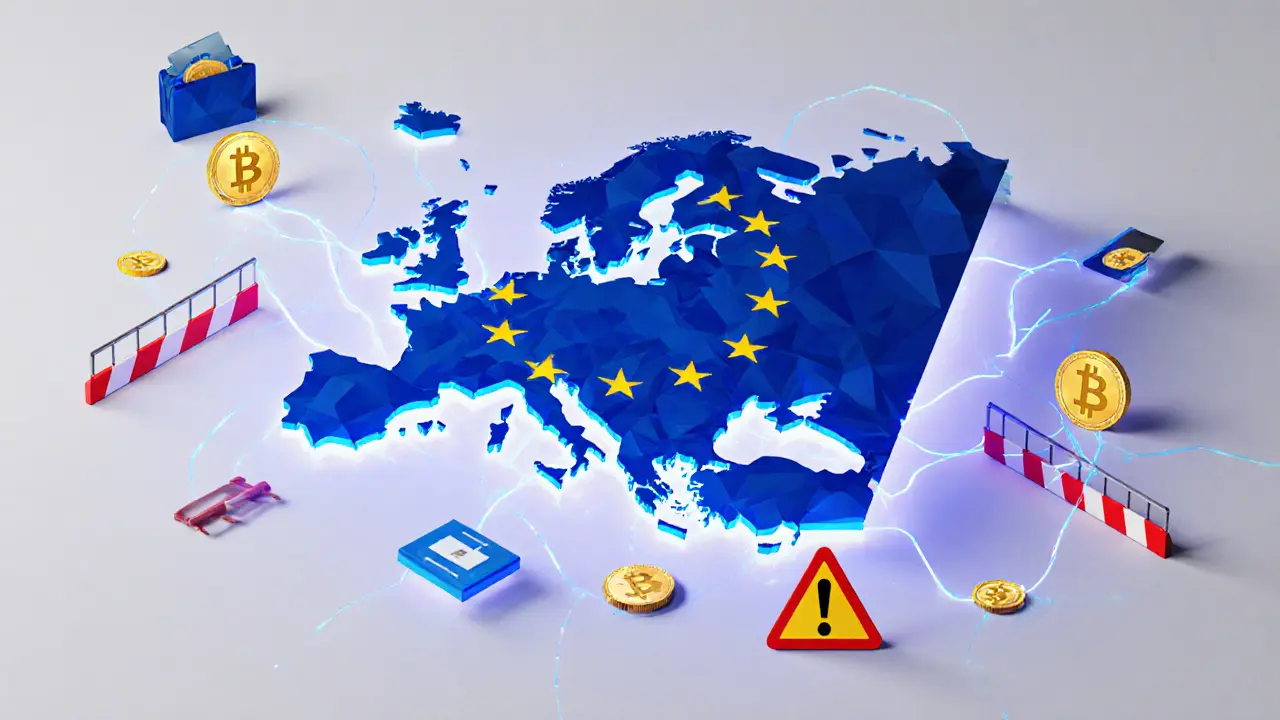
When the EU cryptocurrency sanctions, targeted financial restrictions imposed by the European Union to block illicit crypto flows tied to rogue states, terrorists, and sanctioned entities. Also known as EU crypto sanctions, these rules are meant to stop crypto from becoming a backdoor for money laundering and war funding. Unlike traditional banking, crypto moves fast, crosses borders without paperwork, and often hides behind pseudonyms—making it both a tool for freedom and a weapon for evasion.
The EU doesn’t just slap fines on banks anymore. They’re tracking blockchain analytics firms, companies like Chainalysis and Elliptic that trace crypto transactions to identify wallets linked to sanctioned actors, forcing exchanges to freeze accounts tied to Iranian mining rings or Russian oligarchs. In 2024, the EU added over 200 crypto wallet addresses to its sanctions list—including ones tied to IRGC-backed mining operations, Iran’s state-backed crypto mining farms that use cheap power to generate Bitcoin and evade U.S. and EU financial controls. These aren’t theoretical threats. Real wallets got frozen. Real exchanges got fined. Real users lost access.
But crypto doesn’t just sit still. When the EU blocks one path, users find another. Some move to privacy chains like Manta Network, where transaction details are hidden by default. Others use decentralized exchanges that don’t require KYC, or swap assets through cross-chain bridges that skip traditional oversight. Even stablecoins like USDT and USDC—meant to be stable—are being used as a workaround, moving value out of countries like Argentina and Iran where local currencies collapse. The EU knows this. That’s why they’re pushing for MiCA, their new crypto law that forces all crypto service providers to report suspicious activity, track wallet histories, and block sanctioned addresses automatically.
It’s not about banning crypto. It’s about controlling how it’s used. The EU’s goal? Make it harder to hide money from sanctions without killing innovation. But that’s a tightrope walk. Too strict, and you push users to unregulated platforms. Too loose, and you become a haven for bad actors. That’s why you’ll see posts here about EU cryptocurrency sanctions in action—how Iran’s IRGC uses mining to bypass restrictions, how Sweden’s tax hikes pushed miners underground, and how platforms like HTX and CoinDCX scramble to stay compliant while serving users in high-risk regions.
What follows isn’t theory. It’s real cases. Real wallets. Real exchanges caught in the middle. You’ll find breakdowns of how sanctions hit specific projects, how users adapt, and what happens when a token like MSWAP vanishes overnight—not because of market collapse, but because its team got flagged. This isn’t about hype. It’s about understanding the real stakes: who wins, who loses, and how crypto’s design makes it both a target and a tool in the global fight over money, power, and control.
EU cryptocurrency sanctions are now enforceable under MiCA and TFR. Learn how stablecoin rules, transaction tracing, and licensing requirements affect businesses and users in 2025.