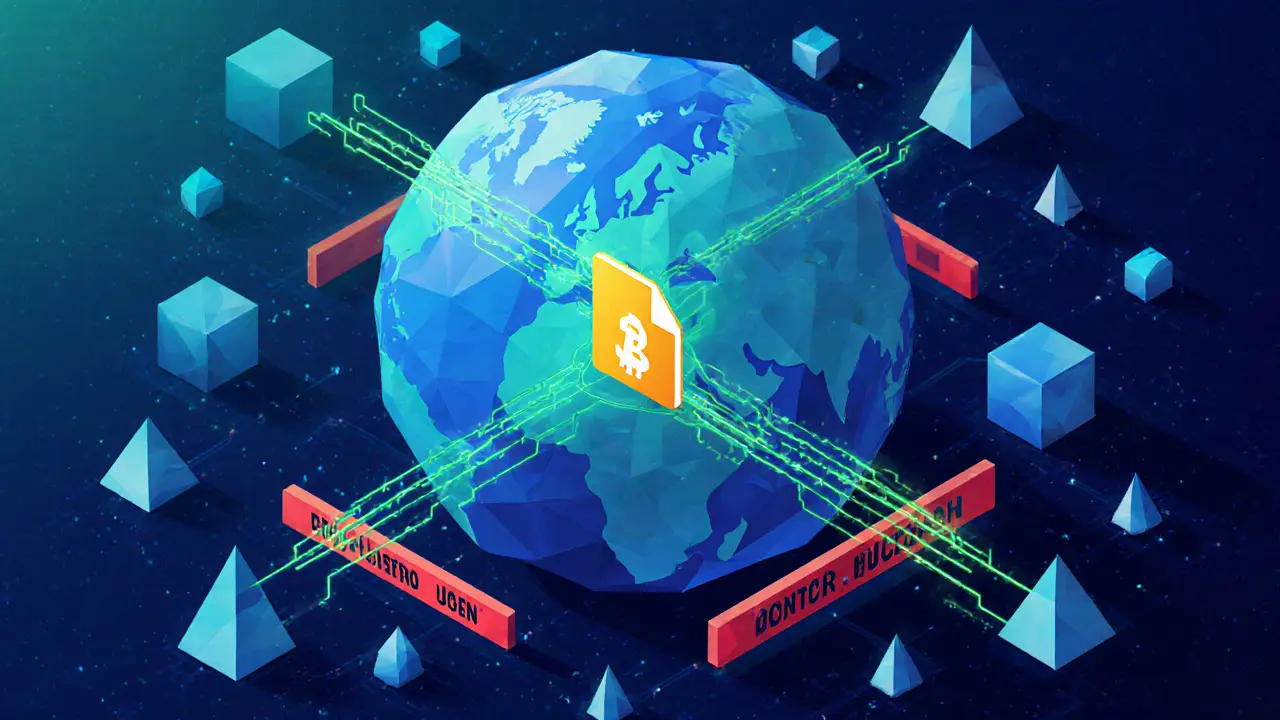

When you hear Filecoin, a blockchain‑based network that creates a marketplace for unused digital storage, you’re looking at a system that lets anyone buy or sell space on a peer‑to‑peer basis. Also called FIL, it blends crypto incentives with real‑world storage demand. The whole idea sits inside decentralized storage, the practice of spreading data across many independent nodes instead of a single, controlled server farm. Built on top of IPFS, the InterPlanetary File System that handles content‑addressed file distribution, Filecoin turns those files into economic value. To keep the network running, participants engage in storage mining, the process of proving you’re storing data correctly and earning FIL as a reward. Together these pieces form a self‑sustaining ecosystem where data, hardware, and token incentives interact.
What makes decentralized storage compelling is its resistance to single‑point failures and censorship. By spreading copies across geographically diverse nodes, you get higher reliability and lower latency for global users. Filecoin leverages this resilience by turning storage capacity into a tradable commodity, so providers can price their space based on market demand. This dynamic market means that when demand spikes—say during a big NFT drop—storage providers earn more FIL, encouraging them to add capacity. In turn, buyers get cheaper, flexible options compared to traditional cloud contracts. If you’re wondering why Filecoin matters, think of it as the bridge between raw storage capacity and real economic value. The relationship can be summed up as: Filecoin encompasses decentralized storage, and decentralized storage influences Filecoin’s token economics.
Behind the scenes, IPFS acts as the data transport layer for Filecoin. When you upload a file, IPFS generates a unique hash that points to the content, not its location. This hash is then referenced in a Filecoin deal, allowing miners to verify they are storing the exact data without needing to know who owns it. Because IPFS is content‑addressed, any change to a file creates a new hash, keeping the system tamper‑proof. The synergy between IPFS and Filecoin means you get both fast retrieval (thanks to IPFS’s peer‑to‑peer routing) and economic guarantees (via Filecoin’s proof‑of‑replication and proof‑of‑spacetime). In short, IPFS provides the roadmap, Filecoin supplies the fuel.
Storage mining is where the rubber meets the road. Miners must continuously run cryptographic proofs that demonstrate they are keeping the data intact over time. These proofs—Proof of Replication and Proof of Spacetime—are submitted to the network, and when verified, the miner receives newly minted FIL or transaction fees. The more reliable a miner’s hardware and power supply, the higher the chance of winning rewards. This setup creates a competitive market where efficiency translates directly into earnings. It also means the network’s security scales with the total amount of stored data, because breaking the system would require compromising a massive, geographically dispersed set of machines. So, Filecoin requires storage mining, and successful mining drives the overall health of the ecosystem.
The FIL token itself plays three core roles: a medium of exchange for storage deals, a reward for miners, and a governance tool for protocol upgrades. Tokenomics are designed to balance supply and demand—new FIL is minted at a decreasing rate, while transaction fees are burned, creating a deflationary pressure as usage grows. Market observers watch on‑chain metrics like total pledged storage and active miners to gauge long‑term value. Because FIL can be traded on major exchanges, price swings often mirror broader crypto sentiment, but the underlying utility anchors it to real storage demand. Understanding FIL’s economics helps you decide whether to hold, stake, or use the token for a specific storage contract.
Now that you have the fundamentals of Filecoin, decentralized storage, IPFS, storage mining, and the FIL token, the articles below will fill in the practical details you might need. We cover everything from upcoming airdrops and how to claim them, to step‑by‑step guides on using crypto exchanges safely. If you’re curious about how blockchain technology powers real‑world use cases, we’ve got deep dives on mining regulations, tokenomics of other projects, and comparisons between traditional and blockchain‑based platforms. Whether you’re a newcomer looking for a quick overview or an experienced trader hunting the latest market analysis, the collection below is organized to give you clear, data‑driven insights without the fluff. Dive in and see which topics match your current questions.
Explore how decentralized storage provides censorship resistance, compare top platforms, and learn step‑by‑step setup for secure, uncensorable data.