

Confidential Transactions Explained: How Blockchain Hides Amounts Without Breaking Trust
 Jul, 29 2026
Imagine sending money to a friend where everyone can see the transaction happened, but no one knows how much you sent. That sounds like magic, but it is actually the core promise of Confidential Transactions (CT), a cryptographic protocol designed to solve the biggest tension in blockchain technology: transparency versus privacy.
Blockchains are public ledgers. By design, anyone can look up your wallet address and see every cent that has ever flowed through it. This total visibility is great for auditing but terrible for financial privacy. If you run a business, your competitors can track your supply chain payments. If you are just trying to keep your finances personal, the open book nature of Bitcoin or Ethereum feels intrusive. Confidential Transactions fix this by hiding the specific amounts being transferred while still proving that the math adds up.
The Core Problem: Why We Need Hidden Amounts
To understand why CT matters, we have to look at how standard blockchains work. In a typical transparent transaction, inputs (money coming in) must equal outputs (money going out) plus fees. The network verifies this balance to prevent users from creating new coins out of thin air. But because the ledger is public, seeing these numbers reveals everything about your financial behavior.
This lack of privacy creates real-world risks. It allows for chain analysis firms to de-anonymize users, exposing their net worth, spending habits, and business relationships. Greg Maxwell, a Bitcoin Core developer, first proposed the concept of Confidential Transactions in 2013. His goal was simple: allow the network to verify that inputs equal outputs without revealing the actual values. This solves the 'transparency versus confidentiality' conflict, letting you prove you didn't create fake money without showing your bank balance.
How Confidential Transactions Work Under the Hood
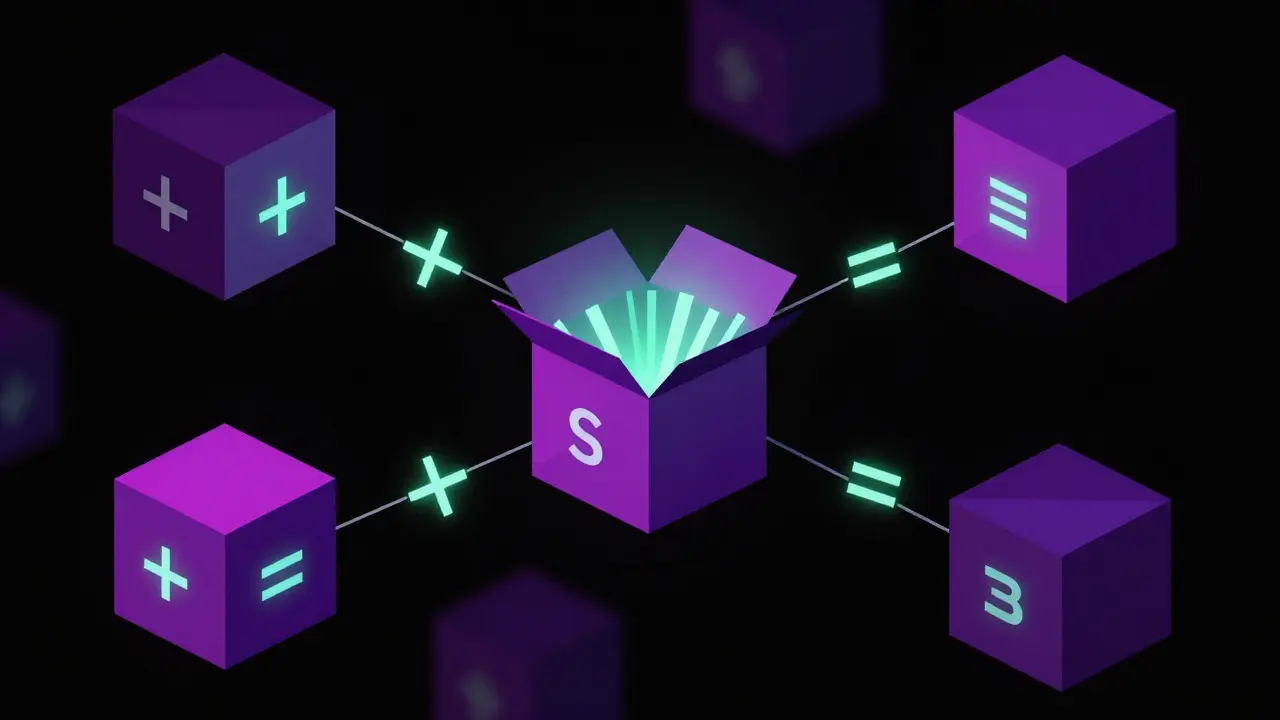
You might wonder how a computer can check if $50 equals $50 + $1 fee when those numbers are hidden. The answer lies in advanced cryptography, specifically a technique called Pedersen Commitments. Think of a Pedersen Commitment as a locked box. You put a number inside and lock it with a random value. The network can see the locked box, but not the number inside.
Here is the clever part. These boxes have a mathematical property called homomorphism. If you add two locked boxes together, the result is a new locked box containing the sum of the original numbers. So, if Alice sends Bob some coins, she creates a commitment for her input and commitments for the outputs. The network adds all the output commitments and subtracts the input commitment. If the result is zero (mathematically speaking), the transaction is valid. No new coins were created. No coins were destroyed. But nobody knows the actual amount.
There is a catch, though. Without extra checks, someone could try to cheat by putting negative numbers or massive overflow numbers into the boxes. To stop this, CT uses Range Proofs. A range proof is a cryptographic guarantee that the hidden number falls within a valid range, such as 0 to 2^64 satoshis, without revealing the exact figure. Early versions of range proofs were bulky, taking up to 10KB per transaction. However, the introduction of Bulletproofs in 2017 by Benedikt Bünz and his team reduced this size to roughly 670 bytes, making confidential transactions practical for everyday use.
RingCT and Monero: The Gold Standard of Privacy
While the basic concept of hiding amounts is powerful, it doesn't hide who sent or received the money. For complete privacy, you need to mix sender and receiver anonymity with amount confidentiality. This is where Monero comes in.
Monero implemented a variant called RingCT (Ring Confidential Transactions) in January 2017. RingCT combines Pedersen Commitments and Bulletproofs with ring signatures. A ring signature mixes your transaction signature with several decoy signatures from other past transactions on the blockchain. This makes it virtually impossible for an observer to tell which input actually paid for the transaction.
Over time, Monero has strengthened its privacy. The anonymity set-the number of possible senders-grew from 5 inputs in 2017 to 11 in 2020, and finally to 16 inputs following the 'Akita' protocol upgrade in May 2023. This upgrade also reduced transaction fees by nearly 24%. Additionally, Monero uses stealth addresses generated via Elliptic-Curve Diffie-Hellman key exchanges. This ensures every payment goes to a unique, one-time address, preventing address reuse and making transaction graph analysis useless.
Liquid Network: Institutional Privacy
Not everyone wants the full anonymity of Monero. Financial institutions need privacy for their settlements but also require regulatory compliance and faster speeds. This is where the Liquid Network, launched by Blockstream in October 2018, shines.
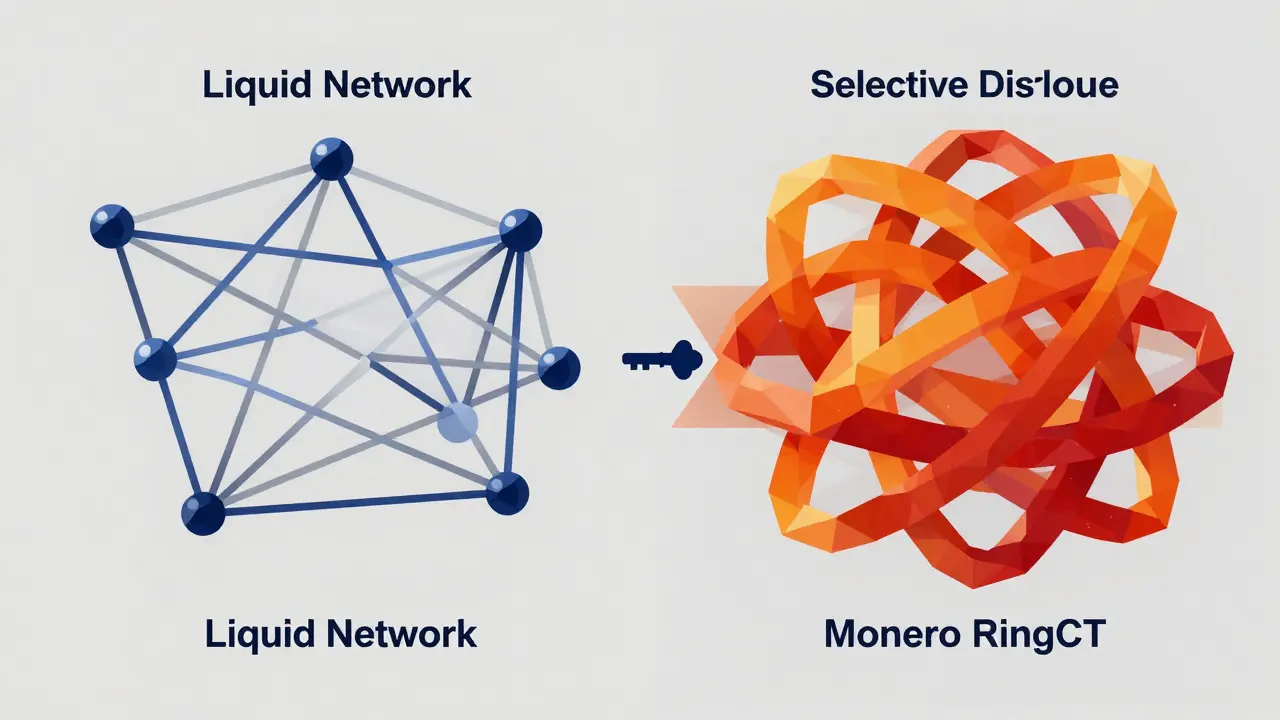
Liquid is a federated sidechain that supports confidential assets. It allows institutional members like Bitfinex and OKCoin to settle trades privately. As of Q3 2023, Liquid handled over $4.2 billion in daily settlement volume across 78 institutional members. Unlike Monero, which is permissionless, Liquid relies on a federation of trusted nodes. This trade-off offers higher throughput and lower fees than Monero, while still keeping transaction amounts hidden from the public eye.
Performance metrics show that Liquid maintains identical validation times of approximately 0.8 seconds per transaction, despite a 15-20% increase in data size compared to transparent transactions. For banks and exchanges, this speed is crucial. They get the privacy they need for competitive advantage without sacrificing the efficiency required for high-frequency trading.
Comparing Privacy Solutions: CT vs. zk-SNARKs
Confidential Transactions are not the only way to achieve privacy on the blockchain. Zcash, for example, uses zk-SNARKs (Zero-Knowledge Succinct Non-Interactive Arguments of Knowledge). While both technologies hide transaction details, they differ significantly in performance and architecture.
| Feature | Confidential Transactions (CT) | Zcash (zk-SNARKs) | Transparent (Bitcoin) |
|---|---|---|---|
| Verification Time | ~0.8 seconds | ~3.2 seconds | <0.1 seconds |
| Transaction Size | ~290 bytes (Liquid) | Variable (larger proofs) | ~250 bytes |
| Anonymity Set | Depends on implementation (e.g., 16 for RingCT) | Global pool (shielded) | None |
| Regulatory Friendliness | Moderate (selective disclosure possible) | Low (harder to audit) | High (fully transparent) |
| Primary Use Case | Institutional settlement, private transfers | Individual privacy, censorship resistance | Public accounting, store of value |
As shown above, CT generally offers superior scalability. Verification is faster because the math involved in Pedersen Commitments is lighter than the complex elliptic curve pairings used in zk-SNARKs. However, zk-SNARKs provide a more robust model for complete sender/receiver anonymity by default, whereas CT often requires additional layers like ring signatures to achieve the same level of obscurity.
The Trade-offs: Bloat and Complexity
Nothing comes for free. Adding privacy to a blockchain introduces computational overhead and storage bloat. A study by the MIT Digital Currency Initiative in 2022 noted that full CT implementation could increase node storage requirements by 25%. This is a significant burden for lightweight clients running on devices like Raspberry Pis.
User feedback reflects this friction. On Reddit’s r/Bitcoin, users reported synchronization issues with CT-enabled wallets taking three times longer than standard wallets. Furthermore, the complexity of implementing range proofs correctly is high. In September 2017, a vulnerability in Monero’s initial CT implementation allowed for potential inflation attacks, resulting in an $8.4 million exposure that was patched within 48 hours. This highlights the steep learning curve for developers, who typically need 6-8 weeks of dedicated study to master the necessary cryptography.
Despite these challenges, the demand for privacy is growing. The privacy-enhancing technology market reached $4.7 billion in 2023, growing at a 22.3% compound annual growth rate. With 97% of privacy-focused cryptocurrency transactions now utilizing some form of confidential transaction technology, the industry is clearly betting on CT as a foundational layer for future financial systems.
Future Outlook: Selective Disclosure and Regulation
The future of Confidential Transactions likely lies in finding a middle ground between total anonymity and regulatory compliance. Governments are wary of untraceable money flows, leading to actions like Binance delisting Monero in the U.S. market in 2022. However, institutions still crave privacy.
New developments aim to bridge this gap. The Monetary Authority of Singapore collaborated with the Liquid Network team in 2023 to develop 'selective disclosure CT' protocols. This technology would allow users to reveal transaction details to authorized auditors or regulators while keeping them hidden from the general public. Pilot testing for these protocols is scheduled for early 2024.
Additionally, Bitcoin’s proposed 'Taproot Assets' implementation aims to integrate CT with Taproot signatures, potentially reducing transaction sizes by 30%. As quantum computing threats loom, the Elements Project is also working on quantum-resistant CT variants. The trajectory is clear: CT will evolve from a niche privacy tool into a standard feature for institutional blockchain deployments, balancing the need for secrecy with the demands of a regulated financial world.
What are Confidential Transactions in simple terms?
Confidential Transactions are a method used in blockchain networks to hide the amount of cryptocurrency being sent in a transaction. While the fact that a transaction occurred is visible, the specific value is encrypted using cryptography. The network can still verify that the sender had enough funds and that no new money was created, ensuring the ledger remains accurate without revealing financial details.
How do Pedersen Commitments ensure validity?
Pedersen Commitments act like locked boxes containing the transaction amounts. Because of their mathematical properties, you can add these locked boxes together. If the sum of the output boxes minus the input boxes equals zero, the transaction is valid. This proves that inputs equal outputs without ever opening the boxes to see the numbers inside.
Is Monero fully anonymous?
Monero is considered highly private rather than perfectly anonymous. It uses RingCT to hide amounts and mix sender signatures with decoys. With an anonymity set of 16 inputs, tracing a transaction is extremely difficult. However, metadata analysis, such as timing patterns, can sometimes leak information, so it offers strong privacy protection but not absolute invisibility.
Why do institutions prefer Liquid Network over Monero?
Institutions prefer Liquid Network because it offers a balance of privacy and compliance. It is a permissioned network with known participants, allowing for faster settlement times (0.8 seconds) and selective disclosure capabilities. Monero is permissionless and slower, which can be less ideal for high-frequency institutional trading that may also need to demonstrate compliance to regulators.
What is the main disadvantage of Confidential Transactions?
The main disadvantages are increased transaction size and computational complexity. CT transactions are larger than transparent ones, leading to 'blockchain bloat' and higher storage requirements for nodes. Additionally, verifying the cryptographic proofs takes more processing power, which can slow down lightweight wallets and increase hardware costs for network validators.