

DEX Security: Risks and Protections for Safe DeFi Trading
 Jul, 4 2026
Imagine handing your house keys to a stranger because it’s faster than using your own lock. That is essentially what happens when you use a centralized exchange (CEX). Now imagine keeping the keys in your pocket, but having to navigate a maze of laser beams every time you want to enter or leave your home. That is the reality of trading on a Decentralized Exchange (DEX), which is a blockchain-based platform enabling peer-to-peer cryptocurrency transactions without central intermediaries. In 2025, DEXs processed $1.37 trillion in Q1 volume alone, capturing nearly 29% of all crypto trading. But with great autonomy comes great responsibility-and significant risk.
The allure of DEXs like Uniswap, PancakeSwap, and Curve Finance is clear: you keep control of your funds, there is no company to freeze your account, and you can trade anything listed on-chain. However, this freedom exposes users to a unique set of dangers that traditional banking simply does not have. From smart contract bugs to user error, the threat landscape is complex. Understanding these risks is not just about protecting your money; it is about understanding how decentralized finance actually works under the hood.
The Core Vulnerability: Smart Contract Risks
At the heart of every DEX lies code. Unlike a bank where human employees process transfers, DEXs rely on smart contracts-self-executing programs stored on the blockchain that automatically execute trades when predefined conditions are met. If the code has a flaw, the money is gone. There is no customer support line to call.
In 2024, DeFi protocols lost $1.48 billion to exploits, according to TRM Labs. The majority of these losses stemmed from smart contract vulnerabilities. While audits have become standard practice, they are not foolproof. Dr. Ari Juels from Cornell Tech warned at Consensus 2025 that 43.7% of audited DeFi protocols still contained critical vulnerabilities due to "audit shopping"-where developers choose auditors who might give them a pass rather than rigorous scrutiny.
Consider the mechanics of an Automated Market Maker (AMM), the engine behind most DEXs. Liquidity providers deposit pairs of tokens into a pool, and traders swap against this pool. If the pricing oracle-the system feeding price data to the contract-is manipulated, attackers can drain the pool. This happened during the Velocore exploit in June 2024, resulting in a $6.8 million loss. To combat this, 76.4% of major DEXs now implement circuit breakers that halt trading if prices move abnormally fast. Yet, new architectures like Uniswap v4's "Hooks" (launching Q3 2025) introduce new complexity, potentially creating fresh attack vectors as customization increases.
User Error: The Silent Killer
If smart contract hacks make the headlines, user error drains wallets quietly. A study by Georgia Tech in May 2025 found that 78.4% of new users required three or more failed attempts before completing their first successful trade. The learning curve is steep, averaging 8.7 hours of median study time before a user feels confident.
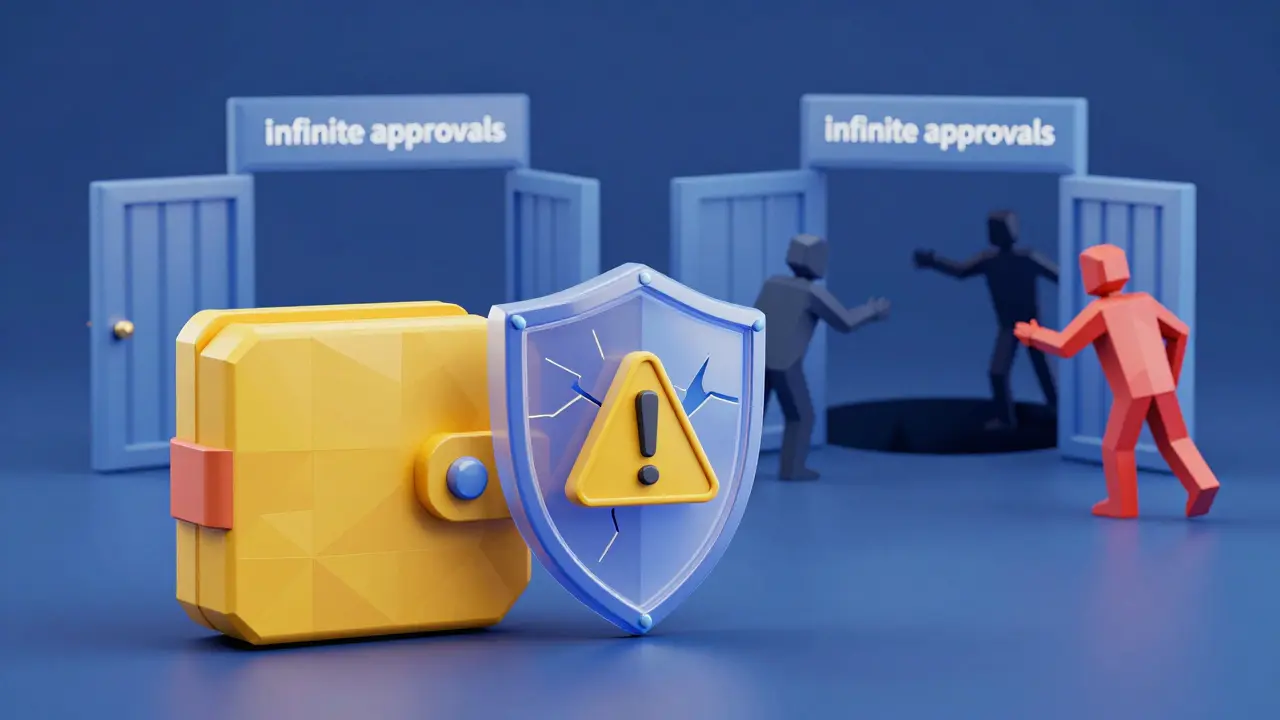
The most common mistake? Infinite token approvals. When you connect your wallet to a DEX to swap Token A for Token B, you must approve the DEX to spend Token A. Many interfaces default to allowing the DEX to spend an "infinite" amount of that token forever. If that DEX interface is later compromised-or if you accidentally interact with a phishing site mimicking the DEX-attackers can drain your entire balance of that specific token. A Trustpilot review from May 2025 documented a user losing $8,450 this way. Cyvers’ 2025 security survey confirmed that 19.3% of users have accidentally granted excessive permissions.
Other frequent pitfalls include:
- Misconfigured Slippage: Setting slippage too high allows malicious bots to front-run your transaction, buying the asset right before you and selling it to you at an inflated price.
- Fake Tokens: Scammers create tokens with the same name and symbol as popular coins (e.g., USDC vs. USC$). If you buy the fake one, it is worthless.
- Gas Fee Miscalculations: On Ethereum mainnet, gas fees averaged $1.85 per transaction in mid-2025, down from previous highs, but insufficient gas estimation still causes 32.7% of new users' transactions to fail, wasting money on rejected blocks.
Phishing and Interface Attacks
Since DEXs are non-custodial, the entry point is often a website or app interface. Attackers know this. They clone legitimate DEX sites, changing only a few letters in the URL (e.g., uniswap.io vs. uniswap.co). When you connect your wallet to these fake interfaces, you are signing malicious transactions that authorize the attacker to move your funds.
TRM Labs reported that phishing through fake DEX interfaces accounted for 18.3% of all security incidents in recent years. The danger is subtle. The interface looks identical. The logo is correct. But the underlying smart contract address connected to the button you click is different. Always verify the contract address of the token you are interacting with on a block explorer like Etherscan or Solscan before confirming any transaction.
Oracle Manipulation and Price Feeds
Determining the price of an asset on a blockchain is harder than it sounds. Blockchains are isolated networks; they do not naturally know the real-world price of Bitcoin or Ethereum. They rely on oracles-services that feed external data onto the blockchain.
CoinDesk’s January 2025 investigation revealed a troubling dependency: 68% of DEXs claiming "full decentralization" rely on centralized oracle providers like Chainlink or Pyth, which control over 73% of price feeds. This creates a single point of failure. If an oracle is hacked or provides stale data, the DEX will execute trades at incorrect prices. For example, if an oracle reports ETH is worth $1,000 instead of $3,000, an attacker could buy massive amounts of ETH cheaply from the liquidity pool, draining it instantly.
To mitigate this, top-tier DEXs use decentralized oracle networks that aggregate data from multiple sources and require a timelock for updates. However, smaller or newer DEXs may cut corners here, making them significantly riskier for large trades.
| Feature | Top Tier (e.g., Uniswap, Curve) | Emerging/Niche DEXs |
|---|---|---|
| Audit Frequency | Multiple independent firms, continuous monitoring | Single audit, often outdated |
| Timelock Duration | 48-72 hours for parameter changes | None or less than 24 hours |
| Oracle Source | Decentralized aggregators (Chainlink, TWAP) | Centralized or single-source feeds |
| Bug Bounty Program | $50k-$2M+ rewards | Rare or non-existent |
| Insurance Coverage | Available via third-party protocols | Uninsured |
Practical Protections: How to Stay Safe
You cannot eliminate risk entirely in DeFi, but you can drastically reduce your exposure. Here is a checklist of protections that experienced users employ daily.
- Use Hardware Wallets: Keep your private keys offline. Devices like Ledger or Trezor ensure that even if your computer is infected with malware, your keys never leave the device. Signatures are verified on the hardware screen.
- Revoke Permissions Regularly: Use tools like Revoke.cash or DeBank to check which contracts have access to your tokens. If you stop using a DEX, revoke its allowance immediately. This prevents future exploitation if that DEX is compromised.
- Verify URLs and Contracts: Bookmark official DEX websites. Never click links from social media or emails. Before swapping, copy the token contract address from a reliable source (like CoinGecko) and paste it into the DEX interface to ensure you are interacting with the real token.
- Start Small: Treat your first few trades as tuition. Send small amounts to test the waters. Once you understand the flow of approval, swap, and settlement, scale up gradually.
- Enable Multi-Sig for Large Holdings: For significant assets, consider using a multi-signature wallet (like Gnosis Safe) that requires two or more keys to authorize a transaction. This adds a layer of consensus that prevents single-point failures.

Regulatory Shifts and Future Outlook
The regulatory landscape for DEXs is evolving rapidly. In the EU, the MiCA framework, effective June 30, 2025, requires DEXs serving EU users to implement optional KYC (Know Your Customer) layers. Meanwhile, the SEC’s April 2025 guidance suggests that DEXs with centralized governance teams may need to register as exchanges. These moves aim to protect investors but also challenge the core ethos of decentralization.
Despite these pressures, the ecosystem is maturing. Exploit frequency decreased by 37.2% year-over-year in 2024, and cybersecurity insurance adoption among major DEXs jumped from 12.3% to 48.7%. Technologies like Ethereum’s Pectra upgrade (May 2025) introduced account abstraction (EIP-3074), allowing for safer recovery mechanisms and social login integrations without sacrificing self-custody.
The future likely holds hybrid models. We are seeing a rise in "intent-centric" architectures where users express what they want (e.g., "swap ETH for USDC") and solvers compete to fulfill it optimally and securely. This abstracts away much of the technical complexity for the end-user while maintaining backend security standards.
Conclusion: Responsibility is Key
Trading on a DEX is not like buying stocks on Robinhood. It is closer to operating heavy machinery. The power is immense, but so is the potential for harm. By understanding smart contract risks, avoiding user errors, verifying oracles, and employing robust wallet hygiene, you can participate in the DeFi revolution safely. Remember: in decentralized finance, you are your own bank. Act like one.
What is the biggest security risk on a DEX?
The biggest risk varies by user experience. For beginners, it is usually user error, such as approving infinite token allowances or falling for phishing sites. For advanced users, smart contract vulnerabilities and oracle manipulation pose the highest financial threats.
Are DEXs safer than centralized exchanges?
In terms of custody, yes. You hold your own keys, so you are immune to exchange hacks like Mt. Gox or FTX. However, DEXs carry higher operational risks due to smart contract bugs and lack of recourse if you make a mistake. CEXs offer better UX and support but introduce counterparty risk.
How do I know if a DEX is legitimate?
Check for public audits from reputable firms, active bug bounty programs, transparent governance, and established track records. Look for listings on trusted aggregators like CoinGecko or DefiLlama. Avoid platforms with anonymous teams and no audit history.
What should I do if I lose funds on a DEX?
Unfortunately, blockchain transactions are irreversible. If you sent funds to a wrong address or approved a malicious contract, recovery is rarely possible. Report the incident to the DEX team and relevant authorities, but focus on securing remaining assets and revoking permissions immediately.
Do I need KYC to use a DEX?
Most DEXs do not require KYC, which is part of their appeal. However, some jurisdictions like the EU are introducing regulations that may require optional identity verification for certain services. Always check local laws and platform-specific policies.