

Layer 2 Security Explained: Risks, Hacks, and How to Stay Safe in 2026
 Aug, 1 2026
Imagine sending money instantly for pennies instead of waiting hours and paying $50. That’s the promise of Layer 2 solutions, which are secondary protocols built on top of main blockchains like Ethereum to handle more transactions faster. But here is the catch: speed and cheap fees often come with new security risks. You might think your funds are as safe as they are on the main network, but the reality is more complex. In 2024 alone, L2 networks saw significant exploits, with average losses hitting nearly $39 million per incident. Understanding how these systems work-and where they can fail-is no longer just for developers; it is essential for anyone holding crypto assets.
The Core Trade-Off: Speed vs. Security
To understand L2 security, you first need to grasp what Layer 2 actually does. It processes transactions off the main chain (Layer 1) and then batches them together to record on the main chain. This reduces congestion. The goal is to inherit the rock-solid security of Ethereum while achieving higher throughput. As of late 2024, Ethereum’s L2 ecosystem was processing over 5 million transactions daily, compared to Ethereum’s base layer capacity of about 1.1 million.
However, this architecture introduces unique vulnerabilities. When you move off the main chain, you introduce new intermediaries and trust assumptions. A study by SDLCCorp in March 2024 highlighted that L2 security challenges differ significantly from traditional L1 implementations. The primary value proposition is cost reduction-enabling microtransactions ranging from $0.0001 to $0.01 versus Ethereum’s $1.50 to $50 average-but this comes with specific failure modes. For example, if the system handling the batch fails, your funds can get stuck or stolen.
Types of Layer 2 Solutions and Their Security Profiles
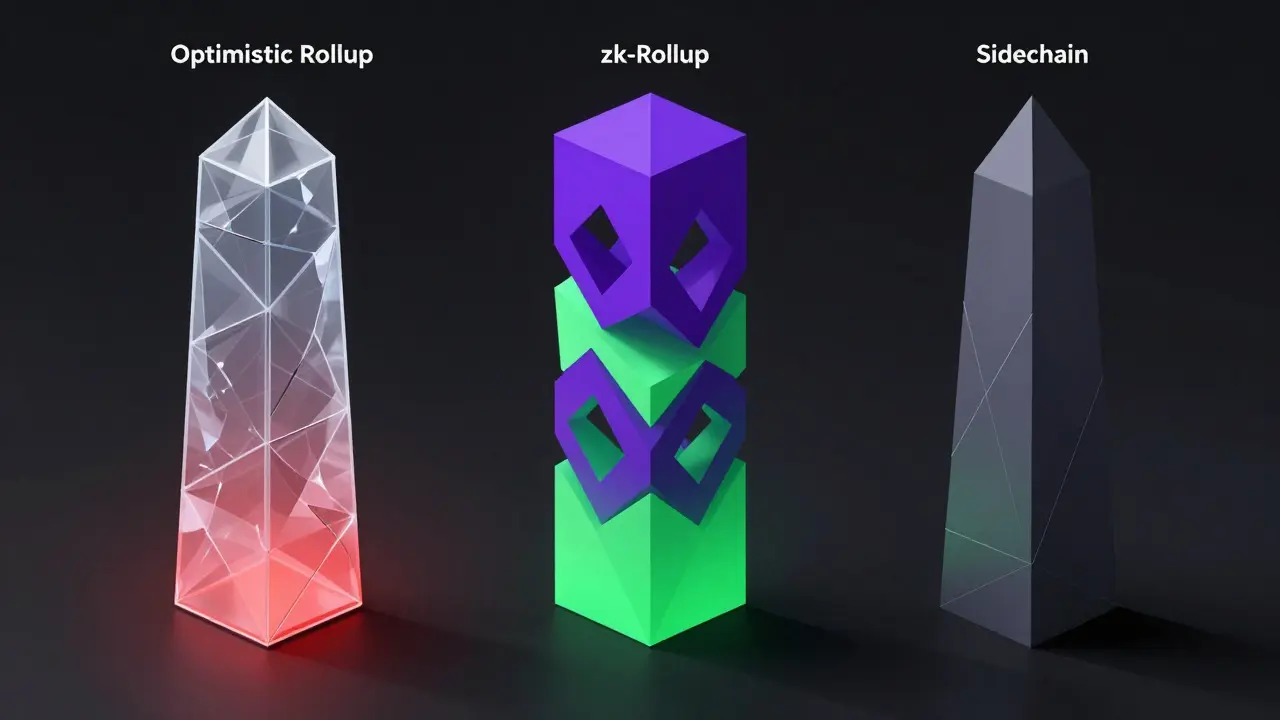
Not all Layer 2s are created equal. There are three main types, each with distinct security mechanisms and risks:
| Feature | Optimistic Rollups | zk-Rollups | Sidechains |
|---|---|---|---|
| Examples | Arbitrum, Optimism | StarkNet, zkSync | Polygon PoS |
| Security Mechanism | Fraud Proofs (assume valid until challenged) | Validity Proofs (cryptographically verified immediately) | Independent Consensus (Proof-of-Stake) |
| Finality Time | 7 days (challenge period) | Near-instant | Seconds to minutes |
| Main Risk | Data availability issues, sequencer centralization | Complex proof generation, trusted setups | Validator collusion, isolated security |
| Decentralization Score | 8.2/10 | 7.3/10 | 5.8/10 |
Optimistic Rollups: The "Trust First" Approach
Optimistic Rollups assume transactions are valid unless someone proves otherwise. This means there is a challenge period-typically 7 days, though Arbitrum reduced this to 4.6 days in its Nitro upgrade-during which validators can dispute invalid state transitions. If no one challenges the batch, it becomes final. The risk? If the data isn’t available on-chain, no one can verify the fraud. In June 2023, Arbitrum suffered a $2.3 million exploit when a malicious sequencer withheld data, preventing users from challenging bad transactions. Additionally, Optimism experienced an 8-hour outage in February 2023 that froze $1.2 billion in user assets due to sequencer downtime.
zk-Rollups: The "Verify First" Approach
zk-Rollups use zero-knowledge proofs to cryptographically verify transaction correctness immediately. This provides instant finality without a long challenge window. However, the technology is complex. Some zk-Rollups require a "trusted setup" ceremony, like StarkWare’s Cairo implementation, which involved 34 participants to establish initial parameters. If those keys were compromised, the entire system could be vulnerable. While they offer immediate cryptographic finality, current throughput limits (around 2,000 TPS) and high implementation complexity remain hurdles. A bug in zkSync’s proof verification in November 2023 temporarily halted $450 million in transactions.
Sidechains: Independent Networks
Sidechains operate independently with their own consensus mechanisms. They do not inherit Ethereum’s security directly. Polygon PoS, for instance, relies on 100 validators compared to Ethereum’s 835,000+. This creates a smaller attack surface for attackers to bribe or collude. The May 2021 Polygon bridge hack, where $23.8 million was stolen after attackers compromised two-thirds of signing keys, highlights this vulnerability. Sidechains score lower on security inheritance because their safety depends entirely on their own validator set, not the main chain.
Common Attack Vectors and Real-World Hacks
Knowing the theory is one thing; seeing how things break is another. Between January 2021 and June 2024, Trezor documented 17 significant L2 security incidents. Here are the most common ways L2s fail:
- Bridge Exploits: Bridges connect L1 to L2 and are responsible for 78% of L2 losses in 2023. They are complex smart contracts that hold massive amounts of value, making them prime targets.
- Sequencer Centralization: Sequencers order transactions. In 87% of Optimistic Rollups, a single entity controls this process. If the sequencer goes offline or acts maliciously, users lose access to funds.
- Proof System Vulnerabilities: Affecting 63% of zk-Rollups, bugs in the mathematical proofs can allow invalid states to be accepted.
- Liveness Attacks: Attackers target data availability, preventing the network from progressing. A Reddit user reported losing $8,500 in July 2024 when an Arbitrum data availability failure prevented confirmation for 14 hours.
Dr. Georgios Konstantopoulos, Chief Scientist at Paradigm, testified before the U.S. House Financial Services Committee in March 2024, noting that Optimistic Rollups introduce new trust assumptions around data availability committees, creating centralization risks that require careful monitoring.

How to Protect Your Assets on Layer 2
You don’t need to be a cryptographer to stay safe, but you do need to change how you interact with these networks. Here are practical steps based on expert recommendations:
- Understand Finality Times: If you use an Optimistic Rollup, remember that withdrawals aren’t truly final for up to 7 days. Don’t treat bridged funds as liquid cash during this window. Trezor found that 43% of L2 wallet integrations fail to warn users about this delay.
- Diversify Bridges: Don’t keep all your eggs in one basket. Use reputable, audited bridges. The Blockchain Security Alliance identified bridge exploits as the leading cause of losses. Stanford researchers published a paper in June 2024 on "Zero-Knowledge Bridge Proofs" that could eventually eliminate 95% of these vulnerabilities, but we aren’t there yet.
- Monitor Network Status: Before moving large sums, check if the sequencer is online. Tools like L2Beat provide real-time health metrics. If a network is down, wait it out rather than forcing transactions through unofficial channels.
- Use Hardware Wallets: Always sign transactions on a hardware device. Private keys controlled by L2 operators during challenge periods create single points of failure, according to Coinbase Institute’s 2024 whitepaper.
- Start Small: Test with small amounts first. A CoinGecko survey in Q2 2024 showed that 31.4% of users had experienced failed transactions due to L2-specific issues. Learning the quirks of a new network costs less when you’re risking $10 instead of $10,000.
The Future of L2 Security in 2026 and Beyond
The landscape is evolving rapidly. Ethereum’s Dencun upgrade in March 2024 introduced proto-danksharding (EIP-4844), reducing L2 data costs by 90% and improving data availability guarantees. By 2026, full danksharding aims to implement decentralized data availability sampling, eliminating reliance on centralized committees. Optimism’s "Bedrock" upgrade launched decentralized sequencers, and zkSync’s "Era 2.0" release in September 2024 implemented recursive proofs enabling 100,000 TPS capacity.
Despite these advances, the World Economic Forum’s September 2024 report notes that L2s will never achieve identical security properties to L1. Users must accept specific trust assumptions. Regulatory scrutiny is also intensifying, with the EU’s MiCA regulations requiring enhanced security measures by January 2025. As adoption grows-with 78 Fortune 500 companies now using L2 solutions-the pressure to secure these networks will only increase. Security investment in the sector jumped 214% in Q2 2024, signaling a maturing industry focused on fixing past mistakes.
Are Layer 2 solutions safer than Layer 1?
No, not inherently. Layer 2s aim to inherit L1 security but introduce new components like sequencers and bridges that can fail. While they reduce costs significantly, they often rely on fewer validators or centralized operators, creating different risk profiles. Always treat L2 interactions as having slightly higher technical risk than direct L1 transactions.
What is the biggest risk with Optimistic Rollups?
The biggest risk is data availability. If the sequencer doesn’t post transaction data to Ethereum, users cannot prove fraud during the 7-day challenge window. This can lead to frozen funds or stolen assets, as seen in the 2023 Arbitrum exploit.
Why are zk-Rollups considered more secure?
zk-Rollups use cryptographic validity proofs that verify transactions immediately. This eliminates the need for a multi-day challenge period and reduces reliance on honest actors to monitor the network. However, they depend on complex math and sometimes trusted setups, which carry their own risks.
How long should I wait before withdrawing from an Optimistic Rollup?
You should wait for the full challenge period, typically 7 days, though some networks like Arbitrum have reduced this to 4.6 days. Withdrawing earlier means your funds are still technically reversible if a fraud proof is submitted.
What happened in the Polygon bridge hack?
In May 2021, attackers compromised two-thirds of the signing keys for Polygon’s sidechain validators. This allowed them to approve fraudulent transactions, stealing $23.8 million. It highlighted the danger of small validator sets in sidechains.