

Liquidation Risk in Crypto Lending: How to Protect Your Collateral
 Jul, 10 2026
You borrow Bitcoin against your stablecoins, thinking you are safe because the market is calm. Then, a sudden flash crash hits. Within minutes, your position is wiped out. You didn't just lose interest; you lost your entire collateral stack. This isn't a hypothetical nightmare scenario-it happens every day in crypto lending. Understanding liquidation risk is not optional if you want to survive in decentralized finance (DeFi) or centralized crypto lending platforms.
What Is Liquidation Risk and Why Does It Exist?
Liquidation risk is the danger that your borrowed assets will be forcibly sold by the protocol before you can repay them. In traditional banking, if you miss a mortgage payment, the bank sends letters, then calls, then eventually forecloses over months or years. In crypto, there is no patience. There is no human manager to call for an extension. The code executes instantly.
This mechanism exists to protect the lenders. When you take a loan on a platform like Aave or Compound, you are borrowing money from other users' pools. If your collateral value drops too low, the protocol must sell it immediately to ensure those lenders get their principal back. Without this automatic safety valve, the entire lending ecosystem would collapse into insolvency during market downturns.
The core issue is volatility. Cryptocurrencies can swing 10-20% in a single hour. Traditional assets rarely move that fast. Because of this speed, the margin for error in crypto lending is razor-thin. One bad news headline, one large whale selling, or a technical glitch with a price oracle can trigger a cascade of liquidations across the network.
How the Math Works: LTV and Health Factors
To understand your risk, you need to speak the language of the protocols. Two key metrics determine when you are in danger:
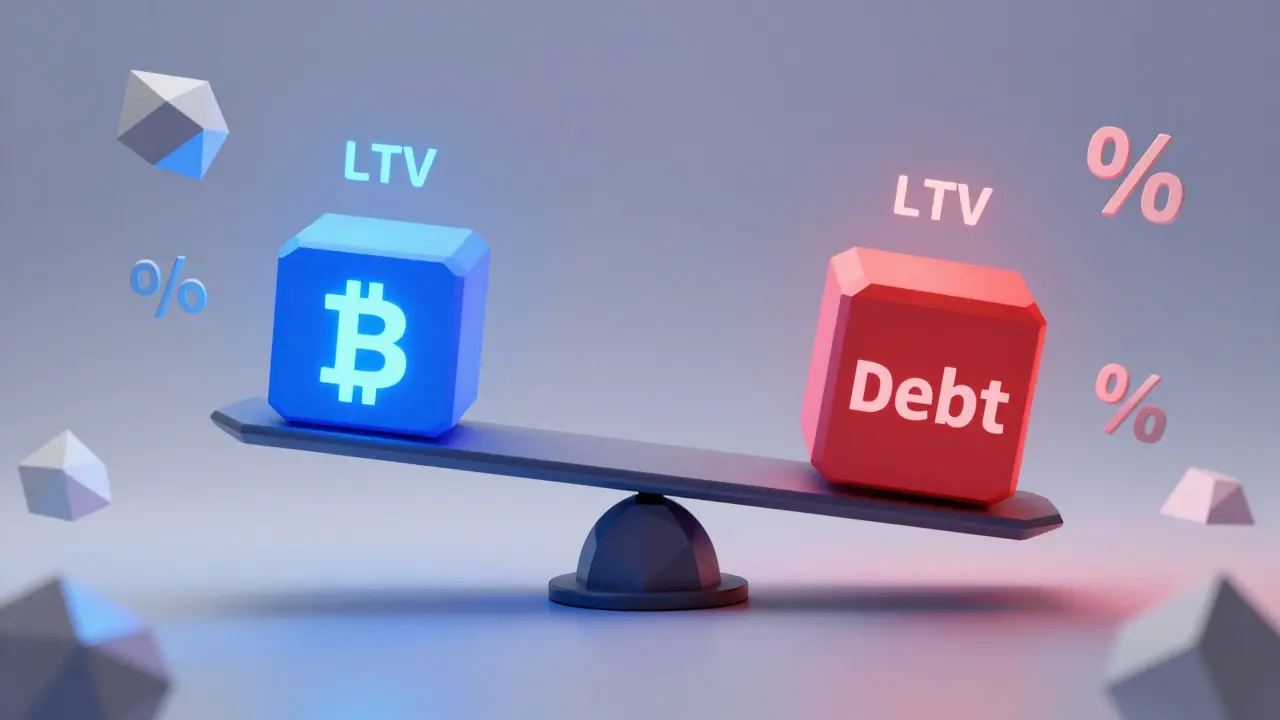
- Loan-to-Value (LTV) Ratio: This is the percentage of your collateral value that you have borrowed. If you deposit $10,000 worth of Ethereum and borrow $5,000 in USDC, your LTV is 50%. Most protocols set a maximum LTV (e.g., 75%) and a lower liquidation threshold (e.g., 80%).
- Health Factor: Used by platforms like Aave, this is a single number that summarizes your position's safety. A health factor above 1 means you are safe. As your collateral value drops or your debt increases (due to interest), this number falls. Once it hits 1.0, you are liquidated.
Let's look at a concrete example. Imagine you deposit $20,000 in Bitcoin as collateral to borrow $10,000 in USDT. Your initial LTV is 50%. The protocol sets a liquidation threshold at 80% LTV. This means if the value of your Bitcoin drops such that your $10,000 debt represents 80% of your remaining collateral, the system acts. Mathematically, your collateral must drop below $12,500 ($10,000 / 0.8) for liquidation to trigger. That is a 37.5% drop in Bitcoin's price. Sounds safe? Maybe. But add daily interest accrual on the debt, and that buffer shrinks every second.
| Protocol | Type | Risk Metric | Liquidation Trigger | Typical Bonus |
|---|---|---|---|---|
| Aave | DeFi | Health Factor | < 1.0 | 5-10% |
| Compound | DeFi | Collateral Factor | Ratio exceeds limit | Variable |
| Nexo | Centralized | LTV Ratio | Platform specific | N/A |
The Hidden Danger: Oracle Manipulation and Flash Crashes
Your biggest enemy might not be the market direction, but the data feed itself. DeFi protocols rely on price oracles like Chainlink to tell them what an asset is worth. These oracles pull data from multiple exchanges to calculate a fair price.
However, during extreme volatility, these feeds can lag or become inaccurate. If a small exchange experiences a "flash crash" where prices drop 90% for a few seconds due to low liquidity, an oracle might pick up that erroneous low price. Even if the real market price hasn't changed, the smart contract sees a crash and liquidates your position. This happened repeatedly during the Terra/Luna collapse in May 2022, where thousands of users were liquidated based on skewed data.
Furthermore, sophisticated attackers sometimes exploit these weaknesses. They might manipulate the price on a less liquid exchange to trigger mass liquidations on a lending protocol, allowing them to buy up the collateral cheaply. This is why relying solely on the protocol's default settings is dangerous. You must assume the worst-case scenario regarding price accuracy.
Why Crypto Liquidations Are Harsher Than TradFi
If you have traded stocks on margin, you know about margin calls. In traditional finance, your broker calls you. You have hours or days to deposit more cash or sell assets manually. In crypto, the process is automated and ruthless.
- No Human Intervention: Smart contracts do not care about your life circumstances. If the math says you are undercollateralized, the transaction executes.
- Speed: Liquidations can happen in seconds. By the time you see a notification on your phone, your funds may already be gone.
- Liquidation Penalties: To encourage others to clean up bad debts, protocols offer a "liquidation bonus" to the liquidator. This means your collateral is sold at a discount. If you had $10,000 in collateral and owed $9,000, you might only get back $8,500 after fees and penalties, losing $500 purely to the cost of the liquidation event.
This lack of flexibility is a major barrier to mainstream adoption. Institutional investors often hesitate to enter DeFi lending because they cannot negotiate terms or request grace periods during temporary liquidity crunches.

Strategies to Mitigate Liquidation Risk
You cannot stop the market from moving, but you can control how much leverage you use. Here are practical steps to protect your capital:
1. Keep Your LTV Low
Experienced DeFi users rarely borrow near the maximum limit. If the protocol allows 75% LTV, aim for 30-40%. This gives you a massive buffer against volatility. If Bitcoin drops 20%, a user at 70% LTV is liquidated. A user at 40% LTV is still safely underwater but far from the edge.
2. Use Stablecoin Collateral
Borrowing against volatile assets like ETH or BTC is risky. Borrowing against stablecoins like USDC or DAI is safer, but remember that stablecoins can depeg. If you borrow USDC using DAI as collateral, and DAI loses its peg to the dollar, you face immediate liquidation risk. Diversify your collateral types if possible.
3. Monitor Health Factors Daily
Don't set it and forget it. Check your positions daily, especially during high-volatility events like Fed announcements or CPI data releases. Set up alerts via tools like Zapper or DeBank to notify you when your health factor drops below 1.5.
4. Understand Partial Liquidations
Newer versions of protocols like Aave v3 introduce partial liquidation. Instead of wiping out your entire position, the protocol sells just enough collateral to bring you back to a safe level. This is a significant improvement, but it still results in losses and fees. Don't rely on it as a safety net; treat it as a last resort.
The Future of Risk Management
The industry is evolving. We are seeing the rise of insurance protocols that cover liquidation risks, though premiums are currently high. Automated position management bots are becoming popular, allowing users to set rules like "if ETH drops 5%, automatically repay $1,000 of debt." These tools reduce the emotional stress and manual effort required to stay safe.
Regulatory clarity is also emerging. Authorities are examining how liquidation mechanisms affect consumer protection. While this may slow down innovation, it could lead to standardized safeguards that make lending safer for everyone. For now, the burden of risk management falls squarely on your shoulders.
What happens to my collateral after I am liquidated?
Your collateral is automatically sold on the open market or transferred to a liquidator. The proceeds are used to pay off your debt plus any accrued interest and liquidation penalties. Any remaining balance is returned to your wallet, but often the penalty eats into this remainder significantly.
Can I avoid liquidation by adding more collateral quickly?
Yes, but you must act before the liquidation threshold is breached. Once the health factor drops below 1, the smart contract may execute the liquidation faster than you can transact. Gas fees during high volatility can also delay your transaction, making it impossible to save the position in time.
Is liquidation risk higher in DeFi or Centralized Finance (CeFi)?
The mechanics differ. CeFi platforms like Nexo may offer more customer support and grace periods, but they carry counterparty risk (the platform could go bankrupt). DeFi is transparent and non-custodial, but the execution is automated and unforgiving. Both carry significant risk, but DeFi requires more active user management.
What is a healthy Loan-to-Value (LTV) ratio?
For most retail users, an LTV below 40-50% is considered safe. This provides a substantial buffer against market swings. Aggressive traders may operate closer to 60-70%, but this exposes them to frequent liquidation events during normal market volatility.
How do price oracles affect liquidation?
Oracles provide the price data that triggers liquidations. If an oracle reports an incorrect low price due to manipulation or latency, your position may be liquidated unfairly. Using protocols with robust, decentralized oracle networks like Chainlink reduces this risk.