

Quantum-Resistant Security Research: Blockchain's Next Frontier
 Aug, 24 2026
Imagine waking up in 2031 to find that every secure transaction you ever made on the blockchain is suddenly readable. That isn't science fiction; it is a realistic scenario predicted by leading quantum experts. Quantum-resistant security is the development of cryptographic algorithms designed to secure digital systems against attacks from both classical and quantum computers. Also known as post-quantum cryptography, this field has moved from theoretical papers to urgent industry action. For blockchain networks, which rely heavily on public-key cryptography for wallet signatures, the shift to quantum-safe methods is not just an upgrade-it is a survival requirement.
Why Quantum Computers Threaten Current Blockchains
To understand the urgency, we have to look at how current encryption works. Most blockchains, including Bitcoin and Ethereum, use Elliptic Curve Cryptography (ECC) or RSA to verify transactions. These systems are safe today because factoring large numbers or solving discrete logarithms takes classical supercomputers billions of years. However, a quantum computer changes the math entirely. Using Shor's algorithm, a sufficiently powerful quantum machine could break these keys in months rather than millennia. This computational advantage comes from qubits, which can exist in multiple states simultaneously, allowing parallel processing that classical bits cannot match.
The threat isn't just about breaking future data. It is about the "harvest now, decrypt later" strategy. Adversaries are already collecting encrypted blockchain data today, storing it, and waiting for quantum hardware to mature. If your private key was exposed even indirectly, or if your transaction data needs long-term confidentiality, the clock is ticking. Dr. Michele Mosca, a prominent researcher at the University of Waterloo, estimates a 50% chance that fundamental public-key tools will be broken by 2031. For a blockchain that aims to be immutable and secure for decades, that timeline is dangerously close.
NIST Standards and the Roadmap to Adoption
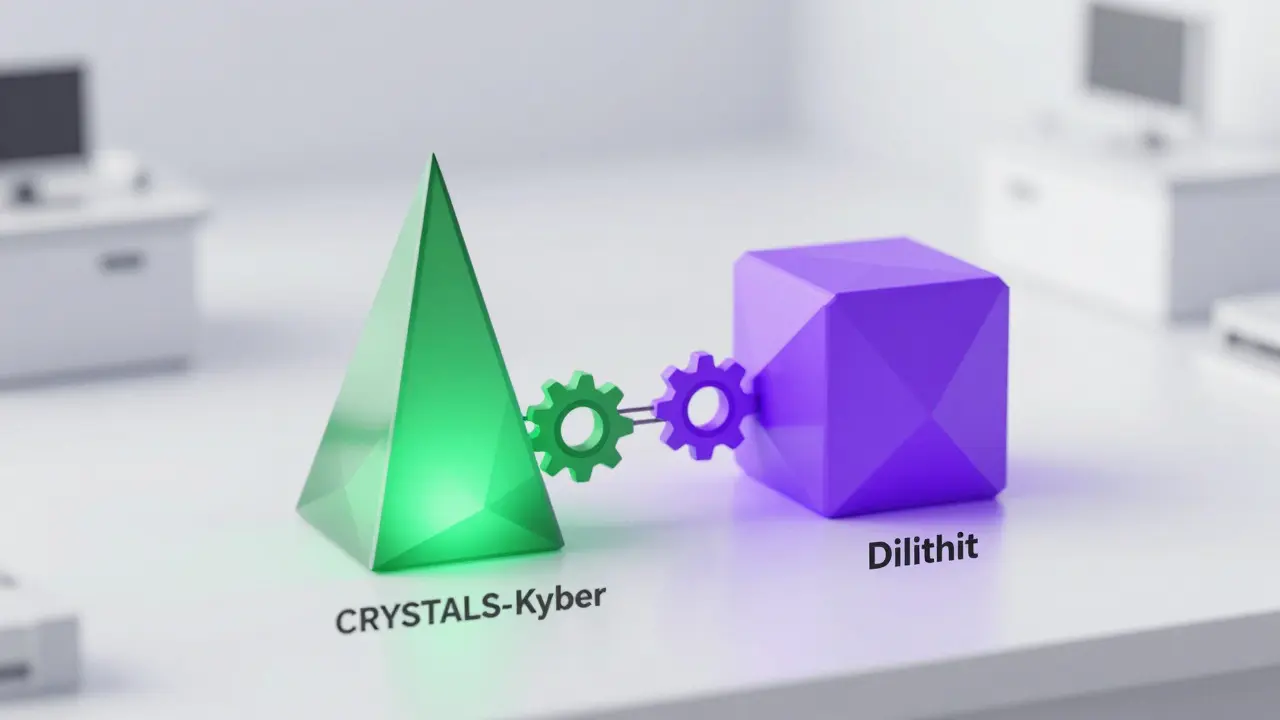
You might wonder if we are just guessing at new algorithms. Not anymore. The National Institute of Standards and Technology (NIST) has completed its rigorous evaluation process, providing clear winners for the transition. NIST selected CRYSTALS-Kyber for key encapsulation and Dilithium for digital signatures. These choices matter because they provide a standardized baseline that developers can trust. Kyber is particularly efficient for establishing secure channels, while Dilithium offers robust signature capabilities suitable for high-throughput blockchain environments.
Adopting these standards means moving away from ad-hoc solutions. Before NIST’s finalization, the market was fragmented with dozens of competing proposals. Now, engineers have a clear path. The standardization ensures interoperability, meaning a wallet built with Kyber in one ecosystem can theoretically interact with a node using Dilithium in another, provided they follow the same protocol specifications. This clarity reduces risk for enterprises looking to integrate quantum-safe features into their existing infrastructure without overhauling everything overnight.
Challenges in Implementing Quantum-Safe Blockchain
Switching to quantum-resistant algorithms is not a simple drop-in replacement. There are significant technical trade-offs. The most immediate issue is size. Lattice-based schemes like Dilithium produce signatures that are much larger than traditional ECDSA signatures. While an ECDSA signature might be around 64 bytes, a Dilithium signature can exceed 2,000 bytes. On a blockchain where block space is precious and fees are tied to data size, this bloat is a major concern. It increases storage requirements for nodes and can impact network bandwidth, especially during periods of high transaction volume.
Performance is another hurdle. Quantum-resistant operations require more computational power than their classical counterparts. For resource-constrained devices like mobile wallets or IoT sensors interacting with blockchains, this added load could lead to slower transaction signing times. Developers must optimize implementations carefully, potentially using hybrid approaches that combine classical and quantum-safe methods during the transition period. This hybrid model allows systems to maintain backward compatibility while gradually shifting to fully quantum-resistant protocols.
| Attribute | Classical (ECDSA/RSA) | Quantum-Resistant (Dilithium/Kyber) |
|---|---|---|
| Signature Size | ~64 bytes | ~2,420 bytes |
| Key Size | ~32-64 bytes | ~1,312 bytes |
| Computational Cost | Low | Moderate to High |
| Quantum Vulnerability | High (Shor's Algorithm) | Low (Lattice Problems) |
| Standardization Status | Legacy (Widely Used) | NIST Finalized (2024-2026) |
Hybrid Approaches and Practical Strategies
Given the size and performance penalties, many experts recommend a hybrid approach. Instead of replacing classical cryptography entirely, systems can use both. For example, a blockchain could require a transaction to be signed by both an ECDSA key and a Dilithium key. This dual-signature method ensures that if one algorithm fails due to a bug or a future breakthrough, the other still holds the line. It also allows for a smoother migration path. Nodes can start verifying hybrid signatures before full quantum-resistant support is mandatory, reducing the risk of network splits or orphaned blocks.
For individual users, the impact is less visible but no less important. Wallet providers are beginning to test quantum-safe seed phrases and address formats. You don’t need to buy new hardware yet, but keeping your software updated is crucial. As protocols evolve, older versions of wallet apps may become incompatible with newer, safer consensus mechanisms. Staying informed about updates from major projects like Ethereum and Bitcoin Cash will help you avoid being locked out of your assets during the transition.

Regulatory Pressures and Industry Momentum
This transition isn't happening in a vacuum. Governments are pushing for change. The U.S. government has issued directives requiring federal agencies to begin transitioning to post-quantum cryptography, setting a precedent for the private sector. In regulated industries like finance and healthcare, compliance officers are already auditing their tech stacks for quantum vulnerabilities. For blockchain companies, this regulatory pressure accelerates R&D budgets. Companies that delay action risk facing higher costs later, as retrofitting legacy systems is far more expensive than designing quantum-safe features from the start.
Major technology players are also investing heavily. IBM, Google, and Microsoft are developing quantum-safe libraries and cloud services that support PQC. This investment signals confidence in the technology’s viability. As these giants build the infrastructure, smaller blockchain projects can leverage existing tools rather than reinventing the wheel. The competitive landscape is shifting from "who has the best classical security" to "who can migrate to quantum safety fastest and most efficiently."
Frequently Asked Questions
Do I need to move my crypto to a new wallet right now?
Not necessarily. Most major blockchains are planning gradual upgrades. However, keeping your wallet software updated is essential. When a specific network announces its quantum-safe upgrade, follow the official migration guides. Moving too early to untested third-party quantum wallets can introduce new risks, so wait for mainnet integration.
Which NIST algorithm is best for blockchain signatures?
Dilithium is currently the primary candidate for digital signatures due to its balance of speed and security. However, its large signature size is a drawback. Some researchers are exploring optimized variants or hybrid schemes to mitigate this. Keep an eye on community discussions regarding specific implementation parameters for your chosen blockchain.
Will quantum computers break Bitcoin immediately when they arrive?
No. Breaking Bitcoin requires a quantum computer with thousands of stable logical qubits, which does not exist yet. Furthermore, Bitcoin developers are likely to implement soft forks to switch to quantum-resistant algorithms before the threat becomes critical. The "harvest now, decrypt later" threat is more immediate for data privacy than for asset theft.
What is the difference between symmetric and asymmetric quantum resistance?
Symmetric encryption (like AES) only needs larger key sizes to resist quantum attacks, making it easier to upgrade. Asymmetric encryption (like RSA/ECC), used for blockchain signatures, requires completely different mathematical foundations, such as lattice problems, because quantum algorithms break them efficiently.
How do hybrid cryptographic systems work?
Hybrid systems combine a classical algorithm with a post-quantum one. A message must be verified by both. This provides redundancy: if the quantum algorithm has an undiscovered flaw, the classical one still protects you, and vice versa. It is the safest bridge during the transition period.