

The Future of Environmentally Friendly Crypto: Green Blockchain Trends for 2026
 Jun, 14 2026
Remember when people said Bitcoin was the future? Well, the future just got a lot quieter. And a lot greener. Back in the day, running a single Bitcoin transaction used enough electricity to power an average Australian home for nearly two weeks. Today, that same amount of energy can process millions of transactions on newer networks. The shift isn't just about saving the planet-though that’s huge-it’s about survival. As governments tighten regulations and investors demand transparency, the old way of mining is dying. The new era belongs to environmentally friendly crypto.
We are now in mid-2026, and the landscape has changed dramatically since Ethereum’s big switch in 2022. It’s no longer a niche interest for eco-warriors; it’s the standard for institutional finance. If you’re looking to invest, build, or simply understand where the money is flowing, you need to know how these green networks work, why they matter, and which ones actually deliver on their promises.
Why Energy Efficiency Matters More Than Ever
Let’s get the elephant out of the room first: traditional Proof-of-Work (PoW) blockchains like Bitcoin are energy hogs. According to the Cambridge Bitcoin Electricity Consumption Index, Bitcoin still burns through roughly 115 TWh annually. That’s more than countries like Belgium or Sweden use in a year. Meanwhile, the global push for ESG (Environmental, Social, and Governance) compliance means big banks and corporations can’t touch PoW assets without facing serious scrutiny.
This isn’t just moral posturing. It’s economics. In early 2025, the U.S. passed the GENIUS Act, creating the first framework for environmentally certified digital assets. Suddenly, having a low carbon footprint became a license to operate. By Q2 2026, 87 S&P 100 companies were actively using green cryptocurrencies for supply chain tracking and payments. They didn’t do it because they loved nature; they did it because it cut their carbon verification costs by up to 37%, as seen with Maersk’s use of Hedera.
The International Energy Agency projects that by late 2026, three-quarters of all blockchain transactions will happen on energy-efficient networks. The train has left the station. If your crypto doesn’t have a green angle, it’s already behind.
How Green Cryptocurrencies Actually Work
You don’t need a physics degree to understand this, but you do need to know that not all "green" cryptos are created equal. The magic happens in the consensus mechanism-the method networks use to agree on who owns what. Here are the main players dominating the space right now:
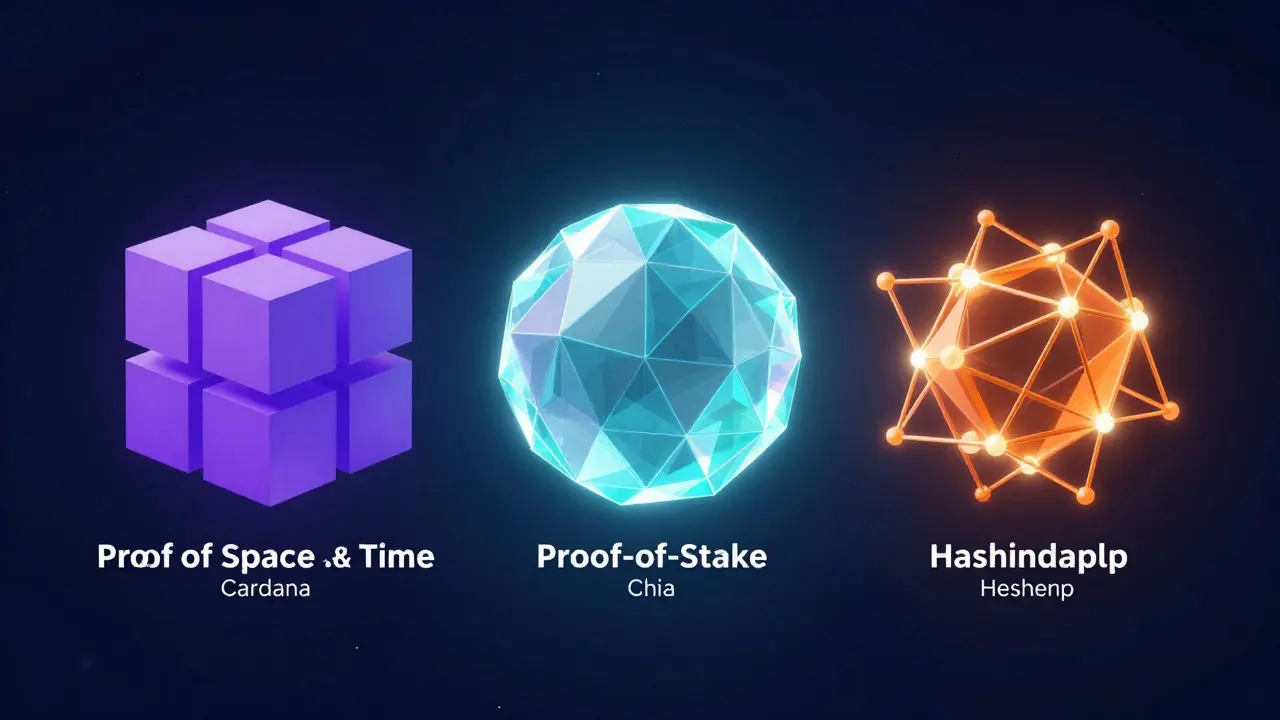
- Pure Proof-of-Stake (PoS): Used by Algorand and Cardano. Instead of miners solving puzzles, validators stake their coins to secure the network. It uses 99.99% less energy than Bitcoin. Algorand, for instance, consumes just 0.000008 kWh per transaction. To put that in perspective, you could power the entire Algorand network for a year with the energy needed to charge your phone twice.
- Proof of Space and Time: This is Chia Network’s approach. Instead of burning electricity, it uses unused hard drive space. You’re essentially renting out empty storage capacity to secure the network. It’s brilliant because it repurposes existing hardware rather than demanding new, specialized ASIC miners.
- Hashgraph Consensus: Hedera Hashgraph doesn’t use a traditional blockchain at all. It uses a directed acyclic graph structure that allows for massive throughput-up to 10,000 transactions per second-with near-zero energy cost per transaction (0.00014 kWh). It’s fast, cheap, and incredibly efficient.
- Renewable Energy Incentives: SolarCoin takes a different route. It doesn’t just try to be efficient; it rewards actual green energy production. For every megawatt-hour of solar energy generated globally, one SolarCoin is minted. It turns renewable energy into a tradable asset.
The key takeaway? Efficiency isn’t a buzzword here. It’s measurable. Algorand even partnered with ClimateTrade to become carbon-negative, meaning it removes more CO2 from the atmosphere than it produces. That’s a claim backed by audits, not marketing fluff.
Top Contenders in the Green Crypto Space
If you’re scanning the market, which names should you keep on your radar? Based on market cap, adoption, and technical performance in 2026, these are the leaders:
| Coin | Consensus Mechanism | Energy Per Transaction | Key Strength | Potential Weakness |
|---|---|---|---|---|
| Algorand (ALGO) | Pure Proof-of-Stake | 0.000008 kWh | Carbon-negative certification; instant finality | Smaller developer community than Ethereum |
| Hedera (HBAR) | Hashgraph | 0.00014 kWh | High speed (10k TPS); enterprise adoption | Governed by a council, less decentralized |
| Chia (XCH) | Proof of Space and Time | 0.023 kWh | Uses existing storage hardware | Slower adoption curve; user interface complexity |
| Nano (XNO) | Block-Lattice | 0.000112 kWh | Zero fees; lightweight architecture | Limited smart contract functionality |
Algorand currently leads the pack in pure efficiency metrics. But Hedera is winning the corporate war, thanks to its governance model which appeals to large organizations like Google and IBM who want stability over total decentralization. Chia is the dark horse-if storage becomes more valuable than compute, XCH could skyrocket. Nano remains the best option for simple, fee-less peer-to-peer payments.
The Reality Check: Trade-offs and Risks
It’s easy to paint a rosy picture, but let’s talk about the cracks in the foundation. The biggest criticism of green cryptos, especially those using Proof-of-Stake, is centralization. In PoW, anyone with a computer can mine. In PoS, you need significant capital to stake enough coins to become a validator. This can lead to a situation where a few wealthy entities control the network.
Then there’s the issue of reliability. While Algorand and Hedera boast high uptime, users have reported transaction failures during peak congestion. A survey in April 2025 showed Hedera had a 12.7% failure rate during heavy traffic, compared to Ethereum’s 2.3%. For everyday users, a failed transaction isn’t just an inconvenience; it’s lost money. Reddit threads are filled with frustrated users complaining about stuck transfers on smaller green chains.
Don’t ignore the "greenwashing" risk either. The Environmental Blockchain Audit Consortium found that 31% of projects claiming to be "eco-friendly" failed to meet minimum energy standards. Just because a coin says it’s green doesn’t mean it is. Always look for third-party audits and transparent energy data before investing.

What This Means for Investors and Users
If you’re an individual investor, the message is clear: diversify beyond Bitcoin. The growth sector is in utility-focused, low-energy tokens. Look for projects with real-world use cases, like supply chain tracking or carbon credit trading, rather than speculative memes.
For developers, the barrier to entry is lower. You don’t need to build complex mining rigs. However, learning curves vary. Kraken’s 2025 data suggests new users take about 8 hours to get comfortable with green wallets due to the extra environmental metrics displayed. But once you’re in, the experience is smoother. Faster confirmations, lower fees, and no guilt.
Institutional adoption is the tailwind here. With 67% of institutional investors now mandating energy efficiency criteria, capital is flowing toward compliant networks. This creates a self-reinforcing cycle: more adoption leads to better infrastructure, which leads to more adoption.
Looking Ahead: The 2027 Horizon
Where do we go from here? The World Economic Forum predicts that blockchain-enabled carbon accounting will save $14.3 billion annually by 2027. We’re moving from a phase of "being less bad" to "actively good." Expect more integrations with renewable energy grids, where crypto transactions directly trigger power generation or storage adjustments.
Regulation will also tighten. The fragmentation of rules across jurisdictions is currently a headache, but unified standards are likely coming. Gartner forecasts that by 2030, energy efficiency will be a mandatory requirement for major exchanges. PoW assets may survive in niche communities, but they’ll be pushed to the fringe of mainstream finance.
The future of crypto isn’t just digital; it’s sustainable. Whether you care about the environment or just the bottom line, going green is the only logical move left.
Is Bitcoin considered environmentally friendly?
No. Bitcoin uses a Proof-of-Work consensus mechanism that requires massive amounts of computational power and electricity. It consumes approximately 115 TWh annually, which is comparable to the energy usage of medium-sized countries. While some miners use renewable energy, the overall footprint remains significantly higher than alternative consensus models.
Which cryptocurrency uses the least energy?
Algorand is currently one of the most energy-efficient cryptocurrencies, consuming just 0.000008 kWh per transaction. Other highly efficient options include Hedera Hashgraph (0.00014 kWh) and Nano (0.000112 kWh). These networks use consensus mechanisms like Proof-of-Stake or Hashgraph that eliminate the need for energy-intensive mining.
Are green cryptocurrencies safe to invest in?
Like any cryptocurrency, they carry market volatility risks. However, from a security standpoint, established networks like Algorand and Hedera are robust. The main risks involve regulatory changes and potential centralization issues in some Proof-of-Stake models. Always conduct your own research and verify third-party energy audits before investing.
What is the difference between Proof-of-Work and Proof-of-Stake?
Proof-of-Work (used by Bitcoin) requires miners to solve complex mathematical puzzles using powerful computers, which consumes vast amounts of electricity. Proof-of-Stake (used by Ethereum, Algorand, etc.) selects validators based on the number of coins they hold and are willing to 'stake' as collateral. This process uses negligible energy while maintaining network security.
Will green crypto replace Bitcoin?
It is unlikely to completely replace Bitcoin, which retains strong brand recognition and store-of-value status. However, for daily transactions, enterprise applications, and institutional finance, green cryptocurrencies are rapidly taking over due to their lower costs, faster speeds, and regulatory compliance. Bitcoin may remain a niche asset for long-term holding.
How can I verify if a crypto project is truly eco-friendly?
Look for transparent, third-party audited energy consumption data. Avoid projects that make vague claims without specific metrics (like kWh per transaction). Check if they use efficient consensus mechanisms like Proof-of-Stake, Hashgraph, or Proof-of-Space. Reputable sources like the Cambridge Bitcoin Electricity Consumption Index or independent audit firms can provide verified data.