

What is BOUNTYKINDS (YU)? A Deep Dive into the Play-to-Earn Token
 Aug, 10 2026
You’ve probably seen a dozen new gaming tokens pop up on your exchange list this year. Most of them vanish just as quickly. But what if one actually changes how you interact with game developers? That’s the promise behind BountyKinds, a blockchain gaming ecosystem built around its native utility token, YU. It’s not just another coin hoping for a pump; it’s designed to be the fuel for a massive, multi-genre gaming universe where players and devs work together.
If you are wondering whether YU is worth your attention or just more noise in the saturated play-to-earn market, you need to look past the price chart. You need to understand the mechanics. How does the token actually function inside the games? What does "co-production" mean for your wallet? And is the current valuation realistic given the project's history?
The Core Concept: Gaming Meets Co-Production
Most crypto games feel like jobs. You grind repetitive tasks for a token that loses value as more people sell. BountyKinds tries to flip this script by introducing a concept called co-production. In simple terms, you aren't just playing the game; you help build it.
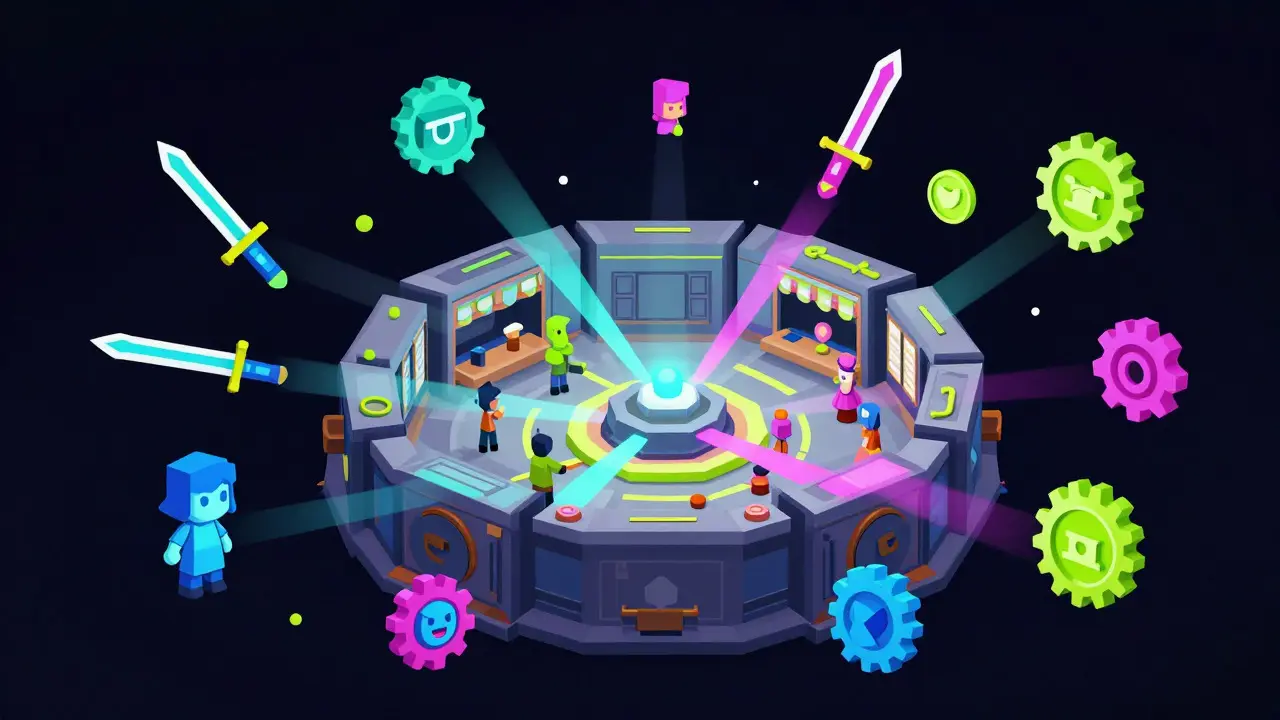
The ecosystem plans to host a wide variety of genres. We’re talking board games, map adventures, role-playing games (RPGs), first-person shooters (FPS), battle royales, and MOBAs. That’s a huge scope. The twist is that players and developers collaborate to decide which specific games get built next. Your gameplay contributions influence the direction of the entire platform.
This creates a unique feedback loop. When you play, you earn points. These points translate to rewards. But more importantly, your engagement helps determine the roadmap. If a community loves a certain RPG mechanic, they can push for its expansion. This aligns the interests of the developers with the player base, theoretically reducing the risk of abandoned projects-a common plague in Web3 gaming.
Understanding the YU Token Mechanics
To understand the value of YU is the primary utility token within the BountyKinds ecosystem, serving as the bridge between real-world value and in-game assets., you have to look at its internal economy. The token operates on a 1:1 exchange rate with "YU points" inside the game environment. This means the liquidity you see on exchanges directly impacts the purchasing power inside the game.
Here is what you actually spend YU tokens on:
- Purchasing NFTs: Buying digital assets, characters, or items that have ownership rights on the blockchain.
- Scholarship NFTs: Renting out high-value gear to other players who don’t own it yet, creating a passive income stream.
- Character Progression: Leveling up avatars and unlocking new abilities.
- Minting Assets: Creating new in-game items that can be traded or used.
Rewards are distributed daily based on your achievement metrics. The system quantifies every contribution you make-whether it’s winning a match, completing a quest, or helping design a level-and scales the reward numerically. Higher achievement equals higher compensation. This attempts to solve the inflation problem seen in older play-to-earn models by tying rewards to meaningful engagement rather than mere time spent online.
Tokenomics: Supply and Scarcity
When evaluating any cryptocurrency, the supply dynamics are critical. For YU, the numbers paint a picture of significant potential dilution if not managed carefully.
| Metric | Value |
|---|---|
| Total Supply | 51.25 Million |
| Maximum Diluted Supply | 3 Billion |
| Circulating Ratio | ~1.7% of Max Supply |
Notice the gap between the total supply (51.25 million) and the maximum diluted supply (3 billion). This suggests that a vast majority of tokens are likely locked, reserved for future emissions, staking rewards, or development funds. While this provides long-term sustainability for the ecosystem, it also means selling pressure could increase significantly as more tokens enter circulation over time. Investors need to watch the vesting schedules closely. If 3 billion tokens eventually hit the market, the price per token would need to absorb that volume without crashing.
Price Performance and Market Reality
Let’s talk numbers. As of mid-2026, the YU token has experienced significant volatility. It reached an all-time high of $2.45 back in March 2024. Since then, it has corrected sharply, finding support near $0.32 in early 2025 before recovering slightly. Recent trading data shows prices hovering around the $0.27 to $0.45 range depending on the exchange and trading pair.
This decline from the peak represents an 81.7% drop. Is this bad? Not necessarily. Many speculative gaming tokens crash 90% or more after their initial hype cycle. The fact that YU has found a floor and maintained some liquidity across multiple exchanges like Binance, Crypto.com, and Kriptomat indicates there is still active interest.
However, the fully diluted valuation (FDV) tells a different story. With a max supply of 3 billion tokens, even at current low prices, the FDV is substantial. This metric often scares off conservative investors because it implies the market cap would be enormous if all tokens were circulating today. It’s a reminder that the current price reflects only a small fraction of the total potential supply.
Where Does YU Trade?
Liquidity is life for a crypto token. YU is listed on several major platforms, which adds a layer of credibility. You can find it on:
- Binance: One of the largest global exchanges, providing deep liquidity and visibility.
- Crypto.com: Offering various trading pairs including USD and regional currencies.
- Kriptomat: Popular in European markets, showing demand outside the US-centric crypto sphere.
Prices vary slightly between these venues due to arbitrage opportunities and local demand. Always check the volume-weighted average price across these exchanges to get the true market value. Low volume on smaller exchanges can lead to slippage, so stick to the major pairs if you’re moving significant amounts.

Risks and Considerations for Players
No investment is without risk, especially in the volatile world of blockchain gaming. Here are the key factors to weigh before diving in:
- Development Risk: BountyKinds promises a multi-genre ecosystem. Building even one successful AAA game is hard. Building six different genres simultaneously is a monumental task. Delays or poor quality in any single game could hurt the entire brand.
- Token Dilution: As mentioned, the jump from 51 million to 3 billion supply is steep. Monitor emission rates. If too many tokens are released too quickly, the price will suffer regardless of game popularity.
- Regulatory Uncertainty: Gaming tokens often fall into gray areas regarding securities laws. Keep an eye on regulatory updates in your jurisdiction, especially if you’re earning significant income through play-to-earn mechanisms.
- Smart Contract Security: While no major hacks have been widely reported in the immediate recent past, always verify audit status. Interacting with un-audited contracts can lead to loss of funds.
How YU Compares to Other Play-to-Earn Tokens
The play-to-earn space is crowded. Axie Infinity pioneered the model, while newer entrants like Illuvium focus on high-fidelity graphics. Where does BountyKinds fit?
| Feature | BountyKinds (YU) | Axie Infinity (AXS) | Illuvium (ILV) |
|---|---|---|---|
| Primary Focus | Multi-genre + Co-production | Tactical Battle RPG | Open World RPG |
| Player Influence | High (Co-design games) | Low (Governance only) | Medium (Staking rewards) |
| Supply Cap | 3 Billion (Diluted) | 270 Million | 10 Million |
| Earning Mechanism | Achievement-based points | Battle wins & breeding | Exploration & crafting |
BountyKinds stands out by offering variety. Instead of betting everything on one game type, it spreads risk across board games, FPS, and MOBAs. This diversification could attract a broader audience but requires immense resource management. The co-production angle is its strongest differentiator, giving players a stake in the creative process, not just the financial outcome.
Is YU Worth It in 2026?
It depends on what you’re looking for. If you want a quick flip, the volatility might offer short-term opportunities, but the heavy dilution ceiling caps the upside compared to lower-supply tokens. If you are a gamer who wants to have a say in how games are made and believes in the long-term vision of a decentralized gaming studio, YU offers a unique entry point.
The project has survived the bear market downturns since its 2024 peak. It maintains listings on top-tier exchanges. The team continues to develop its multi-genre roadmap. These are signs of resilience. However, success ultimately hinges on execution. Can they deliver fun, engaging games that keep players coming back? If yes, the YU token becomes essential infrastructure. If no, it remains a speculative asset with diminishing returns.
Do your own research. Join the community channels. Test the games when they launch. Don’t just buy the ticker; engage with the ecosystem. That’s the whole point of BountyKinds anyway.
What is the main use of the YU token?
The YU token is a utility token used within the BountyKinds gaming ecosystem. It exchanges 1:1 with in-game YU points, which are used to purchase NFTs, rent scholarship NFTs, level up characters, and mint new assets. It also serves as the currency for rewarding players based on their achievements.
How does the co-production model work in BountyKinds?
Co-production means that players and developers collaborate to decide which games and features are developed next. Player contributions and engagement metrics influence the direction of the platform, allowing the community to shape the gaming universe rather than just consuming it passively.
What is the maximum supply of YU tokens?
The total supply of YU tokens is currently 51.25 million, but the maximum diluted supply is capped at 3 billion tokens. This large difference indicates that most tokens are reserved for future distribution, rewards, and ecosystem growth.
Where can I buy YU tokens?
YU tokens are available on several major cryptocurrency exchanges, including Binance, Crypto.com, and Kriptomat. Prices may vary slightly between platforms due to liquidity and trading volume differences.
What types of games are included in the BountyKinds ecosystem?
The BountyKinds ecosystem plans to include a diverse range of genres such as board games, map adventure games, role-playing games (RPG), first-person shooters (FPS), battle royale games, and multiplayer online battle arena (MOBA) games.
What was the all-time high price of YU?
The YU token reached its all-time high of $2.45 on March 14, 2024. Since then, it has experienced significant volatility, trading in a much lower range in 2026.
Is YU a good investment for beginners?
YU carries high risk due to its large diluted supply and dependence on the success of multiple unreleased games. Beginners should approach it cautiously, understanding that play-to-earn tokens are highly volatile and require active participation to maximize value.