

What is NuCypher (NU)? The Truth About the Token and Its Migration to Threshold
 May, 24 2026
Have you ever wondered why a cryptocurrency project that once had a billion-dollar valuation seems to have vanished from the top charts? If you are holding NuCypher (NU) tokens or researching it for your portfolio, you need to know one critical fact immediately: NuCypher as an independent entity no longer exists in its original form. It has merged into a new protocol called Threshold Network, and the NU token is effectively deprecated.
This isn't just a minor update; it's a complete structural shift that affects how you should view any remaining NU assets. Understanding what happened to NuCypher requires looking back at what it was trying to build, why it struggled to gain traction, and how it evolved into something else entirely. Let’s break down the history, the technology, and most importantly, what this means for you today.
The Original Vision: Decentralized Key Management
To understand where NuCypher went, we first need to look at where it started. Founded in 2015 by MacLane Wilkinson and Michael Egorov (who later founded Curve Finance), NuCypher aimed to solve a massive problem in blockchain: privacy without sacrificing transparency. Public blockchains like Ethereum are transparent by design, which is great for security but terrible for storing sensitive data like medical records or private keys.
NuCypher positioned itself as a decentralized Key Management Service (KMS). Think of it like AWS KMS or Google Cloud KMS, but instead of trusting a single company with your encryption keys, you trust a decentralized network. Their goal was to allow users to store encrypted data off-chain (on services like IPFS or Amazon S3) while using the blockchain to manage who could decrypt that data and when.
The core innovation here was not just encryption, but access control. In traditional systems, if you want to share a file with someone, you either send them the password or re-encrypt the file for them. Both methods are cumbersome and risky. NuCypher introduced a method that allowed data owners to grant access dynamically without revealing their private keys or relying on a central authority to hand out passwords.
The Technology: Umbral and Ursulas
The technical backbone of NuCypher was a cryptographic scheme called Umbral. This is a type of threshold proxy re-encryption (PRE). Let’s translate that jargon into plain English. Proxy re-encryption allows a third party to transform an encrypted message so that it can be decrypted by a different key, without the third party ever seeing the actual content.
Here is how it worked in practice:
- Encryption: Alice encrypts her data with her own public key.
- Policy Creation: Alice creates a policy on the blockchain stating, "Bob can decrypt this data only between 9 AM and 5 PM on Tuesday."
- Re-encryption: When Bob tries to access the data, the network generates fragments that allow him to decrypt it, provided the policy conditions are met.
- Decryption: Bob uses his private key to unlock the data. Alice never gave Bob her key, and the network never saw the data.
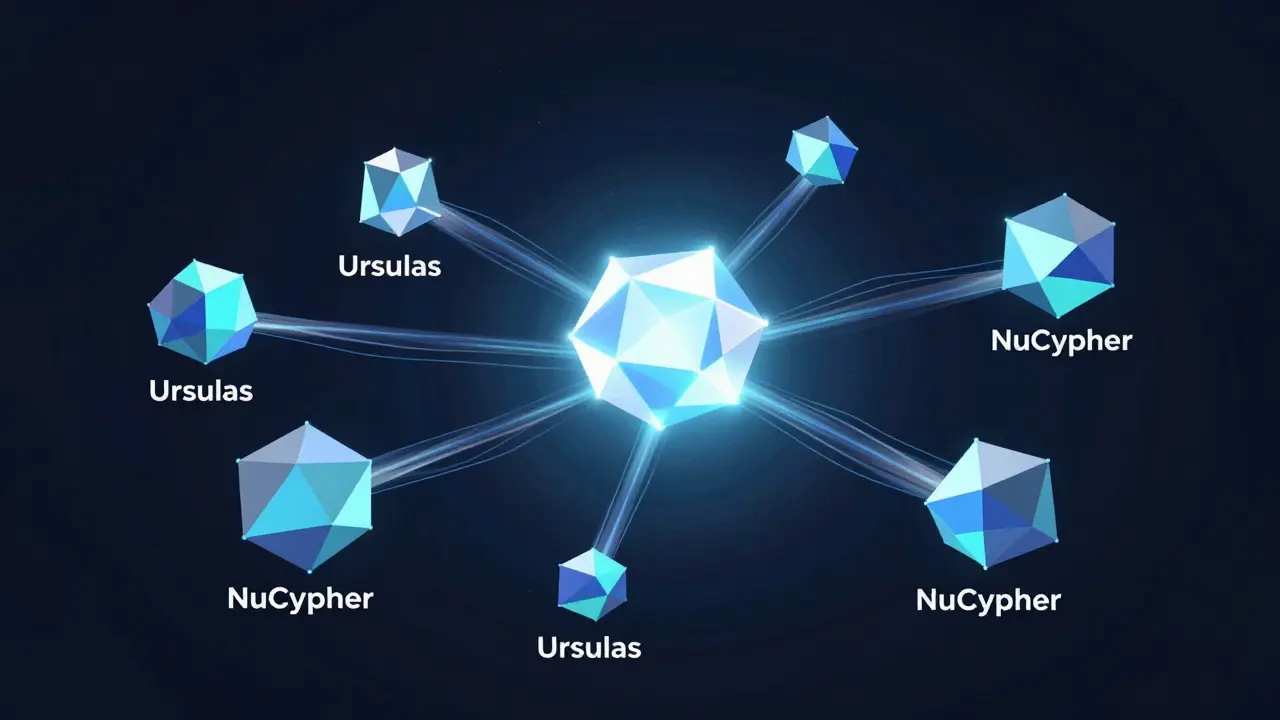
The nodes performing these complex calculations were called Ursulas. These were independent operators who staked NU tokens to join the network. They earned rewards for processing re-encryption requests but faced slashing (loss of stake) if they went offline or acted maliciously. This created an economic incentive for reliability and security.
| Component | Function | Technical Basis |
|---|---|---|
| Umbral | Cryptographic algorithm for secure key transformation | Threshold Proxy Re-Encryption (PRE) |
| Ursulas | Worker nodes that perform re-encryption tasks | Staked validators on Ethereum |
| NU Token | Used for staking, governance, and paying fees | ERC-20 Utility Token |
| Policies | Rules defining who can access data and when | Ethereum Smart Contracts |
The Market Reality: Why Adoption Was Slow
Despite having strong cryptography and a respected team, NuCypher faced significant headwinds. The primary issue was market fit. During the peak of the DeFi boom (2020-2021), investors and developers were obsessed with yield farming, lending protocols, and NFTs. Privacy infrastructure, while essential for long-term scalability, did not offer immediate financial returns or viral growth potential.
Furthermore, the reliance on Ethereum meant that every time a user wanted to set up an access policy, they had to pay gas fees. During periods of high network congestion, these fees made small-scale data sharing prohibitively expensive. While the cryptography was elegant, the user experience was complex. Developers had to integrate specific SDKs, manage local testnets, and navigate a steep learning curve compared to simpler solutions.
By late 2021, it became clear that NuCypher needed a broader utility to survive. The standalone use case of "decentralized KMS" was too narrow to sustain a large ecosystem. This realization led to a strategic pivot that would change everything.
The Merger: Birth of Threshold Network
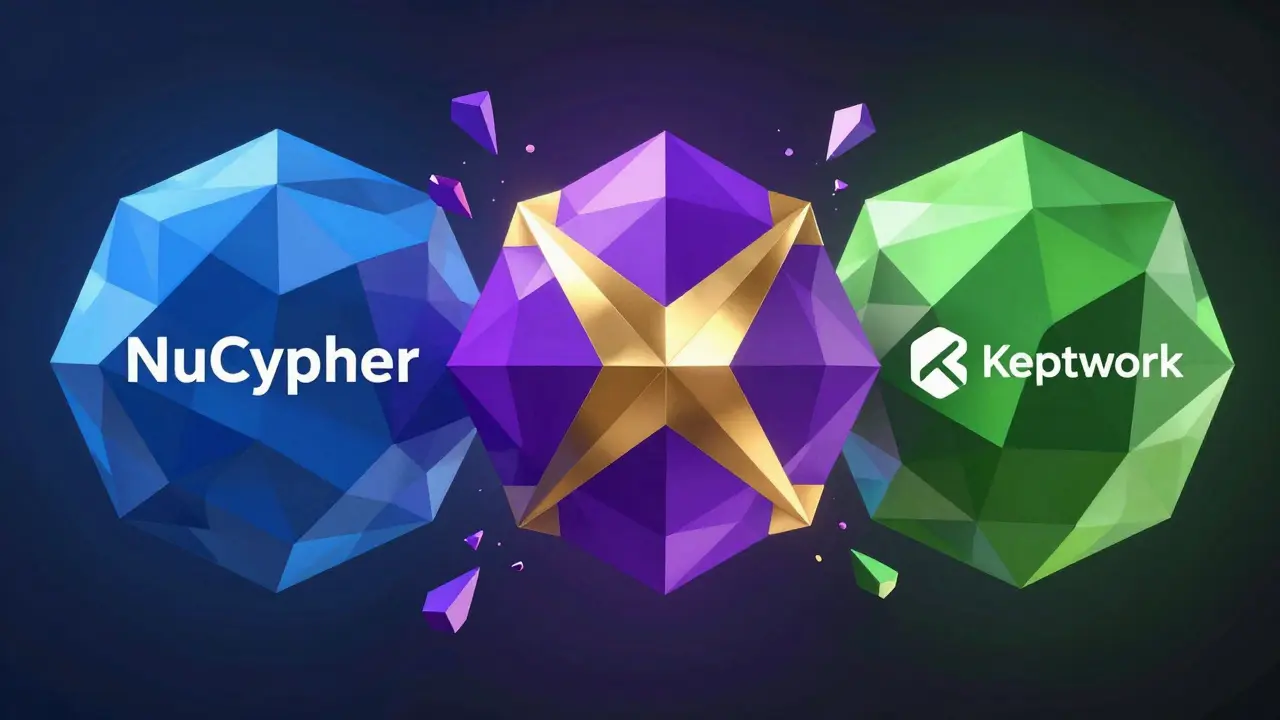
In June 2021, NuCypher announced a merger with another protocol called Keep Network. Keep Network specialized in threshold signatures and private key custody, particularly for bridging Bitcoin into DeFi (tBTC). The logic was sound: combine NuCypher’s access control expertise with Keep’s signing capabilities to create a comprehensive threshold cryptography platform.
The result was Threshold Network. This wasn't just a partnership; it was a full integration. The two communities voted to merge their tokens into a new token called T.
Here are the critical details of the migration:
- Conversion Rate: 1 NU token converted to 3.26 T tokens.
- Timeline: The migration contract went live in January 2022.
- Governance: Control shifted from the NuCypher DAO to the Threshold DAO.
- Development: All future R&D moved under the Threshold brand. NuCypher’s repositories were archived.
This merger was necessary for survival. By joining forces, the combined entity could offer a wider range of services, including tBTC v2 (a non-custodial bridge for Bitcoin) and general-purpose threshold signing services. However, for holders of NU, this meant their asset was now legacy.
Current Status of the NU Token (2026 Context)
As of May 2026, the NU token is essentially a relic. Most major exchanges have delisted it or suspended trading due to lack of liquidity and utility. The token still exists on the blockchain as an ERC-20 asset, and some secondary markets may show thin order books, but these prices are often distorted and do not reflect true value.
If you hold NU tokens today, you have two options:
- Migrate to T: If the migration window is still open via the official contracts, convert your NU to T. This gives you exposure to the active Threshold Network ecosystem.
- Hold NU: This is highly speculative. Since NU has no staking rewards, no governance power, and no utility within the current protocol, its value is derived solely from nostalgia or arbitrage opportunities, which are rare.
Market data shows NU trading at fractions of a cent, with negligible volume. For example, CoinMarketCap lists it with a ranking below #5000, indicating it has fallen off the radar for most investors. The focus of the community and developers is entirely on Threshold (T).
Comparison: NuCypher vs. Threshold
To clarify the distinction, let’s compare the old NuCypher setup with the current Threshold Network.
| Feature | NuCypher (Legacy) | Threshold Network (Current) |
|---|---|---|
| Primary Token | NU | T |
| Main Function | Data Access Control (Proxy Re-Encryption) | Threshold Signatures & Access Control |
| Key Product | Umbral Encryption | tBTC v2, Random Beacons, PRE |
| Governance | NuCypher DAO (Dormant) | Threshold DAO (Active) |
| Status | Deprecated/Migrated | Active Development |
Is NuCypher Still Relevant?
Technically, yes. The cryptography developed by NuCypher-specifically the Umbral scheme-is still considered state-of-the-art for decentralized access control. It forms a foundational layer of the Threshold Network. If you are a developer building a dApp that requires fine-grained privacy controls, the underlying principles remain valid and useful.
However, as an investment vehicle or a standalone brand, NuCypher is dead. The energy, funding, and innovation have all migrated to Threshold. Any discussion about "NuCypher" in 2026 should really be about Threshold Network. The NU token serves no functional purpose other than being convertible to T.
For users concerned about privacy in Web3, the lesson from NuCypher is that good cryptography alone isn't enough. You need a compelling use case, low costs, and seamless integration. Threshold attempts to solve this by offering broader services like Bitcoin bridging, which drives real demand for its threshold signature services.
What happened to NuCypher (NU) token?
NuCypher merged with Keep Network to form Threshold Network. The NU token was deprecated and migrated to the new T token at a rate of 3.26 T per 1 NU. As of 2026, NU is a legacy asset with no active utility.
Can I still buy NU tokens?
You might find NU on some decentralized exchanges or smaller centralized platforms, but liquidity is extremely low. It is not recommended for investment as it has been replaced by T. Major exchanges like Coinbase have delisted it.
How do I convert my NU to T?
The official migration contract launched in January 2022. You need to interact with the Threshold Network migration interface using an Ethereum wallet like MetaMask. Check the official Threshold documentation for the latest status of the migration window.
What is the difference between NuCypher and Secret Network?
NuCypher focused on proxy re-encryption for access control on Ethereum, keeping computation off-chain. Secret Network uses Trusted Execution Environments (TEEs) to run smart contracts with encrypted state directly on the blockchain. They solve privacy differently.
Is Threshold Network safe?
Threshold Network has undergone multiple audits and uses established cryptographic techniques. Like any DeFi protocol, it carries smart contract risks. Always verify addresses through official channels before interacting with migration contracts.