

What is Subsquid (SQD)? Tokenomics, Tech, and Use Cases Explained
 Jul, 20 2026
Building a decentralized application usually hits a wall: getting the data. You have your smart contracts running on-chain, but pulling that history out to build a dashboard or an analytics tool is slow, expensive, and often breaks when the chain gets busy. That is exactly where Subsquid comes in. It is not just another crypto coin; it is the engine behind a massive decentralized data lake designed to make accessing blockchain history fast and cheap.
If you are holding SQD the native ERC-20 utility token of the Subsquid network, or thinking about using their tech, you need to understand how this machine works. It separates data storage from querying, uses a high-performance database called DuckDB, and relies on the SQD token to keep the lights on. Let’s break down what this means for developers, investors, and the broader Web3 stack.
The Problem with Blockchain Data
Blockchain networks are great at storing transactions securely, but they are terrible at searching them. If you want to know "how many NFTs did user X buy last month?" across ten different chains, you aren’t just reading one block. You are sifting through terabytes of raw data. Traditional indexers try to solve this by pre-packaging data into APIs, but they often become bottlenecks. They charge high fees, limit how much you can query, and sometimes go offline.
Subsquid was born out of frustration with these limitations. The team started building a video platform and realized existing tools couldn’t handle the scale or flexibility they needed. Instead of patching old systems, they built a modular architecture. This approach treats data like water in a lake-raw, accessible, and ready to be filtered however you want. By decoupling the storage layer from the query layer, Subsquid allows developers to define their own schemas and run complex analytical queries without hitting arbitrary rate limits imposed by centralized servers.
How the Technology Works
At its core, Subsquid operates as a decentralized data lake combined with a powerful query engine. Here is the simple breakdown:
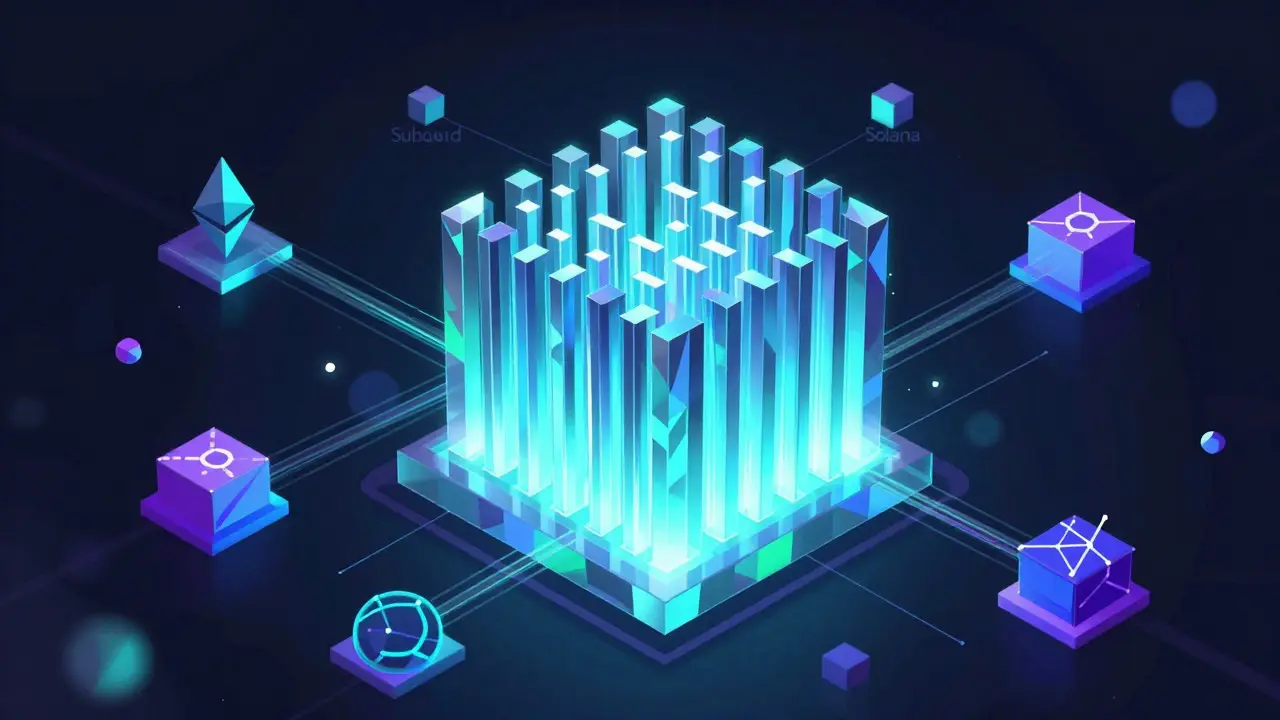
- Data Lake: This is where all the historical on-chain data lives. It stores information in its raw format from over 100 different blockchain networks. Think of it as a massive library where every book (transaction) is kept exactly as it was written, ensuring nothing is lost or altered.
- Query Engine: This is the brain. It uses DuckDB an open-source columnar analytical database optimized for fast OLAP-style queries. Unlike traditional databases that read row-by-row, DuckDB processes columns of data simultaneously. This makes it incredibly fast for analytical tasks, like calculating averages or trends across millions of transactions.
- SDK & API: Developers use Subsquid’s Software Development Kit (SDK) to write scripts that fetch data from the lake, transform it, and serve it via APIs. You can self-host this logic or use Subsquid’s managed service, which handles the heavy lifting of deployment.
This setup makes Subsquid chain-agnostic. While it gained early traction in the Polkadot and Substrate ecosystems because of its efficiency there, it now supports Ethereum, Arbitrum, Solana, and dozens of others. It is not tied to one ecosystem, making it a critical piece of cross-chain infrastructure.
SQD Tokenomics: More Than Just Speculation
The SQD token is the fuel that keeps this decentralized network running. It is an ERC-20 token deployed on Ethereum and bridged to Arbitrum One to lower transaction costs. But unlike meme coins or pure store-of-value assets, SQD has specific mechanical roles within the protocol.
| Attribute | Value / Detail |
|---|---|
| Total Supply | 1,337,000,000 SQD (Fixed Cap) |
| Circulating Supply | ~1.01 - 1.04 Billion SQD (as of mid-2026) |
| Token Type | ERC-20 Utility Token |
| Primary Chains | Ethereum (Settlement), Arbitrum One (Operations) |
| Initial Sale Price | $0.094 USD (January 2024 IEO) |
The supply is fixed at approximately 1.33 billion tokens. There is no inflationary emission schedule printing new tokens endlessly. By mid-2026, roughly 75-78% of these tokens were already in circulation. This scarcity model is crucial for long-term value retention if demand for the network’s services grows.
Core Use Cases for SQD Holders
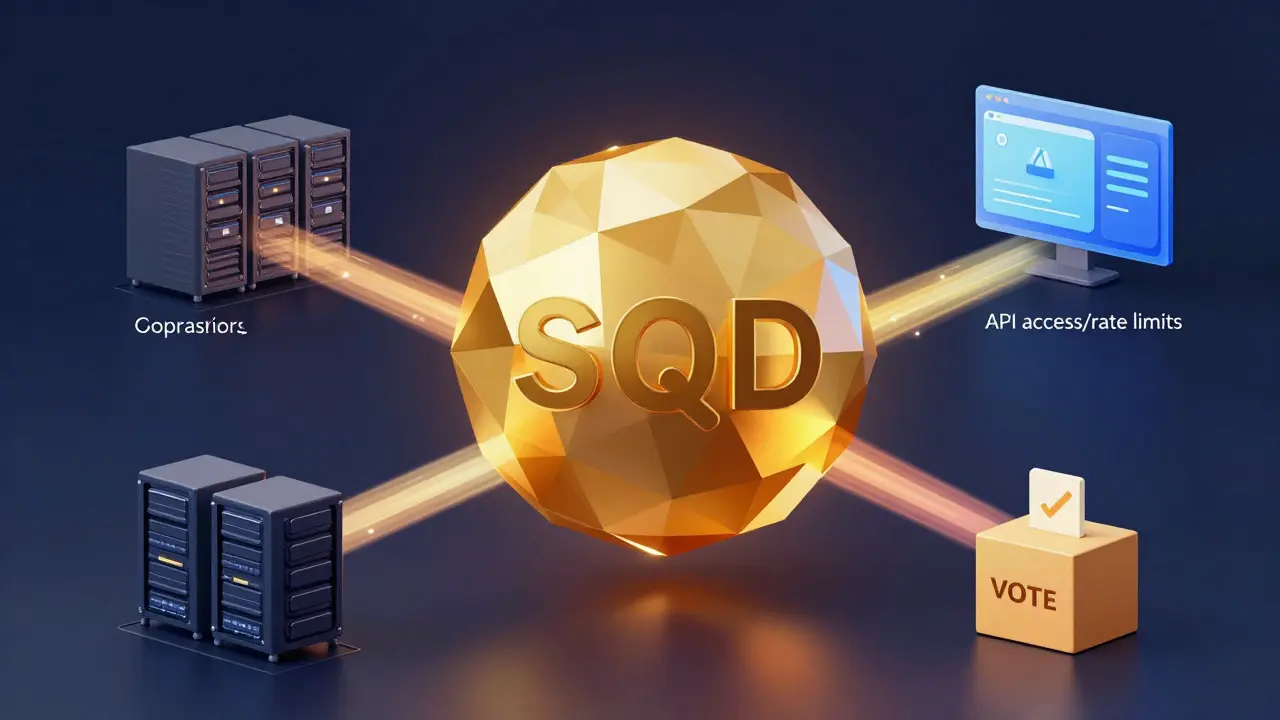
Why do you need SQD? The token serves three main functions that align incentives between users, node operators, and the protocol itself.
- Node Operator Rewards: Running a node on the Subsquid network requires computational power and storage space. Node operators contribute resources to the data lake and execute queries. In return, they earn SQD rewards. These rewards come from network fees paid by consumers of the data. If you hold SQD, you can delegate your tokens to trusted node operators to share in these fee revenues, similar to staking in proof-of-stake networks but focused on data availability rather than block production.
- Access Control & Rate Limits: For developers and dApps needing high-volume data access, SQD acts as a bandwidth key. Users can lock SQD tokens to increase their rate limits. The more SQD you lock, the higher your query throughput cap. This prevents spam and ensures fair resource consumption across the network.
- Governance: SQD holders have a say in the future of the protocol. They vote on proposals related to parameter changes, treasury spending, and other governance decisions. This decentralized control ensures that the network evolves based on community consensus rather than a central authority.
Additionally, SQD can be used to pay directly for premium datasets or API request fees. Staking SQD also grants discounts on these services, creating a circular economy where holding the token reduces operational costs for builders.
Market Context and Performance
When evaluating SQD, it helps to look at its market journey. The token launched via an Initial Exchange Offering (IEO) in January 2024 at $0.094 per token. A significant portion of the supply was vested, with 20% released immediately and the rest linearly over six months, preventing immediate dumping by early investors.
As of mid-2026, the secondary market price has settled in the range of $0.04 to $0.05. While this represents a decline from the initial listing price, it reflects broader market conditions and the maturation of the token’s distribution. Trading volumes remain healthy, with daily volumes often exceeding $6 million, indicating active liquidity on major exchanges like KuCoin, Gate.io, and Binance.
Experts view Subsquid as a "best-in-class" indexer, particularly for its cost-efficiency and speed compared to older solutions. However, it faces competition from established players like The Graph and newer entrants. Subsquid’s edge lies in its DuckDB integration and its ability to handle complex, custom schemas without forcing developers into rigid predefined structures.
Who Should Care About Subsquid?
If you are a developer building a DeFi dashboard, an NFT marketplace, or any dApp that needs real-time or historical data, Subsquid offers a robust backend solution. It removes the headache of maintaining your own indexing nodes. You simply write your query logic, deploy it, and let the network handle the rest.
If you are an investor, SQD represents a bet on Web3 data infrastructure. As more applications move on-chain, the demand for efficient data retrieval will only grow. SQD captures value from this demand through fee sharing and access controls. It is not a speculative asset with vague promises; it has a working product, a clear tokenomic model, and a growing user base across multiple chains.
Frequently Asked Questions
Is Subsquid only for Polkadot?
No. While Subsquid started with strong support for the Substrate and Polkadot ecosystems, it is now a multi-chain solution. It supports over 100 networks, including Ethereum, Arbitrum, Solana, and many others, making it versatile for cross-chain development.
How does SQD differ from other indexing tokens like GRT?
The primary difference lies in the underlying technology. Subsquid uses DuckDB, a high-performance analytical database, allowing for more complex and flexible queries compared to traditional graph-based indexers. Additionally, Subsquid’s tokenomics focus heavily on locking mechanisms for rate limiting and direct node operator rewards via delegation.
Can I stake SQD to earn passive income?
Yes. You can delegate your SQD tokens to node operators who provide computation and storage services. In return, you share in the network fees they earn. This is similar to staking in proof-of-stake blockchains but tailored for data infrastructure providers.
What is the total supply of SQD?
The total maximum supply of SQD is fixed at 1,337,000,000 tokens. There is no inflationary mechanism adding new tokens to this cap, which creates a deflationary pressure if tokens are burned or locked permanently.
Do I need to be a developer to use Subsquid?
To fully leverage Subsquid’s SDK and custom schema capabilities, yes, technical knowledge is helpful. However, end-users of dApps built on Subsquid don’t need to interact with the protocol directly. Investors can participate by holding, staking, or delegating SQD tokens without writing code.
Where can I buy SQD?
SQD is listed on several major cryptocurrency exchanges, including KuCoin, Gate.io, and Binance. You can typically trade it against USDT, USDC, or ETH. Always verify the current listing status on your preferred exchange before trading.