

Blockchain Finality and Double-Spend Prevention Explained
 Mar, 29 2026
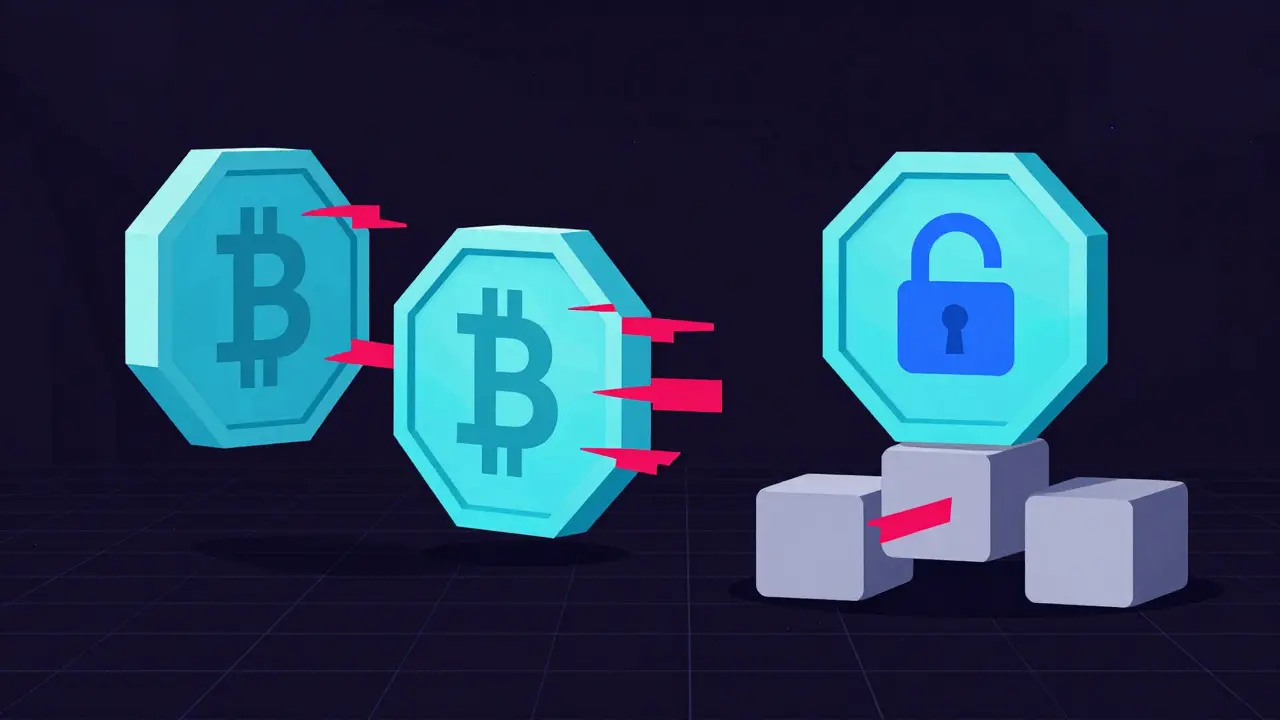
You might wonder how your digital coins stay safe when there isn't a bank watching them. In a world where files can be copied instantly, stopping someone from using the same token twice is the single hardest challenge in cryptocurrency.
This is the double-spend problem. Without a solution, anyone could create two identical copies of a digital dollar and send them to two different people. That would make the currency worthless. The answer lies in how blockchain networks reach agreement, specifically through a concept called finality. When you send funds, you aren't just hoping the other person gets them; you are waiting for the network to mathematically prove the transaction cannot be reversed.
The Mechanics of Double Spending
To understand why security systems exist, you first have to see the danger. Imagine sending $100 to a merchant. You want that money gone forever. In a centralized system like Visa, the bank simply updates its database. It locks the funds instantly. In a decentralized ledger, everyone holds a copy of the database, and no one trusts each other implicitly.
Double Spending is the potential risk that a digital currency unit could be spent more than once due to the ease of copying digital information.If I broadcast a transaction to pay you, and then quickly broadcast a second transaction paying someone else instead, the network sees both. Which one wins? If the protocol doesn't decide fast enough, a malicious actor could try to trick the recipient before the truth settles.
Satoshi Nakamoto solved this with a specific architecture in 2009. By linking transactions into blocks and requiring work to produce those blocks, the system ensures that rewriting history becomes prohibitively expensive. It transforms a question of trust into a question of physics and math.
Understanding Blockchain Finality
Not all confirmations are created equal. This distinction is often missed by beginners. When you open your wallet and see "1 confirmation," does that mean the money is yours? Not necessarily.
Block Finality represents the state at which a transaction is included in a block that cannot be removed or altered.We generally divide finality into two main types used across the ecosystem today.
- Probabilistic Finality: This is how Bitcoin works. The more blocks added on top of your transaction, the less likely it is to be reversed. It is never truly absolute, but eventually, the cost to reverse it exceeds the value of the money itself. It gets safer exponentially.
- Deterministic Finality: Used in many Proof-of-Stake networks. Here, once a vote is reached or a slot is finalized, the block is locked permanently. There is zero chance of reversal unless the entire economic model fails catastrophically.
For a business accepting payments, this matters. If you accept Bitcoin with only one confirmation, a miner might reorganize the chain hours later, stealing your goods. Most exchanges wait for six confirmations (about one hour) to consider funds settled. This waiting period is the price we pay for trustlessness.
Consensus Mechanisms and Security
The engine driving finality is the consensus mechanism. This is the rulebook the nodes follow to agree on the truth. Different blockchains use different strategies to prevent attackers from rewriting history.
Proof-of-Work (PoW) is a consensus mechanism where miners compete to solve mathematical puzzles to validate transactions and secure the network.In Proof-of-Work networks, security comes from electricity. To revert a transaction, an attacker needs to control 51% of the global computing power. They must outpace all honest miners combined. For Bitcoin, this requires billions of dollars in hardware and energy. That makes it economically irrational for most actors.
However, smaller chains are vulnerable. If a small network has few miners, a hacker can rent powerful cloud GPUs to launch a 51% attack, reverse transactions, and steal funds. This highlights why network size matters alongside technology.
Proof-of-Stake (PoS) is a mechanism where validators lock up cryptocurrency as collateral to secure the network and propose new blocks.Newer networks like Ethereum rely on stakes. Validators put up real money. If they lie about the chain's state, they get "slashed," meaning their stake is burned and confiscated. This creates immediate economic punishment rather than relying solely on energy costs.
Vulnerabilities in Modern Architectures
As the technology scales, the attack surface changes. We are building complex layers on top of the base blockchain to make transactions faster. These are known as Layer 2 solutions. While efficient, they introduce new risks.
Security researchers have flagged specific flaws in how some applications verify finality. A notable audit discovered that certain clients were checking for transaction completion incorrectly. Instead of waiting for true consensus, they relied on simple delays. This is dangerous because a delay is not a guarantee.
If a Layer 2 bridge accepts funds based on a short timer and the underlying network reorganizes, users lose money. The funds move to the destination chain before the source chain actually confirms the burn. Recent patches in major ZK-rollup clients addressed these issues, proving that developer vigilance is still required even with advanced math.

Best Practices for Developers and Users
Whether you are building a smart contract or running a shop, handling finality correctly prevents disaster. You cannot simply assume the blockchain always works perfectly immediately.
Smart Contracts are self-executing code on the blockchain that enforces agreements without human intervention. They require strict adherence to finality standards to ensure assets are not locked or reversed during disputes.Here are concrete steps to ensure safety:
- Define Wait Times: For high-value transfers, implement logic that waits for multiple block confirmations before releasing goods or tokens.
- Monitor Chain Reorgs: Applications should listen for chain updates. If the latest block header changes unexpectedly, pause operations.
- Audit Cross-Chain Logic: Bridges are prime targets. Ensure verification scripts check for actual block hashes and signatures, not just timestamps.
- Educate Merchants: Tell customers that blockchain payments take time. Don't promise instant shipping for instant crypto payment.
Maintaining security is ongoing. As tools evolve, so do the exploits. Staying updated on the finality requirements of the specific chains you use is non-negotiable.
The Future of Transaction Security
We are moving towards faster, yet more secure systems. New protocols aim to reduce the wait time from minutes to seconds without sacrificing the security margin. This is crucial for things like gaming or high-frequency trading where waiting an hour for settlement ruins the experience.
The focus is shifting to "provable" systems where finality can be cryptographically verified instantly after the fact, rather than guessing based on probability. As institutional adoption grows, the bar for security will only rise. Understanding these mechanics now puts you ahead of the curve when the next generation of ledgers matures.
What is the difference between probabilistic and deterministic finality?
Probabilistic finality means a transaction is secure only until the risk of reversing it drops below a certain threshold (like Bitcoin needing 6 confirmations). Deterministic finality guarantees that once a block is finalized, it cannot be changed under any normal circumstances, common in Proof-of-Stake networks.
How many Bitcoin confirmations do I need for safety?
For small amounts, 1 to 3 confirmations are usually acceptable. For larger transactions worth thousands of dollars, industry standards typically recommend waiting for at least 6 confirmations to eliminate the risk of a chain reorganization.
Can a 51% attack happen on large networks?
It is extremely unlikely on major networks like Bitcoin or Ethereum due to the enormous cost required to control 51% of the hashing power or stake. However, it remains a significant threat for smaller altcoins with fewer validators or miners.
Why do Layer 2 solutions have higher vulnerability risks?
Layer 2 solutions process transactions off the main chain to save fees. If they finalize too quickly without verifying the main chain properly, a reorganization on the base layer can invalidate the Layer 2 transactions, leading to losses.
Does Proof-of-Stake offer better finality speed?
Generally, yes. Proof-of-Stake networks often provide deterministic finality much faster than Proof-of-Work networks because they don't need to wait for statistical confidence over time, allowing transactions to settle in seconds rather than tens of minutes.
Alex Kuzmenko
March 29, 2026 AT 16:22i thnik the explication is cleare enogh for most peopel to get the basic idea of finality its just hard to wrap ur head around how a database agrees without a boss i see lots of folk ignoring the risk of reorgs tho and thats scary
we need more awarenes about how confirmations work before buying in blindly otherwise u lose everything when the chain rolls back
Ashley Stump
March 30, 2026 AT 22:23This whole blockchain thing is just a scam waiting to happen and you're all walking into a trap blindfolded.
Alex Lo
April 1, 2026 AT 01:38Everyone keeps saying bitcoin is secure but they forget the math behind it. You really need to understand how hashes work before invesment money. I spent yeras reading whitepapers and papers and stuff. The energy cost is hig but necesary for proof of work chains. Proof of stake is fasster but feals les solid in my mind. People trst valiadters instaed of eletricity which worries me deepey. We se haks on smaler chais almost weeky now days. Bridges are the weake link in the entier architucture today. If a reorg hapens your funds move backards in time basicaly. It souns crazy but that is the literal risk invovled here. I am worreid about layer tuo solutiosn failng badely soon. They prmise speed but saftie coms second in thier models. We shuld wait for mor historry befroe trustng new networks fuly. Do not put al eggs in on basiket regarles of marketign hyphe. Stay safe and divarsifiy your asset acrros multipl protocoles aways.
I hope some day the sysstem gets bettar but untl then watch out for the slashting funs.
Matt Bridger
April 1, 2026 AT 22:26probabilistic finality is merely a statistical guess whereas deterministic finality offers true mathematical certainty this distinction separates the amateurs from the professionals in crypto adoption
Lisa Miller
April 3, 2026 AT 19:31I appreciate that breakdown really helps clear up the confusion I had been feeling lately
It is great to know there are safer ways to handle transactions if we just wait a bit longer for confirmations. Being patient pays off in security instead of risking losses on a reorg
Sean Carr
April 4, 2026 AT 20:16Just a reminder to check your bridge settings regularly since they are the weakest link right now
Disha Patil
April 5, 2026 AT 00:46I read this and started shaking thinking about my wallet oh my god i have so much on there
Shaira Vargas
April 6, 2026 AT 02:08Why does it feel like nobody tells us the truth about risks until we lose everything it hurts so much seeing people get greedy
Joy Crawford
April 7, 2026 AT 02:22feels like im watching a horror movie unfold slowly and painfully :(
just scared of losing it all
Cara Boyer
April 8, 2026 AT 12:49These systems are likely tools for surveillance and control disguised as freedom 😤🇺🇸
We need national sovereign ledgers instead of foreign controlled chains
Beverly Menezes
April 9, 2026 AT 17:23It seems simpler than i thought once you break down the terms into easy pieces
Different countries should learn from these ideas to make payments easier globally
Michael Nadeau
April 10, 2026 AT 15:34The nature of trust in digital systems relies on immutable mathematics rather than human integrity and this shift changes our philosophical stance on ownership completely
When we delegate truth to nodes we surrender agency but gain efficiency which is the eternal tradeoff of modern civilization
Security is not a product but a process of constant verification against entropy and chaos
We must accept that perfection is impossible in decentralized systems but robustness is achievable through redundancy
Every transaction represents a vote in favor of the current state of reality
Finality is simply the moment doubt evaporates under weight of consensus
History records show centralization fails eventually while distributed models persist despite flaws
We stand on the precipice of a new economic paradigm defined by code
Understanding these mechanics is the key to surviving future financial volatility
The path forward requires vigilance not complacency
Our digital signatures become our legal identity in this new era
The cost of attack is the price of entry for honest participants
We build these walls to protect the value stored within the ledger
Trustless infrastructure is the bedrock of the next industrial revolution
Patience becomes the ultimate currency in waiting for confirmation blocks
Chris R
April 12, 2026 AT 12:56In my home region we rely on mobile money and this adds another layer of choice for us
Financial inclusion improves when technology handles the heavy lifting securely
Markus Church
April 13, 2026 AT 15:05The implications for cross-border settlements are significant given the current inefficiencies in traditional banking rails
Samson Abraham
April 14, 2026 AT 18:22verification mechanisms require rigorous adherence to protocol specifications to prevent exploitation vectors from emerging
Leah Lara
April 16, 2026 AT 01:05Meh whatever works fine by me
Jay Starr
April 16, 2026 AT 02:36The silence on potential failures is deafening sometimes