

How Public Key Cryptography Secures Crypto: A Simple Guide
 Apr, 4 2026
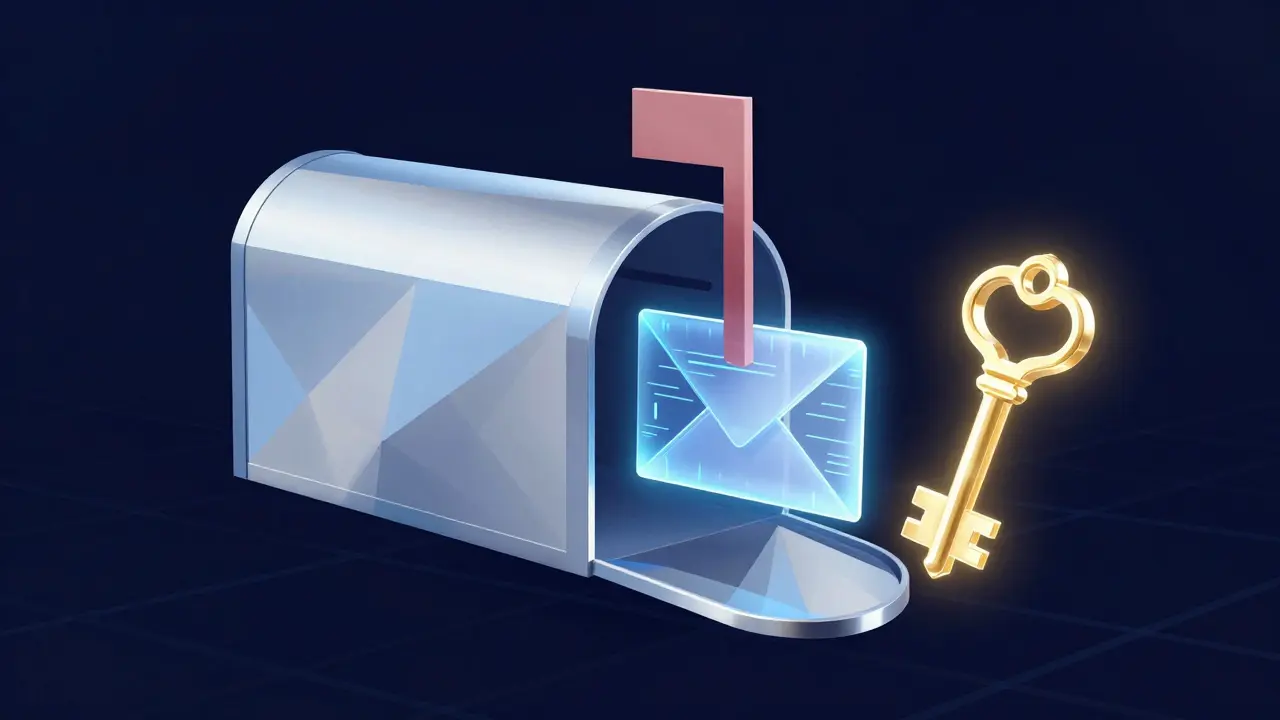
Imagine having a mailbox where anyone in the world can drop a letter, but only you have the key to open it and read what's inside. That's essentially how public key cryptography is a mathematical system that uses a pair of related keys-one public and one private-to secure digital data. In the world of cryptocurrency, this isn't just a cool trick; it's the only reason your digital assets don't vanish into thin air the moment you put them online. Without it, the very idea of "owning" Bitcoin or Ethereum would be impossible.
Most people think of a crypto wallet as a digital pocket, but it's actually a key management tool. The real magic happens through asymmetric cryptography, a method that allows two parties to communicate securely without ever having to meet or share a secret password beforehand. If you've ever sent crypto to a friend using a long string of random characters, you've used this system.
The Dynamic Duo: Public vs. Private Keys
To understand how your funds stay safe, you need to understand the relationship between your two keys. Think of the public key as your bank account number and the private key as your secret PIN and signature combined.
- Public Key: This is a 512-bit value derived from your private key. It's safe to share with anyone. When someone wants to send you money, they send it to an address generated from this key.
- Private Key: This is a randomly generated 256-bit integer. This is the "crown jewel." Anyone who has this key has total control over the funds. If you lose it, your money is gone; if you share it, your money is stolen.
The beauty of this system is that it's a one-way street. You can easily create a public key from a private key, but doing the reverse is practically impossible. According to the National Institute of Standards and Technology (NIST), breaking a 256-bit elliptic curve would take about 2^128 operations. To put that in plain English: all the computers on earth working together for billions of years couldn't guess your private key through brute force.
How a Transaction Actually Happens
When you hit "send" on a transaction, you aren't actually moving coins. Instead, you're creating a digital signature. This is where the Elliptic Curve Digital Signature Algorithm (or ECDSA) comes into play.
Here is the simple breakdown of the process:
- The Request: You create a transaction message (e.g., "Send 0.1 BTC to Alice").
- The Signing: Your wallet uses your private key to "sign" this message. This creates a unique mathematical proof that you authorized the move.
- The Broadcast: The signed transaction is sent to the network.
- The Verification: Other computers (nodes) on the network use your public key to verify that the signature is valid. They can confirm you signed it without ever seeing your private key.
This provides three essential security pillars: authentication (proving you are the sender), integrity (proving the transaction wasn't changed mid-flight), and non-repudiation (meaning you can't later claim you didn't send the funds).
| Feature | Symmetric (e.g., AES) | Asymmetric (Public Key) |
|---|---|---|
| Key Setup | Shared secret key | Public/Private key pair |
| Trust Level | Requires pre-existing trust | Trustless (no prior contact needed) |
| Speed | Very Fast | Slower (computationally heavy) |
| Primary Use | Data encryption | Authentication & Signatures |

From Keys to Addresses: The Hashing Process
You might notice that your Bitcoin address doesn't look like a long mathematical coordinate. That's because of a process called hashing. To add an extra layer of security and make addresses shorter, your public key goes through a "shredder" that can't be reversed.
First, the public key is processed by SHA-256 (a cryptographic hash function), and then it's further refined by RIPEMD-160. This creates a shorter 160-bit hash, which is then encoded into a human-readable format like Base58Check or Bech32. This ensures that even if someone finds a flaw in the final address format, they still have to crack the original public key and then the private key to steal your funds.

The Human Element: Where the System Actually Breaks
If the math is so perfect, why do people still lose money? Because the weakness isn't in the cryptography; it's in the humans using it. Most "hacks" are actually just cases of poor key management.
Consider the 12-word recovery phrase (BIP-39 mnemonic) you get when setting up a wallet. That phrase is simply a human-friendly version of your private key. If you write that phrase on a piece of paper and lose it, you've lost your private key. There is no "Forgot Password" button in a decentralized system because there is no central company that holds a backup of your keys.
Common pitfalls include:
- Public Exposure: Accidentally uploading a private key to a site like GitHub.
- Phishing: Giving your recovery phrase to a fake "support agent."
- Device Failure: Storing keys on a hard drive that crashes without a backup.
To fight this, many pros use hardware wallets. These devices store the private keys in a Secure Element chip, meaning the key never actually touches the internet, making it nearly impossible for a remote hacker to steal it.
The Future: Quantum Computers and the "Crypto-Apocalypse"
Is this system bulletproof forever? Not quite. There is a theoretical threat called Shor's algorithm. If someone builds a powerful enough quantum computer, they could potentially derive a private key from a public key in minutes rather than billions of years.
While this sounds scary, most experts believe we have time. IBM's roadmaps suggest practical quantum threats are still 10-15 years away. In the meantime, developers are already working on "Post-Quantum Cryptography" (PQC). New standards like CRYSTALS-Dilithium are being designed to replace current elliptic curves with lattice-based math that even quantum computers can't crack.
We are also seeing improvements in current tech. Bitcoin recently introduced Schnorr signatures, which make transactions smaller and more private by allowing multiple signatures to be combined into one.
Can someone steal my crypto if they have my public key?
No. The public key is designed to be shared. It only allows people to send funds to you. To move funds out of your wallet, a digital signature created by the corresponding private key is required. Unless a quantum computer is used, it is mathematically impossible to guess the private key from the public key.
What is the difference between a seed phrase and a private key?
A private key is a long string of numbers used to sign a single address. A seed phrase (mnemonic) is a master key that can generate multiple private keys for different addresses. If you have the seed phrase, you can recover all the private keys associated with that wallet.
Is ECDSA used by all cryptocurrencies?
Most, but not all. Bitcoin and Ethereum use the secp256k1 curve. However, other networks like Ripple use Ed25519 (Edwards-curve Digital Signature Algorithm), which is slightly different and often faster to verify.
What happens if I lose my private key?
Because cryptocurrency is decentralized, there is no central authority to reset your password. If you lose your private key and don't have a backup (like a seed phrase), your funds are permanently inaccessible. They remain on the blockchain, but no one can ever move them again.
How does a hardware wallet protect my keys?
A hardware wallet generates and stores the private key inside a physical chip that never connects to the internet. When you sign a transaction, the data is sent into the device, signed internally, and sent back out. Your private key never leaves the chip, protecting it from malware and online hackers.
Erica Mahmood
April 4, 2026 AT 12:14actually the secp256k1 curve is specifically chosen for its efficiency in ecc operations and the a=0 parameter makes it way faster for hardware implementations
definitely worth looking into the difference between koblitz curves and random curves if you want to get deeper into the math
JERRY ORTEGA
April 5, 2026 AT 09:00most people just need a solid hardware wallet and a steel backup for their seed phrase to be safe enough for most portfolios
Sharhonda Walker
April 6, 2026 AT 07:17i think its imporant to mention that seed phrasess are basically just a way to derive the master private key using a checksum and binary representation so you dont make a typo when writing it down
Arwyn Keast
April 7, 2026 AT 10:38Typical American obsession with oversimplifying complex systems. The lack of mention regarding the specific entropy requirements for a truly secure private key is a glaring omission. In the UK, we actually appreciate the rigour of cryptographic standards without needing it watered down for the masses
Alexandra Lance
April 8, 2026 AT 13:48LMAO imagine trusting "experts" who say quantum computers are 10 years away 🙄 They've probably already got them and they're just waiting to dump the market in one go. Wake up people! 🤡🕵️♀️
Joshua Aldrich
April 9, 2026 AT 20:48It's kinda wild when you think about it. We've basically traded the trust in human institutions for a trust in pure math. There is something deeply poetic about the fact that our wealth is now just a specific arrangement of numbers that no one can guess. I've seen so many people lose their life savings because they treated a seed phrase like a simple password, and it really makes you realize how fragile our interaction with technology actually is. We are basically digital nomads wandering through a landscape of primes and curves, hoping we don't trip over a phishing link
Manisha Sharma
April 11, 2026 AT 01:10this is so basic lol. anyone with a modicum of intellect knows that the real beauty lies in the prime field arithmetic and not just some simple mailbox analogy. truly a novice's guide that fails to capture the transcendental nature of computation in the east
Evan Borisoff
April 12, 2026 AT 08:56The sheer computational overhead involved in asymmetric encryption is a necessary evil for the preservation of American digital sovereignty in a globalized market where state-sponsored actors from adversarial regimes are constantly probing for vulnerabilities in the SHA-256 hashing process to undermine the stability of decentralized finance
Hugo Lopez
April 14, 2026 AT 03:51I love how this explains it! 😊 It makes the whole process feel so much less intimidating for beginners. Great way to break down the concepts!
shubhu patel
April 16, 2026 AT 02:04I find it very interesting how the transition from a public key to a shortened address adds that extra layer of security by hiding the full public key until the first time a transaction is spent from that address, which is a subtle but very important detail for privacy-conscious users who are worried about early quantum attacks on known public keys
Krystal Moore
April 16, 2026 AT 20:24Omg it is literally a crime that people are still falling for phishing scams in 2024! Like, how do you give away your seed phrase? Honestly, some people just want to be robbed at this point
Sonya Bowen
April 17, 2026 AT 01:56True ownership requires total responsibility
gladys christine
April 17, 2026 AT 18:58YESSS get those keys secured everyone!! dont let the hackers win just get yourself a ledger or a trezor and sleep like a baby!!! 🚀✨
Bruce Micciulla Agency
April 17, 2026 AT 19:20the math is fine but the implementation of these wallets is where the real failure occurs because most devs cant even handle basic memory safety and then they wonder why their multisig implementation has a vulnerability that allows a simple overflow attack to drain the vault without any private key ever being exposed
Patty Levino
April 19, 2026 AT 14:38It can be really scary for people who aren't tech-savvy. Just remember to take your time when writing down your phrase and maybe store it in a fireproof safe
Lauren Gilbert
April 20, 2026 AT 11:07It's fascinating to consider the philosophical implication of a system where no one can help you if you lose your key. It removes the human element of mercy or error correction entirely. We are moving toward a world where the law is not a person or a judge but a mathematical constant that simply doesn't care if you had a family emergency or a house fire. It's a cold way to handle value, but I suppose that's the only way to achieve true decentralization without a central point of failure that could be corrupted by power
Carmelita Gonzales
April 20, 2026 AT 12:19glad this is out there to help people avoid the common mistakes
Carol Prates
April 21, 2026 AT 16:11Wait, so if I just lose my paper with the 12 words, my money is just... gone? That is literally the most stressful thing I've ever heard! Why is it designed to be so cruel?! lol