

Tokenomics Red Flags: How to Spot Dangerous Crypto Economic Models
 Apr, 25 2026
Most people stare at price charts and hype cycles when picking a coin, but they're looking at the wrong data. The real story isn't in the green candles; it's in the math. Tokenomics is the economic model of a cryptocurrency, encompassing its supply, distribution, and utility. When this model is broken, no amount of marketing can save the project. You aren't just buying a token; you're buying into a financial system. If that system is designed to leak value, you're the one paying the price.
The Inflation Trap: Unlimited Supply
The most glaring warning sign is a token with an unlimited supply and no real way to pull tokens out of circulation. Imagine buying a piece of art, but the artist decides to print ten thousand identical copies every single week. Your original piece doesn't just lose value; it becomes irrelevant. This is exactly what happens with infinite supply models that lack controlled emission schedules.
Take Dogecoin as a classic example. While it has a massive community, its infinite supply creates a persistent inflationary pressure. Without a mechanism to counteract this, the long-term value of each individual token is constantly under threat of dilution. Compare this to Ethereum, which evolved its model through EIP-1559. By burning a portion of transaction fees, Ethereum created a deflationary pressure that can actually reduce the total supply over time, aligning the token's value with the network's usage.
Insider Dumps and Vesting Nightmares
Who owns the tokens, and when can they sell them? If the team and early investors hold a massive chunk of the supply with a short or non-existent vesting period, you are essentially betting against a group of people who are incentivized to dump their holdings on you. A "vesting schedule" is just a fancy term for a lock-up period. If the team can unlock 20% of their tokens in the first month, they have a massive incentive to pump the price and exit quickly.
Look for "cliff" periods-dates where a huge amount of tokens suddenly become liquid. If you see a massive unlock event coming up on a project's calendar, expect a price drop. Sustainable projects use long-term, linear vesting that forces the founders to stay committed to the project's growth for years, not weeks.
| Attribute | Sustainable Model (Green Flag) | Risky Model (Red Flag) |
|---|---|---|
| Supply Limit | Capped or managed by burn mechanisms | Unlimited with no burn/emission control |
| Vesting | Multi-year linear vesting for team | Short lock-ups or immediate liquidity |
| Utility | Required for network function/revenue | Purely speculative or "governance only" |
| APY/Yield | Based on actual protocol revenue | 100%+ paid via inflationary minting |

The Utility Illusion
Ask yourself: "Why does this token actually need to exist?" If the only answer is "to increase the price" or "for voting on things that don't matter," you've found a red flag. Many projects claim to have utility, but it's often just a thin veil for speculation. A token that provides no real-world value or doesn't solve a specific problem within its ecosystem is effectively a lottery ticket.
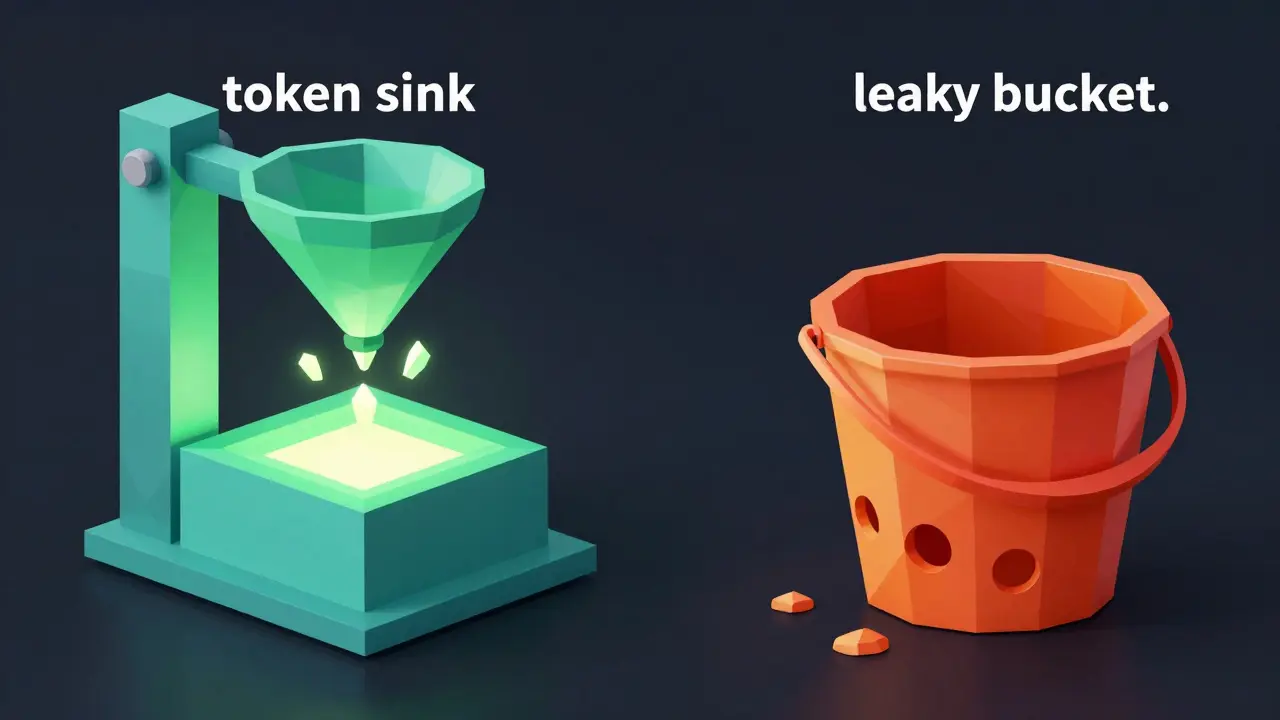
Contrast this with GMX, which uses a decentralized perpetual exchange model. The token isn't just a placeholder; it's tied to actual revenue generation and community rewards. When a project has a "token sink"-a reason for people to buy and hold the token to access a service or earn a share of profits-it creates a sustainable value cycle. Without a sink, you just have a leaky bucket.
Over-Engineering and Yield Traps
If you need a PhD in mathematics to understand how a token earns value, be careful. Some projects build "economic Rube Goldberg machines"-complex layers of staking, bonding, minting, and burning-to hide the fact that there is no actual value being created. This complexity is often a smokescreen for centralization risks or structural flaws.
The most dangerous version of this is the unsustainable APY (Annual Percentage Yield). If a project promises 1,000% returns without explaining where the money comes from, it's likely a liquidity trap. They aren't paying you from profits; they're paying you with new tokens they just printed. This creates a death spiral: more tokens are minted to pay rewards, which increases inflation, which crashes the price, which leads to more selling.
Due Diligence: Your Practical Checklist
Don't rely on a single Telegram group or a charismatic founder's Twitter thread. You need to cross-reference data. Start by checking the "Max Supply" and "Circulating Supply" on aggregators like CoinMarketCap or CoinGecko. If the circulating supply is only 10% of the max supply, there is a massive amount of future inflation waiting to hit the market.
Next, dig into the whitepaper. You aren't looking for the technical jargon; you're looking for the emission schedule. Who gets the tokens? When do they get them? Is there a treasury? If the distribution is opaque or hidden in a "community fund" controlled by the founders, walk away. Finally, look for a revenue model. If the project doesn't make money from a product or service, the token is likely just a vehicle for shifting money from new investors to old ones.
What is the biggest tokenomics red flag?
The most critical red flag is an unlimited token supply combined with no controlled emission or burn mechanisms. This creates constant inflationary pressure that dilutes the value of your holdings, regardless of how popular the project becomes.
Are high APYs always a bad sign?
Not always, but if the yield exceeds 100% and isn't backed by actual protocol revenue (like transaction fees), it's usually a red flag. If the rewards are paid in the token itself via minting, you're likely witnessing a hyper-inflationary cycle that will eventually crash.
How do I check a project's vesting schedule?
Review the project's whitepaper or official documentation under sections like "Token Allocation" or "Distribution." Additionally, many projects list their unlock dates on transparency dashboards or blockchain explorers if the tokens are locked in smart contracts.
What does "burn mechanism" actually mean?
A burn mechanism is a process where tokens are permanently removed from circulation-usually by sending them to an inaccessible address. This reduces total supply, which can increase scarcity and potentially raise the value of the remaining tokens.
Can a project fix bad tokenomics after launch?
Yes, but it's difficult. Ethereum is a prime example, as it implemented EIP-1559 to introduce a burn mechanism. However, this usually requires a governance vote or a hard fork and significant community alignment.
Next Steps for Your Analysis
If you're looking at a new project, don't rush in. Start by mapping out the flow of tokens: where do they come from, and where do they go? If the flow only goes from the protocol to the users without any one coming back (the "sink"), the model is broken. For those new to this, start by studying established DeFi leaders like Aave to see how governance and ecosystem rewards can be aligned for long-term sustainability.
If you find a project with a hidden supply or a team that refuses to share their vesting dates, treat it as a high-risk gamble. In the world of blockchain, transparency isn't a feature-it's the bare minimum. If they won't show you the math, it's because the math doesn't work in your favor.
Felix Eduardo Velasquez
April 26, 2026 AT 01:57The concept of the "token sink" is the most critical part of this entire analysis. Most retail investors focus on the pump and ignore the fact that if there's no intrinsic reason to hold the asset other than hoping someone else pays more for it, you're just playing a game of musical chairs. True value capture happens when the token is required for a service that people actually want to pay for, effectively turning the token into a productive asset rather than a speculative chip. It's the difference between owning a company that produces a product and owning a ticket to a raffle. If you can't identify the specific utility that creates a demand floor, you're basically gambling on social sentiment.
Robert Smith
April 26, 2026 AT 16:36Spot on! 🚀🔥
Arti Jain
April 27, 2026 AT 10:39Typical Western bias. Indian developers are building far more sustainable models than these US-centric examples.
Jimmy vasquez
April 28, 2026 AT 12:25Really great breakdown! If anyone is struggling with the whitepapers, just remember to look for the 'Token Allocation' section first. It's usually where the most honest info is hidden before they start the marketing fluff.
AP Fisher
April 29, 2026 AT 11:43I'm not sure I get the part about the Rube Goldberg machines. Does it just mean the math is too hard or that the system is actually fake?
Lloyd I
April 30, 2026 AT 19:12I can help clarify that! It's basically when they make the system way more complex than it needs to be just to distract you from the fact that no real money is being made. Let's all try to simplify our research process together!
Chloe Fletcher
April 30, 2026 AT 22:38Love the energy here! Keep digging into those whitepapers everyone! 🌟💪
Tracy McBurney
May 1, 2026 AT 03:24The author's attempt to simplify tokenomics is quaint, but it ignores the nuance of algorithmic stabilization. Most of you are just following a checklist without understanding the underlying game theory, which is why you continue to lose money in these markets. It's almost impressive how many people fall for a 'burn mechanism' without considering the impact on liquidity depth.
VIVEK SINGH
May 2, 2026 AT 18:30Oh look, another "guide" to not getting scammed. How novel. I'm sure the people buying 10,000% APY tokens are reading this with great interest while their portfolios vanish into the void. It's a beautiful cycle of greed and ignorance, isn't it?
Ryan Nakielny
May 3, 2026 AT 01:47Wait, you guys actually read the whitepapers? I just look for the dog logo and hope for the best. Truly revolutionary stuff here.
Kristi Swartz
May 3, 2026 AT 15:54the part about the insiders is correct since it is morally wrong to dump on retail investors who just want to grow their money and the founders should be held accountable for this behavior
Veronica Bago
May 3, 2026 AT 22:29This is such a helpful vibe. Thanks for keeping it simple and easy to follow!
Bevon Findley
May 4, 2026 AT 15:16Pretty standard stuff for anyone who actually knows the space :)
Tony Phan
May 5, 2026 AT 00:37LITERALLY THE SAME THING AS PONZI SCHEMES! I've been through this so many times and it just drains me that people still don't get it. The slippage is insane and the liquidity pools are just smoke and mirrors man! Just absolute madness!
Harvey Alford
May 5, 2026 AT 00:47I bet you're just scared of losing money. Tell me your portfolio and I'll tell you why you're wrong.
Andrew Todd
May 6, 2026 AT 08:50This is why America leads the world in finance. We build the systems that others just try to copy poorly. The math is simple if you're actually smart.
Sri Astuti
May 7, 2026 AT 14:30Honestly it's just laughable that we're still talking about burn mechanisms in this day and age because it's such a primitive way to handle inflation and it really shows the lack of creativity in the current DeFi landscape where everyone is just copying Aave or Uniswap without adding any actual value to the blockchain architecture 🙄 it's all just a giant circle of pretending to be innovative while the venture capitalists laugh all the way to the bank with their early seed rounds and zero-cost bases while the retail peasants fight over crumbs in some dusty telegram group :)
Gabby Puche
May 7, 2026 AT 19:07Stay safe everyone! Do your own research! 🌈✨