

What is EdgeSwap (EGS)? Tokenomics, Risks, and Reality Check
 May, 18 2026
Buying a cryptocurrency because it sounds technical isn't enough anymore. You've probably seen the term "Layer 2" or "Zero-Knowledge" thrown around in every new project announcement. EdgeSwap (EGS) claims to be exactly that: a high-speed, low-cost trading protocol built on Ethereum using advanced privacy tech. But when you dig past the marketing buzzwords, the picture gets complicated. Is this a legitimate innovation in decentralized finance, or just another small-cap token with shaky fundamentals?
I’ve looked into the data behind EdgeSwap, cross-referencing exchange listings, aggregator reports, and community signals. The short answer? It’s a high-risk, speculative asset with significant transparency gaps. If you are thinking about buying EGS, you need to understand what you're actually getting-and more importantly, what information is missing.
The Core Promise: Speed, Privacy, and Low Fees
Let's start with what EdgeSwap says it does. The project positions itself as an Ethereum Layer 2 solution. In plain English, Ethereum is slow and expensive for regular users. Layer 2 networks sit on top of Ethereum to handle transactions faster and cheaper, then settle them on the main chain later. EdgeSwap specifically uses ZK Rollups, which use zero-knowledge proofs to verify batches of transactions without revealing the details.
The pitch from Edge Labs, the development team behind the protocol, focuses on two things: hardware acceleration and circuit optimization. They claim this setup allows for ultra-fast off-chain proof generation. For a trader, this means less waiting time and lower gas fees compared to swapping tokens directly on Ethereum Mainnet. They also emphasize privacy, suggesting that user assets and trade data are protected by these cryptographic methods.
However, there is a catch. While the technology sounds solid, the execution details are vague. Major competitors like Loopring or zkSync Era have published extensive documentation, open-source code repositories, and third-party security audits. EdgeSwap lacks these critical trust signals. Without a public whitepaper or detailed technical specs linked on major aggregators, it's hard to verify if their "hardware acceleration" is real innovation or just marketing jargon.
Tokenomics: A Messy Picture
If you want to invest in a token, you need to know its supply dynamics. Here is where EdgeSwap becomes confusing. Different reputable data sources give conflicting numbers, which is a red flag for due diligence.
| Metric | CryptoRank | HTX (Huobi) | DropsTab |
|---|---|---|---|
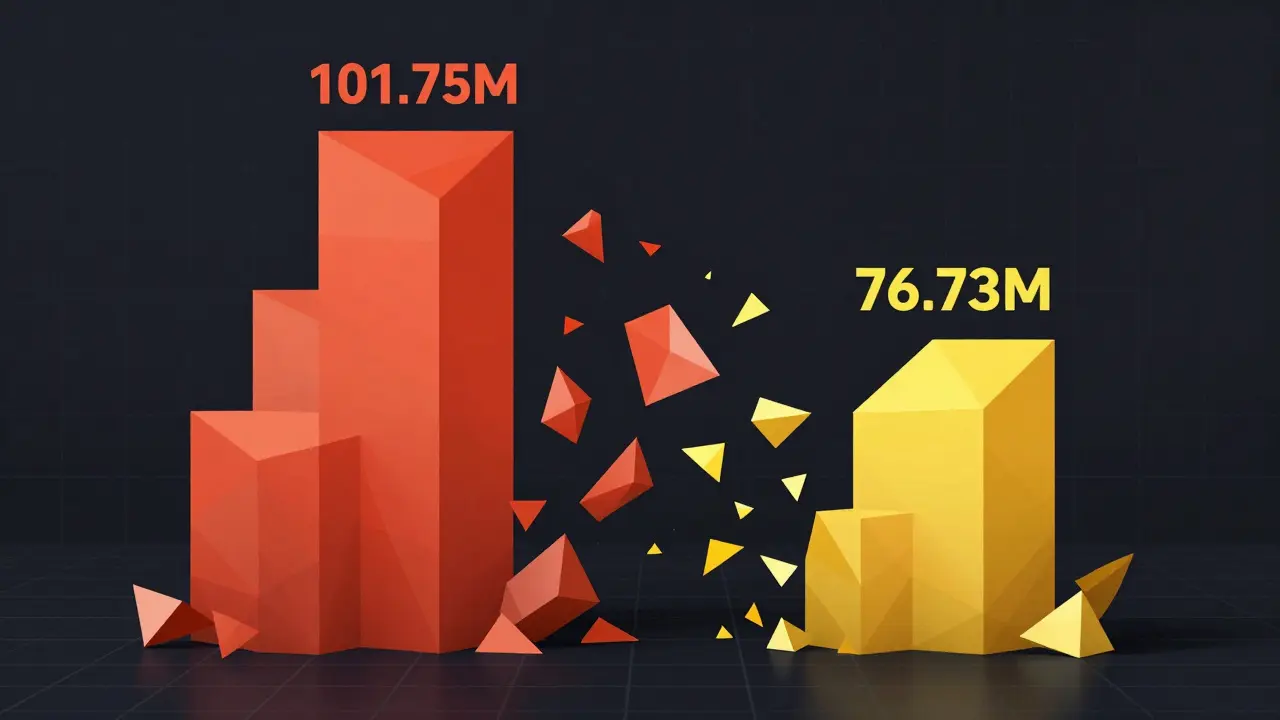
| Total Supply | 101.75 Million | 76.73 Million | Not Specified |
| Circulating Supply | 56.70 Million | Not Specified | Not Specified |
| Funds Raised | $100 (Likely Error) | Not Specified | $220,000 |
| Tokens Sold in IDO | 14.67 Million | Not Specified | 14.67 Million |
Look at those discrepancies. One source says the total supply is over 100 million; another says under 80 million. This isn't just a minor rounding error-it suggests either poor data management by the project or inconsistent reporting across platforms. When I calculated the implied launch price based on DropsTab’s $220,000 raise and 14.67 million tokens sold, it came out to roughly $0.015 per EGS. Yet, current prices are often a fraction of that.
The utility of the EGS token is also unclear. Most descriptions mention "swapping and farming services," but they don't specify if EGS is used for governance voting, fee discounts, or staking rewards. Without clear utility, the token relies entirely on speculative demand rather than actual usage within the protocol.
Price History and Volatility: The Danger Zone
You cannot talk about EdgeSwap without addressing its price action. The volatility here is extreme. According to HTX, the all-time high (ATH) for EGS was $0.14. The all-time low (ATL) was $0.00025. That is a drawdown of nearly 99.8%. To put that in perspective, if you bought at the peak, your investment lost almost all its value before recovering slightly.
Recent price data shows EGS trading in the sub-$0.001 range. Some trackers show prices around $0.00006, while others list it closer to $0.0005. Why such a big difference? Liquidity. Daily trading volumes are tiny-often ranging from $300 to $30,000 depending on the exchange and time of day. When volume is this low, even small buy or sell orders can cause massive price swings. This makes it dangerous for anyone trying to enter or exit a position quickly.
Where Can You Trade EGS?
If you decide to proceed despite the risks, you need to know where the token lives. EGS is not widely available on major centralized exchanges like Binance or Coinbase. Instead, it appears on smaller platforms:
- HTX (formerly Huobi): Lists EGS with spot trading pairs, likely against USDT.
- LBank: Hosts informational pages and likely offers trading pairs.
- Crypto.com: Tracks the price but may not offer direct trading on the exchange.
Because it is an Ethereum-based token, it might also be tradable on decentralized exchanges (DEXs) via bridges, but finding the correct contract address requires careful verification to avoid scams. Always double-check addresses on official channels, though finding those official channels is part of the challenge with EdgeSwap.

The Missing Pieces: Audits and Documentation
In the world of crypto, trust is built on transparency. EdgeSwap fails this test significantly. WorldCoinIndex explicitly marks the whitepaper, Reddit community, and Bitcointalk threads as "not available." CoinMarketCap and other aggregators repeat marketing copy but provide no links to GitHub repositories or smart contract audit reports.
No independent security firm like CertiK or Trail of Bits has publicly reviewed EdgeSwap's code. For a project handling user funds and promising "high-level security," this is a major oversight. How do you know the "zero-knowledge proofs" aren't flawed? How do you know the developers can't drain the liquidity pool? Without audits, you are betting on their word alone.
Is EdgeSwap Worth Your Attention?
Here is the bottom line. EdgeSwap operates in a crowded market. It competes with established Layer 2 giants like Arbitrum, Optimism, and StarkNet, which have billions in total value locked (TVL) and massive developer communities. EdgeSwap has none of that scale. Its market cap is in the low six figures, making it a micro-cap asset.
The potential upside exists only if the project delivers on its technical promises and gains adoption. But the downside risk is severe. The lack of documentation, conflicting tokenomics data, extreme volatility, and absence of security audits make EGS a highly speculative bet. It is not an investment for beginners or those seeking stable growth.
If you are curious about ZK rollups and Layer 2 scaling, look at the leaders in the space first. They offer better security, clearer roadmaps, and deeper liquidity. EdgeSwap remains a niche experiment with too many unknowns to recommend broadly.
What is the total supply of EdgeSwap (EGS)?
There is conflicting data regarding the total supply of EGS. CryptoRank lists it as 101.75 million, while HTX lists it as 76.73 million. This discrepancy highlights the lack of standardized reporting for the token, so investors should verify the most recent on-chain data themselves.
Is EdgeSwap safe to use?
Safety cannot be guaranteed. EdgeSwap lacks publicly available third-party security audits from firms like CertiK or Trail of Bits. Additionally, the absence of a public whitepaper and detailed technical documentation makes it difficult to assess the security of their smart contracts and ZK rollup implementation.
Where can I buy EGS tokens?
EGS is primarily traded on smaller centralized exchanges such as HTX (Huobi) and LBank. It may also be tracked on platforms like Crypto.com, but trading availability varies. Always check for the correct trading pair, usually EGS/USDT, and be aware of low liquidity.
Who developed EdgeSwap?
The project is attributed to a team called Edge Labs. However, specific details about individual founders, their backgrounds, or the company's jurisdiction are not publicly disclosed on major aggregator sites, adding to the anonymity surrounding the project.
How does EdgeSwap compare to Loopring?
Both projects use ZK rollup technology for Layer 2 scaling. However, Loopring is a much more mature project with a longer history, higher trading volumes, and greater market capitalization. EdgeSwap is a newer, smaller competitor with significantly less liquidity and fewer public resources.
What is the utility of the EGS token?
Public descriptions state that EGS is used for swapping and farming services within the EdgeSwap protocol. Specific utilities like governance voting rights, fee discounts, or staking mechanisms are not clearly defined in available documentation.
Mike S
May 18, 2026 AT 16:41Oh look, another "innovative" ZK rollup that's basically a rug pull waiting to happen. 🙄 The fact that the supply data is all over the place should be your first red flag, but sure, keep buying the dip on this micro-cap trash. I've seen better code in my grandma's knitting patterns.
Ellie Riddell
May 19, 2026 AT 09:23I mean, it's funny how every new L2 claims to solve everything while having zero audits. It's like watching a car crash in slow motion but with more buzzwords.
The real question is why anyone still believes these whitepapers when they're just marketing fluff wrapped in technical jargon. We've been here before, and we'll be here again. Just stick to BTC or ETH if you value your sanity.
John Gonzalez Bentham
May 20, 2026 AT 22:53actually most of these projects are fine its just the media making them look bad. i bought some egs last week and its going up slowly. people are too negative about crypto innovation. the tech is solid even if the docs are missing.
Ellie Riddell
May 22, 2026 AT 14:08Oh, so now missing audits and conflicting supply numbers are just "media negativity"? That's a bold take. Maybe check back when you haven't lost 99% of your principal.
But hey, good luck with that "slowly going up" narrative. I'll be over here laughing as you try to exit that liquidity pool.
John Gonzalez Bentham
May 23, 2026 AT 11:36you are just jealous because you didnt get in early. typical loser mentality. keep crying about audits while i make money from the innovation.
Bianca Vilas Boas Lourenço
May 23, 2026 AT 22:09Ugh, reading this gives me such a headache. 😩 Why do these projects always sound so promising until you actually read the fine print? It's like dating someone who looks great in photos but turns out to be a complete mess in person.
I'm just going to hide under my covers and ignore crypto until it stops being such a circus. 💅
Sudarshan Anbazhagan
May 25, 2026 AT 07:54It is imperative that one considers the fundamental lack of transparency as a critical failure point in any decentralized financial instrument. The discrepancies in tokenomics are not merely errors but indicative of a deeper structural negligence within the project's governance framework which suggests an alarming disregard for investor due diligence protocols.
Destiny Kilby
May 25, 2026 AT 15:38i understand the frustration but maybe the team is just focused on building rather than documenting right now. it happens with startups sometimes. i hope they release the audit soon so everyone can feel safe investing their hard earned money into this protocol
Mike S
May 27, 2026 AT 14:09Focused on building? Or focused on draining the pool? There's a difference. If you're defending a project with no public repo and no audits, you're either paid shill or completely clueless. Probably both. 🤡
Jerry CUNNINGHAM SR
May 28, 2026 AT 19:27Let us maintain a respectful dialogue here. While the concerns regarding security audits are valid, it is important to recognize that many innovative projects operate in gray areas initially. We should encourage transparency without resorting to personal attacks. Perhaps the developers will provide clarity in due time.
Bradley Geldenhuys
May 30, 2026 AT 05:11look man im tired of seeing these scams. edge swap is just another one. dont listen to the hype. the tech might work but the trust is gone. save your self the trouble and stay away from anything that doesnt have a certik audit. its that simple.
Michael Berggren
June 1, 2026 AT 03:14Great breakdown of the risks! 🌟 It's crucial to highlight the lack of liquidity. When daily volume is only $300, you're essentially gambling on whether you can sell at all. I always recommend checking CoinGecko for real-time liquidity metrics before touching any micro-cap. Stay safe out there! 🛡️
Kiran CS
June 2, 2026 AT 13:44How utterly pedestrian. To suggest that EdgeSwap lacks merit because it does not adhere to the conventional standards of Loopring is to misunderstand the very nature of disruptive innovation. The elite few know that true alpha lies in the unverified, the obscure, and the dangerous. You plebeians cling to your Binance listings like life rafts in a hurricane.
Bijan Das
June 3, 2026 AT 15:34yeah whatever. the price is low so its cheap. thats all that matters. why read whitepapers when you can just buy the dip and pray. i dont care about audits i care about gains. simple logic for simple minds.
Ashley Rodriguez
June 4, 2026 AT 02:09i really think we should give these smaller projects a chance because they are trying hard and maybe they will succeed eventually even if the documentation is not perfect yet. it takes time to build trust and i believe in the potential of decentralization to change our lives for the better in the long run
Bridget Coogle
June 4, 2026 AT 17:34let's keep the conversation positive though. we all want crypto to succeed. maybe the team needs feedback to improve their transparency. constructive criticism helps more than hate. lets support growth
Zara Zaman
June 5, 2026 AT 00:17This is exactly why American investors get screwed. Foreign projects with no accountability coming in and taking our money. We need stricter regulations on these offshore entities. Stop buying garbage tokens and demand US-based compliance. Enough is enough.
Larry Port
June 5, 2026 AT 06:41I was wondering about the contract address issue mentioned in the post. How do users typically verify the correct address for DEX trading when official channels are scarce? Is there a reliable way to cross-reference on-chain activity to avoid honeypots?
Jocelyn Garcia
June 5, 2026 AT 18:29The mempool propagation delay on such low-liquidity pools is significant. Slippage tolerance needs to be set aggressively high if you're attempting swaps on HTX or LBank. The order book depth is practically non-existent, leading to severe price impact for any meaningful size transaction.
Amit Varpe
June 7, 2026 AT 03:13Indian devs are better than these anonymous teams. At least we show our faces. This project is suspicious. Avoid it. 🇮🇳
Bronwen Butler
June 8, 2026 AT 05:06everyone is wrong about this. the lack of audits means they are confident in their code. mainstream auditors are just bottlenecks. real innovation happens in the shadows. buy the fear.
beti macedo
June 9, 2026 AT 11:54it is very unfortunate that the information is so scattered. i hope the community can come together to create a wiki or something to help new investors understand the basics. education is key to navigating this complex landscape safely
Michelle Bonahoom
June 10, 2026 AT 21:08just another scam. don't waste your time. i told you so. keep your money in the bank where it belongs. crypto is for losers who cant follow basic rules of finance.