

What is Trusta.AI (TA) Crypto Coin? A Clear Breakdown of Its Purpose, Tech, and Market Status
 Mar, 15 2026
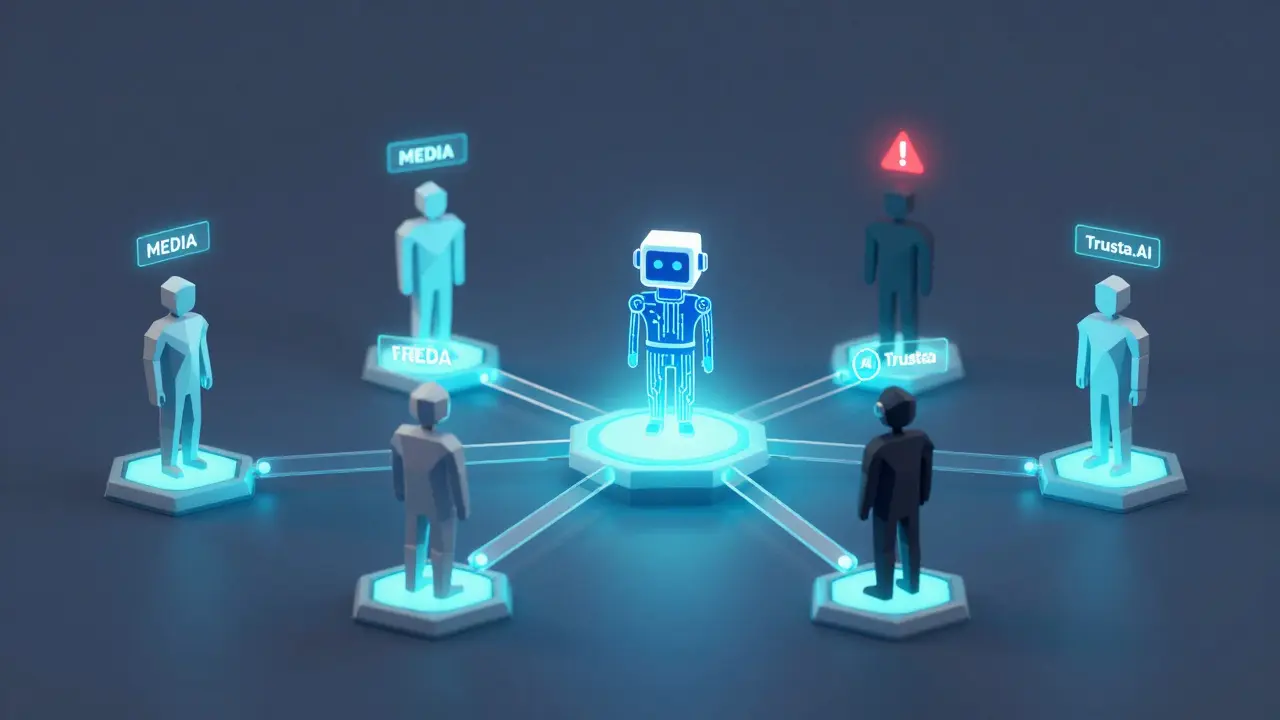
Trusta.AI (TA) isn’t just another crypto coin. It’s a blockchain identity protocol built to solve a real problem: how do you know if someone-or something-is who they say they are online? In crypto, scams, fake profiles, and fraudulent AI agents are everywhere. Trusta.AI tries to fix that by giving users and AI systems a verifiable, on-chain reputation score. Think of it like a digital ID card that gets smarter over time based on behavior, not just paperwork.
What Exactly Is Trusta.AI?
Trusta.AI is a decentralized system that verifies identities for both humans and AI agents on the blockchain. It launched in 2022, created by a team of AI and risk management experts, though no names are publicly listed. Unlike other crypto projects that focus on payments or DeFi, Trusta.AI works behind the scenes as infrastructure. Its main product? The Trusta Attestation Service (TAS). This is a public blockchain registry that stores verified identity data. When a dApp-like an NFT marketplace or DeFi platform-wants to check if a user is trustworthy, it queries the TAS. The system then returns a reputation score called a MEDIA score, generated by AI that analyzes on-chain behavior.
This isn’t just about usernames. It’s about patterns: How often does this wallet trade? Does it interact with known scam contracts? Has it been flagged before? The AI learns from these signals and builds a dynamic trust rating. For AI agents-like automated trading bots or customer service bots operating on blockchain networks-this is especially useful. Most identity systems ignore AI, but Trusta.AI was built with them in mind.
The TA Token: More Than Just a Coin
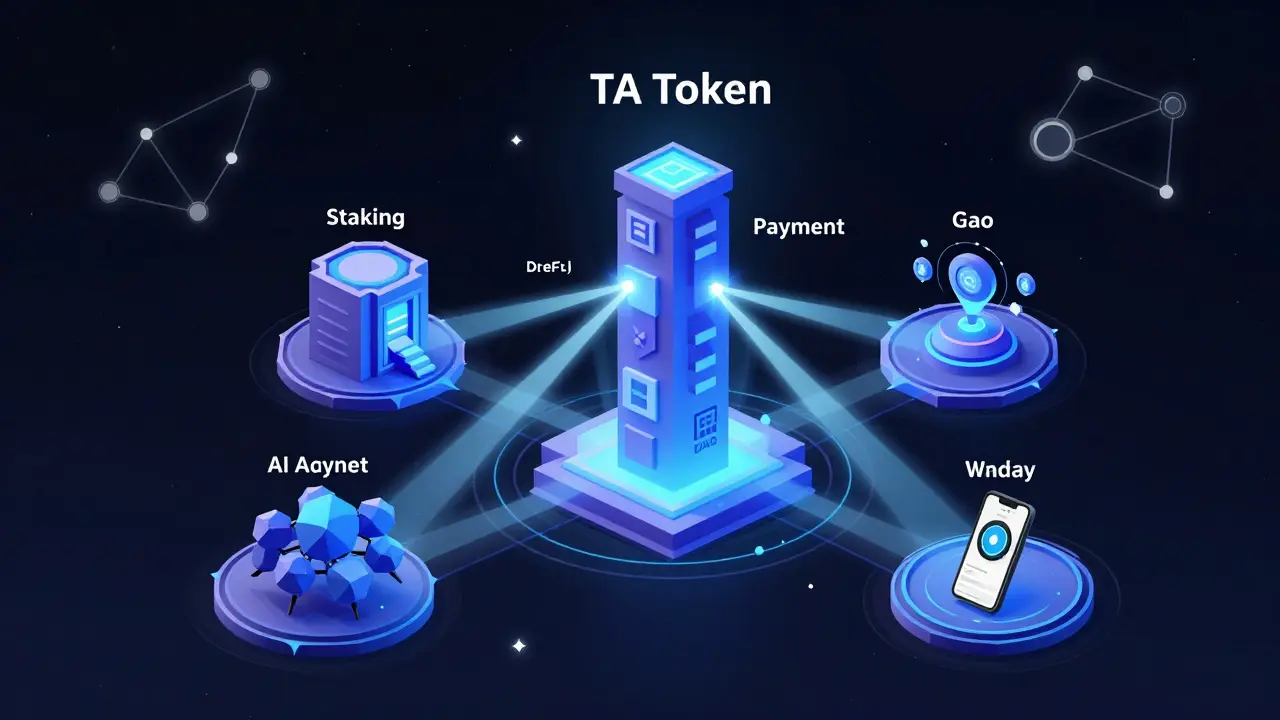
The TA token is the fuel for the entire Trusta.AI ecosystem. It’s not a speculative asset-it has four clear, technical uses:
- Staking for services: Providers who offer identity verification or reputation scoring must lock up TA tokens as collateral. This ensures they have skin in the game-if they lie or mess up, they lose their stake.
- Payment for services: Users pay TA tokens to access APIs, get verified, or unlock premium reputation features. The cost varies depending on how complex the check is.
- Governance voting: TA holders vote on protocol upgrades, fee changes, and new features. The more tokens you hold, the more voting power you have.
- Future gas token: Trusta.AI plans to make TA the native token for transaction fees on its own blockchain network. Right now, it runs on Arbitrum (an EVM-compatible chain), but once its mainnet launches, users will pay gas in TA.
There are 1 billion TA tokens total. As of November 2025, around 217 million are in circulation, according to Coinpedia. The rest are locked in team, treasury, or future incentive pools. The token trades at roughly $0.029, giving it a market cap of about $9.18 million. That’s tiny compared to giants like Civic or Ontology, but it’s not about size-it’s about usefulness.
How It Compares to Other Identity Projects
There are other identity protocols out there. Civic (CVC) and Ontology (ONT) are bigger names. But here’s the difference:
| Feature | Trusta.AI (TA) | Civic (CVC) | Ontology (ONT) |
|---|---|---|---|
| Focus | Humans + AI agents | Humans only | Enterprise identity |
| Reputation System | Dynamic AI-powered MEDIA scores | Static KYC checks | Static on-chain identity |
| Blockchain | EVM (Arbitrum) | Multi-chain | Ontology chain |
| AI Agent Support | Yes | No | No |
| Market Share (2025) | 2.3% | 41.2% | 28.5% |
Civic relies on government ID uploads and static verification. Once you’re verified, that’s it. Trusta.AI’s system keeps learning. If a wallet suddenly starts sending funds to known phishing addresses, its MEDIA score drops. That’s real-time trust tracking. Ontology is strong in enterprise use cases but doesn’t touch AI agents at all. Trusta.AI fills a gap no one else is addressing.
Real-World Use Cases
Here’s where Trusta.AI actually works:
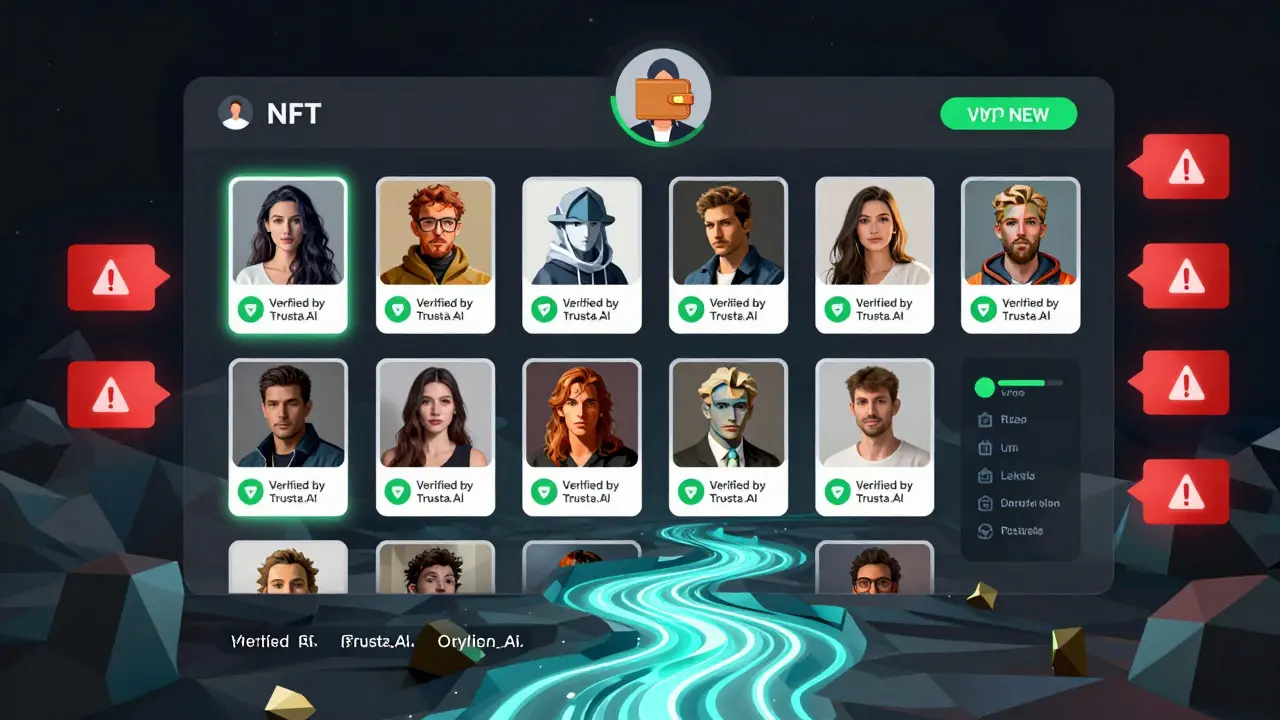
- NFT marketplaces: A seller with a high MEDIA score gets featured more. A low score? Their listings get flagged or hidden. One NFT platform reported a 63% drop in scam listings after integrating Trusta.AI.
- DeFi lending: Borrowers with strong reputation scores get better loan rates. No need for over-collateralization if the system knows you’ve never defaulted.
- AI agent marketplaces: If you’re buying an AI bot to automate your trading, you want to know it’s not a scam. Trusta.AI verifies the bot’s identity and past performance.
- DAO governance: Prevents sybil attacks. One person can’t create 100 fake wallets to vote. Each identity is tied to a verifiable MEDIA score.
By November 2025, 17 new projects integrated Trusta.AI in just three months. Most were AI-focused protocols. That’s a sign the market is starting to notice.
Why It’s Still Risky
Don’t get it twisted-Trusta.AI isn’t a sure thing. Here’s why:
- No major DeFi adoption yet: Only 8% of the top 100 DeFi protocols use it. If big players like Aave or Compound don’t adopt it, it stays niche.
- Documentation is weak: Developers say the API docs are incomplete. One GitHub issue from November 2025 called it “insufficient for complex use cases.” Integration can take weeks, not days.
- Market cap is tiny: $9 million is a drop in the ocean. If the whole crypto market drops 20%, TA could easily fall below $0.01.
- Competition is coming: Ethereum might roll out EIP-725, a standard identity protocol. If that happens, Trusta.AI could become redundant.
Also, the price has been wild. It spiked to $0.067 after a partnership announcement, then crashed back to $0.029. That’s not a trend-it’s hype. Many investors bought in during the Binance Alpha listing hype and lost 80%+ of their money.
What’s Next for Trusta.AI?
The roadmap is clear, and it’s ambitious:
- Q1 2026: Support for non-EVM chains like Solana and Polygon. Right now, it’s stuck on Arbitrum.
- Q2 2026: Zero-knowledge proofs for AI agent verification. This means proving identity without exposing private data.
- Q3 2026: Mobile SDK for on-the-go identity checks. Imagine scanning your face to verify your wallet in seconds.
Plus, the EU’s new AI Act (effective January 2026) requires verifiable identities for AI agents interacting with financial systems. Trusta.AI could be one of the few compliant solutions. That’s a massive regulatory tailwind.
Should You Care About TA?
If you’re a trader looking for the next 10x coin? Probably not. The token’s value is tied to adoption, not speculation. If you’re a developer building on blockchain? Then yes. Trusta.AI solves a real problem. It’s not flashy, but it’s necessary.
Early adopters are seeing results. One developer reported a 41% drop in fraudulent transactions after using its reputation system. That’s not theory-it’s real money saved.
But here’s the bottom line: Trusta.AI’s success depends entirely on whether big projects start using it. Right now, it’s a brilliant idea waiting for a breakthrough. If it gets picked up by even one major DeFi platform or AI marketplace, everything changes. Until then, it’s a high-risk, high-reward bet on the future of trust in Web3.
Is Trusta.AI (TA) a good investment?
It depends on your goals. If you’re looking for short-term gains, TA is too volatile and lacks broad adoption. Its price swings on hype, not fundamentals. If you believe in AI-driven identity as the future of Web3, then TA is a speculative bet on infrastructure. It’s not a stock-it’s a utility token. Only invest what you can afford to lose.
Can I use Trusta.AI as a regular user?
Not directly. Trusta.AI isn’t a wallet or app you download. It’s a backend system used by other platforms-like NFT marketplaces or DeFi apps. If you’re using a dApp that integrates Trusta.AI, you’ll see a "Verified by Trusta.AI" badge or be asked to complete a quick reputation check. You don’t need to hold TA to use it, but you might pay a small fee in TA for verification.
How does the MEDIA score work?
The MEDIA score is an AI-generated trust rating based on on-chain behavior. It looks at transaction history, contract interactions, wallet age, frequency of use, and whether the wallet has been flagged for scams. Unlike static KYC (which just checks your ID), MEDIA scores update in real time. A wallet that suddenly starts sending funds to phishing contracts will see its score drop. A wallet that consistently interacts with trusted protocols will climb. It’s reputation, not identity.
Why does Trusta.AI focus on AI agents?
Most identity systems ignore AI agents-like automated trading bots or customer service bots running on blockchain. But these agents are becoming common in DeFi, NFTs, and DAOs. Without a way to verify them, scammers can deploy fake bots to steal funds. Trusta.AI gives each AI agent a unique, verifiable identity and reputation score. This stops fraud before it starts.
Is Trusta.AI only on Ethereum?
No. Currently, it runs on Arbitrum, which is EVM-compatible. That means it works with Ethereum, Polygon, BNB Chain, and others that use the same virtual machine. But its roadmap includes adding support for non-EVM chains like Solana and Aptos in 2026. So it’s not locked to Ethereum.
Steph Andrews
March 17, 2026 AT 03:08Prakash Patel
March 17, 2026 AT 21:02Zachary N
March 19, 2026 AT 17:21Anastasia Thyroff
March 21, 2026 AT 05:43Derek Lynch
March 22, 2026 AT 22:16Katrina Smith
March 24, 2026 AT 14:24Marie Vernon
March 25, 2026 AT 06:57Arlene Miles
March 25, 2026 AT 11:20Jessica Beadle
March 26, 2026 AT 19:18Tony Weaver
March 27, 2026 AT 23:26Patty Atima
March 29, 2026 AT 08:46Lucy de Gruchy
March 29, 2026 AT 11:11Lauren J. Walter
March 30, 2026 AT 09:47Carol Lueneburg
March 31, 2026 AT 17:01Tobias Wriedt
March 31, 2026 AT 18:48S F
April 1, 2026 AT 23:04Angelica Stovall
April 3, 2026 AT 00:04Taylor Holloman.
April 3, 2026 AT 08:28sai nikhil
April 4, 2026 AT 02:04Sahithi Reddy
April 4, 2026 AT 20:55George Hutchings
April 5, 2026 AT 09:25