

What is YoCoin (YOCO)? A Deep Dive into the Token's Reality, Risks, and Status in 2026
 May, 22 2026
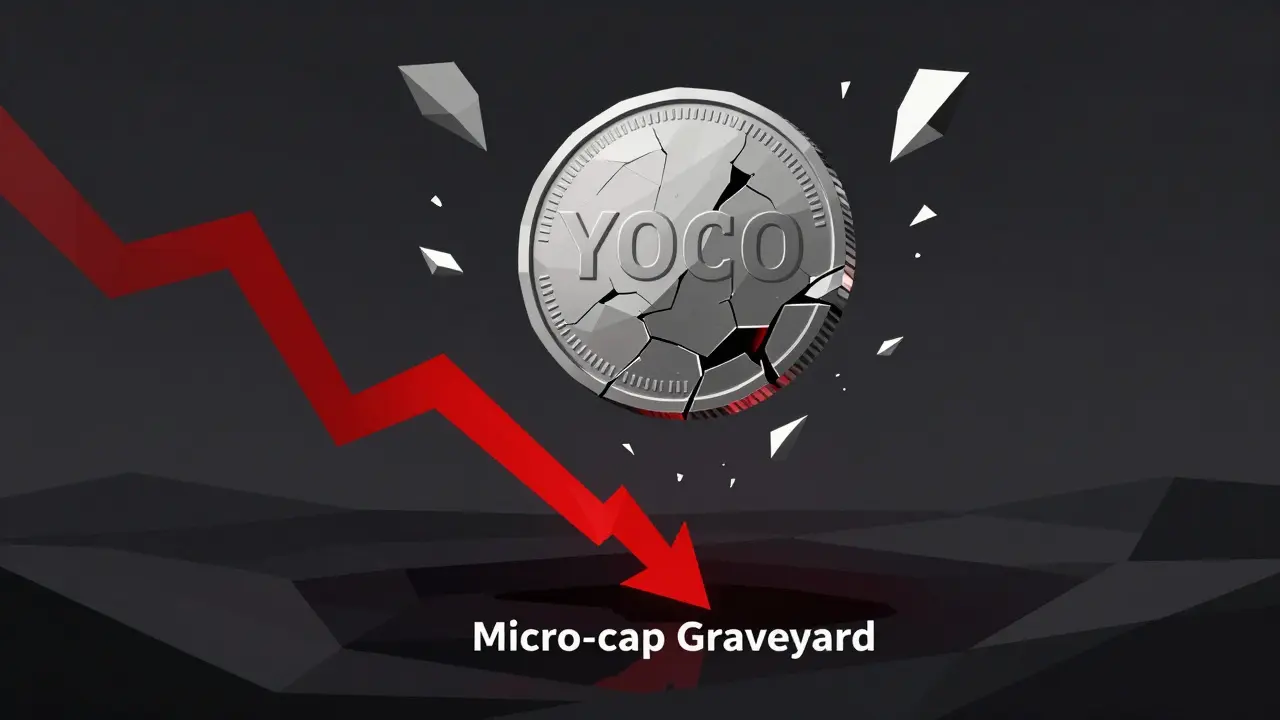
You’ve probably stumbled across YoCoin (YOCO) is a community-driven digital asset marketed as an ultra-fast global payments system. on a social media feed or a low-tier exchange list. The name sounds familiar enough, and the promise of "automatic rewards for life" is catchy. But if you are asking what this coin actually does today, the answer might surprise you. It isn’t the powerhouse payment solution it claims to be. In fact, by May 2026, YoCoin sits in the shadowy corner of the crypto market known as the micro-cap graveyard.
We need to look past the marketing slogans. When you dig into the data, you find a token that has lost over 99% of its value since its peak, trades with almost no liquidity, and lacks any real-world utility. This article breaks down exactly what YoCoin is, where it stands technically, and why you should proceed with extreme caution-or avoid it entirely.
The Basic Facts: What Is YoCoin?
At its core, YoCoin (ticker: YOCO) is a utility token built on the BNB Chain is a blockchain network that uses Proof-of-Staked-Authority consensus.. While some older records from late 2022 mistakenly listed it on Ethereum, current technical verification confirms it operates within the Binance Smart Chain ecosystem. The project launched with the tagline "YOUR coin," positioning itself as a fair-launched, 100% community-driven asset.
Here are the hard numbers you need to know right now:
- Total Supply Cap: 100,000,000 tokens.
- Circulating Supply: Approximately 96.6 million tokens.
- All-Time High (ATH): $0.055129 (reached on July 17, 2022).
- Current Price Range (Early 2026): Roughly $0.00073 - $0.00083.
- Market Capitalization: Around $69,000 - $70,000.
That price drop-from five cents to less than one-tenth of a cent-is not a minor correction. It represents a near-total collapse in investor confidence. For context, when Bitcoin dropped 50% during major bear markets, it still retained billions in market cap. YoCoin’s decline is far more severe because it never established a solid foundation to begin with.
The Broken Promise: Payments vs. Reality
YoCoin’s whitepaper and marketing materials claim it is an "ultra-fast global payments system." They promise low fees and eco-friendly transactions. Sounds great, right? But let’s look at the evidence.
To function as a payment system, a currency needs two things: merchants who accept it and users who want to spend it. As of mid-2026, YoCoin has neither. A comprehensive audit of major payment processors like BitPay and Coinbase Commerce shows zero integration with YOCO. There are no documented case studies of businesses using YoCoin for payroll, goods, or services.
Compare this to established competitors:
| Feature | YoCoin (YOCO) | XRP (Ripple) | Stellar (XLM) |
|---|---|---|---|
| Market Cap | ~$70,000 | ~$28 Billion | ~$3 Billion |
| Daily Volume | ~$47,000 | ~$500 Million+ | ~$100 Million+ |
| Merchant Adoption | None verified | Global banking partners | MoneyGram, IBM integrations |
| Liquidity Risk | Extreme (High Slippage) | Low | Low |
The gap is staggering. XRP and Stellar have billions in liquidity and institutional partnerships. YoCoin has a daily trading volume of roughly $47,000. That means if you try to sell $10,000 worth of YOCO, you could crash the price yourself because there aren’t enough buyers in the order book. This makes it useless as a payment method. You can’t pay for coffee with a coin that takes 30 minutes to sell without losing half its value.
The "Automatic Rewards" Mechanism
One of the main selling points for YoCoin was its "protocol static rewards with dynamic DeFi liquidity." Essentially, holders were promised automatic rewards just for keeping the token. This is a common tactic in micro-cap tokens to encourage people to buy and hold, hoping the price will rise due to artificial demand.
However, there is a critical flaw here. Without new money entering the system, these rewards are essentially inflationary. If everyone is getting rewarded from a fixed pool or through transaction taxes, the value per token dilutes over time unless the total market cap grows significantly. Given that YOCO’s market cap has shrunk to under $70k, the "rewards" are likely negligible fractions of a cent-hardly worth the gas fees required to interact with the BNB Chain.
Furthermore, the technical implementation of these rewards is undocumented. There are no public GitHub repositories showing active code commits for YoCoin’s smart contracts. This lack of transparency is a major red flag. In the world of decentralized finance, if you can’t see the code, you can’t trust the mechanism.
Liquidity and Trading Risks
If you are considering buying YOCO, you need to understand the concept of liquidity risk. Liquidity refers to how easily you can buy or sell an asset without affecting its price. YoCoin has extremely poor liquidity.
As of early 2026, YOCO is only traded on three decentralized exchanges (DEXs). It is not listed on any major centralized exchanges like Binance, Coinbase, or Kraken. This isolation means:
- High Slippage: Buying even a small amount can push the price up artificially, making your entry point worse than expected.
- Selling Difficulty: Trying to exit a position may result in long wait times or significant losses as you eat through the thin order books.
- Price Manipulation: With such a low market cap, a single whale holding 1% of the supply can manipulate the price chart to trigger stop-losses or create fake breakout signals.
User reports from late 2025 highlight these issues. One trader noted that a simple $10 purchase took 30 minutes to fill due to insufficient liquidity. For a token claiming to be an "ultra-fast" payment system, this is ironic and dangerous for investors.
Community and Development Status
A healthy crypto project needs an active community and continuous development. YoCoin fails on both fronts.
Social Media Presence: The Telegram group, often the hub for crypto communities, has only about 1,200 members. Of those, daily activity is minimal-just 3 to 5 messages per day. Compare this to active projects which see hundreds of discussions daily. Twitter mentions are mostly automated bot alerts rather than organic user engagement.
Development Activity: GitHub, the platform where developers host code, shows zero recent commits for YoCoin-related repositories. This suggests the project is effectively abandoned or maintained by a skeleton crew with no roadmap for future upgrades. In the fast-moving crypto industry, standing still is moving backward.
Expert Analysis:
There are no research reports from reputable firms like Messari, CoinDesk Research, or Bloomberg Intelligence covering YoCoin. The absence of professional scrutiny usually indicates that the asset lacks fundamental value. As one pseudonymous analyst noted in late 2025, "Tokens that drop 99% from ATH with no utility rarely recover. Extreme caution is warranted."

Regulatory and Environmental Concerns
While YoCoin claims to be "eco-friendly," this assertion is unverified. Since it runs on the BNB Chain, which uses a Proof-of-Staked-Authority (PoSA) consensus mechanism, it consumes energy, though less than Bitcoin’s Proof-of-Work. However, without independent audits from organizations like the Crypto Carbon Ratings Institute, these green claims remain marketing fluff.
More importantly, regulatory bodies like the SEC have issued warnings about micro-cap cryptocurrencies. Tokens with vague utility, high centralization, and aggressive reward promises often fall under securities laws. Investing in such assets carries legal risk, especially if the project turns out to be an unregistered security offering.
Should You Buy YoCoin in 2026?
Let’s be direct. From an investment perspective, YoCoin is a high-risk speculative asset with little hope of recovery. Here is why most financial advisors would tell you to stay away:
- No Utility: It doesn’t solve a problem better than existing solutions.
- No Liquidity: You might get stuck with tokens you can’t sell.
- No Development: The team appears inactive.
- Massive Decline: Recovering from a 99% loss requires a 10,000% gain, which is statistically improbable without a major catalyst (which doesn’t exist).
If you are a collector of rare, low-cap tokens for fun, you might buy a tiny amount ($5-$10) knowing you could lose it all. But do not put serious capital into YOCO. There are thousands of other projects on the BNB Chain with actual usage, active developers, and growing communities.
Is YoCoin (YOCO) a scam?
It is difficult to legally label it a "scam" without proof of intent to defraud, but it exhibits many characteristics of failed or abandoned projects. These include a 99% price drop, lack of transparent development, minimal community engagement, and no real-world utility. While it may not be a malicious hack, it is a high-risk asset that has failed to deliver on its promises.
Where can I buy YoCoin?
YoCoin is not available on major centralized exchanges like Binance or Coinbase. It can only be found on a few decentralized exchanges (DEXs) operating on the BNB Chain, such as PancakeSwap. Be aware that trading on DEXs involves higher risks, including slippage and potential interaction with unaudited smart contracts.
What is the maximum supply of YOCO?
The maximum supply of YoCoin is capped at 100,000,000 tokens. As of early 2026, approximately 96.6 million tokens are in circulation, meaning most of the supply is already distributed.
Does YoCoin have any real-world use cases?
Currently, no. Despite marketing claims of being a global payment system, there is no evidence of merchant adoption, integration with payment processors, or practical utility beyond speculative trading. Its low liquidity makes it unsuitable for actual transactions.
Will YoCoin price go back up?
Historically, tokens that drop 99% from their all-time high with no underlying utility rarely recover. Without new features, partnerships, or a surge in genuine user interest, the likelihood of YOCO returning to its 2022 highs is extremely low. Most analysts view it as a dead-end investment.