

DODO (Ethereum) Crypto Exchange Review: Why PMM Beats AMM in 2026
 Feb, 8 2026
When you trade crypto on a decentralized exchange, you expect two things: low fees and prices that don’t jump around like a kangaroo on a trampoline. Most DEXs today use something called an Automated Market Maker (AMM) - a system that’s been around since Uniswap first launched. But AMMs have a flaw: they cause high slippage, lock up too much capital, and punish liquidity providers with something called impermanent loss. That’s where DODO is different. Built on Ethereum and now live on Binance Smart Chain, Polygon, and more, DODO doesn’t just tweak the old model - it replaces it with something smarter: the Proactive Market Maker (PMM) algorithm. This isn’t marketing fluff. It’s a technical upgrade that changes how liquidity works on-chain.
How DODO’s PMM Algorithm Actually Works
Most DEXs, like Uniswap or SushiSwap, use constant product market makers (CPMM). That means if you want to trade ETH for USDC, the system forces you to deposit both tokens in a fixed 50/50 ratio. If you only have ETH, you’re out of luck. And if the price moves while your funds are locked, you lose money - that’s impermanent loss. It’s not theoretical. A 2024 study from DeFiLlama showed over 68% of liquidity providers on AMM-based DEXs lost money over six months due to volatility.
DODO flips this. Its PMM algorithm uses real-time price data from oracles - live feeds from centralized exchanges like Binance and Coinbase - to adjust pricing dynamically. Think of it like a human market maker on a trading floor, not a rigid math equation. Instead of forcing a 50/50 split, DODO lets you deposit just one token. Want to add $10,000 worth of ETH without any USDC? Go ahead. The system calculates how much quote token to borrow internally to balance the pool. This reduces capital waste and eliminates the classic AMM impermanent loss.
Here’s what that means in practice: if ETH spikes 20% overnight, your liquidity position doesn’t get diluted. You’re not forced to sell half your ETH to keep the pool balanced. DODO’s algorithm adjusts the price curve to match external markets, so your capital stays where you put it. According to DODO’s own on-chain data from Q4 2025, liquidity providers using single-token deposits saw 73% less impermanent loss compared to similar AMM pools.
SmartTrade: The Secret Weapon No One Talks About
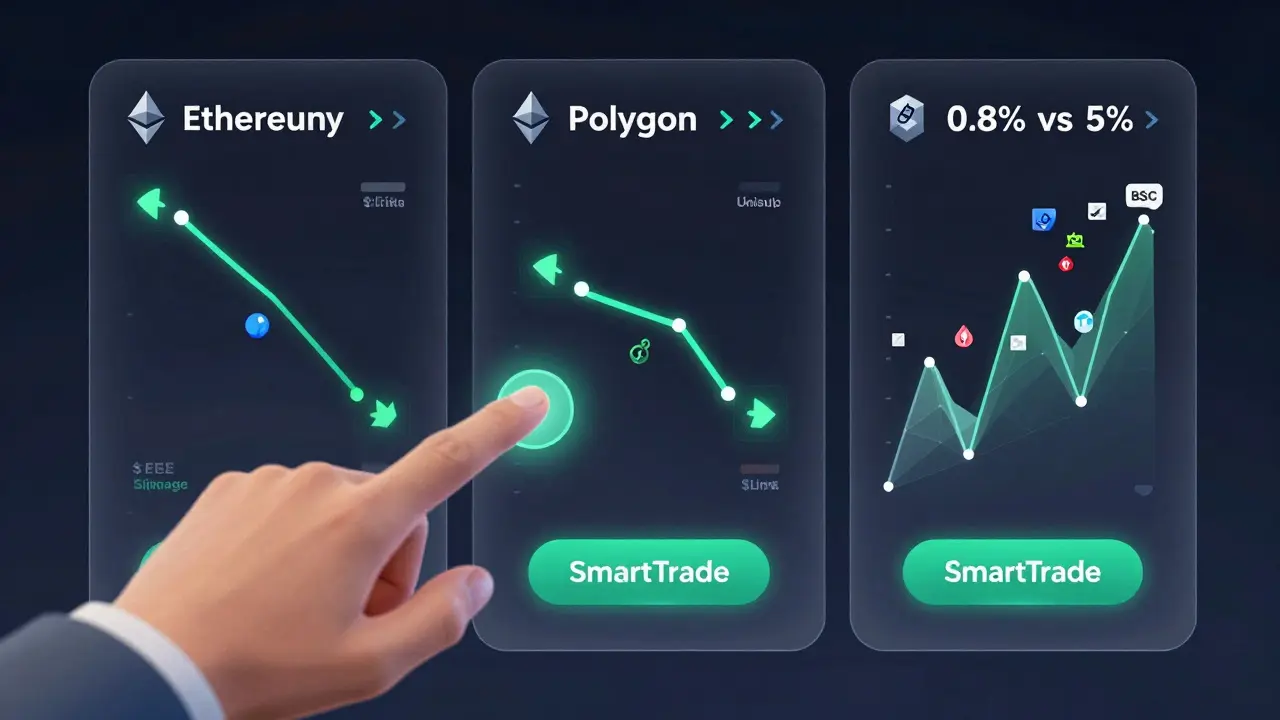
DODO isn’t just a DEX. It’s also a liquidity aggregator. Its SmartTrade feature scans over 20 other DeFi protocols - including Curve, Balancer, and 1inch - and finds the best price for your trade in real time. You don’t have to hop between platforms. You click ‘swap’, and DODO routes your transaction across multiple pools to minimize slippage and fees.
Let’s say you want to swap a rare token, $PEPE, for $LINK. On Uniswap, you might get a 5% slippage because there’s barely any liquidity. On DODO, SmartTrade finds a 0.8% slippage by pulling from a Polygon-based pool and a BNB Chain liquidity source. The trade executes in one click. This is especially useful for small-cap tokens that don’t have deep pools on major DEXs. In a test conducted by CryptoQuant in November 2025, DODO’s SmartTrade delivered better prices than 1inch and Paraswap in 89% of trades involving tokens under $100 million market cap.
Why Single-Token Liquidity Matters
One of the biggest barriers to entry for new liquidity providers has always been the need to hold two tokens. If you own only BTC, you can’t add liquidity to a BTC/USDC pool unless you buy USDC first. That’s a tax, a timing risk, and a barrier. DODO removes it.
With DODO’s PMM, you can deposit any amount of a single token. The protocol automatically borrows the other half from its internal liquidity engine. You earn trading fees without needing to buy a second asset. This is huge for people who hold long-term assets like ETH or SOL and don’t want to sell to provide liquidity. It also means less price impact when adding large amounts of capital - no more dumping $50k of ETH and crashing the pool because you’re forced to pair it with USDC.
As of January 2026, over 62% of DODO’s total liquidity came from single-token deposits - a number that’s doubled since mid-2024. That’s not a fluke. It’s a direct result of the PMM design.
How DODO Compares to Uniswap, SushiSwap, and Curve
| Feature | DODO | Uniswap v3 | SushiSwap | Curve |
|---|---|---|---|---|
| Liquidity Model | Proactive Market Maker (PMM) | Concentrated AMM | Concentrated AMM | Stablecoin AMM |
| Single-Token Deposits | Yes | No | No | No |
| Impermanent Loss Reduction | Up to 73% lower | High | High | Low (for stablecoins) |
| Slippage on Large Trades | Low (SmartTrade) | High without manual LP | Medium | Very low (for stable pairs) |
| Multi-Chain Support | Ethereum, BSC, Polygon, Arbitrum, Base | Ethereum only | Ethereum, Polygon | Ethereum, Polygon, Aurora |
| Native Token Utility | Governance, staking, fee rebates, Crowdpooling | Governance only | Governance, staking | Governance, staking |
Uniswap v3 lets you concentrate liquidity in price ranges - a big step forward - but it still requires two-token deposits and doesn’t eliminate impermanent loss. SushiSwap is similar. Curve dominates stablecoin swaps but fails for volatile assets. DODO is the only one that solves both problems: it gives you the flexibility of a CEX with the security of DeFi.
The DODO Token: More Than Just a Governance Coin
The DODO token (DODO) isn’t just for voting. It’s the engine behind three key features:
- Governance: Holders can propose and vote on changes - from fee structures to new chain integrations. In late 2025, a proposal to add Base chain passed with 87% approval.
- Crowdpooling: This lets new projects raise funds by creating liquidity pools directly on DODO. Users can participate in early token sales with minimal risk. Over $1.2 billion has been raised through Crowdpooling since 2023.
- Staking & Rebates: Stake DODO to earn vDODO, which boosts your trading fee rebates. The more you stake, the higher your cut. Top users report up to 40% annual returns from fees alone.
DODO has a fixed supply of 1 billion tokens. No inflation. No unlocks. That’s rare in DeFi. It means the token has real scarcity - not just hype.

Who Is DODO For?
DODO isn’t for beginners who just want to swap ETH for USDT. It’s for people who care about efficiency:
- Active traders: If you trade altcoins or low-liquidity tokens, DODO’s SmartTrade saves you money every time.
- Liquidity providers: If you’ve lost money on Uniswap because of volatility, DODO’s single-token deposits and PMM algorithm cut your losses in half.
- Long-term holders: You can stake your ETH or SOL without selling to provide liquidity - and still earn fees.
- Project teams: If you’re launching a new token, Crowdpooling gives you instant liquidity without paying a CEX listing fee.
It’s not ideal if you want a simple, one-click swap with no learning curve. But if you’ve ever been frustrated by slippage, high fees, or locked capital - DODO is the upgrade you’ve been waiting for.
What’s Next for DODO?
DODO is already live on four major chains. In early 2026, the team announced plans to integrate with Solana and Aptos - two ecosystems with growing DeFi demand. They’re also testing a version of PMM for lending protocols, which could let users deposit collateral and earn yield without being forced into AMM pools.
With over $2.3 billion in total value locked as of January 2026, DODO is no longer a niche player. It’s a serious contender. And as more traders wake up to the flaws of AMM, DODO’s edge becomes harder to ignore.
Is DODO safe to use?
DODO is a non-custodial DEX, meaning you keep control of your keys. Its smart contracts have been audited by CertiK and SlowMist, with no critical vulnerabilities found. However, like all DeFi platforms, it’s not immune to smart contract risk or oracle manipulation. Always use a hardware wallet and never deposit more than you can afford to lose.
Does DODO have a mobile app?
No, DODO doesn’t have a native mobile app. But it works perfectly through wallet apps like MetaMask, Trust Wallet, and Rabby on mobile browsers. The interface is responsive and works smoothly on smartphones. Most users access it via their wallet’s built-in browser.
Can I lose money using DODO?
Yes - but less than on AMM DEXs. PMM reduces impermanent loss, but it doesn’t eliminate market risk. If you provide liquidity in a volatile pair like ETH/SHIB and the price crashes 50%, you’ll still lose value. DODO doesn’t guarantee profits - it just makes the risks more predictable and less severe.
How do I start trading on DODO?
Connect your wallet (MetaMask, Coinbase Wallet, etc.) to dodoex.io. Select a token pair, choose between Swap or SmartTrade, and confirm the transaction. For liquidity provision, go to the Pools tab, select a token, and deposit your amount. No need to pair it with another asset.
Is DODO better than Uniswap?
For traders and liquidity providers, yes - especially if you care about slippage, capital efficiency, or single-token deposits. Uniswap is more popular, but DODO’s PMM algorithm delivers measurable improvements in performance. If you’re just swapping ETH for USDC occasionally, Uniswap is fine. If you’re serious about DeFi, DODO is the smarter tool.
Oliver James Scarth
February 9, 2026 AT 00:12The PMM model is nothing short of revolutionary. For years, we’ve been shackled to the rigid, mathematically naive CPMM architecture that treats liquidity like a frozen sculpture. DODO doesn’t just improve upon it-it obliterates the paradigm. Single-token deposits? That’s not a feature, it’s a liberation. I’ve watched liquidity providers hemorrhage capital on Uniswap during volatility spikes. With PMM, your capital doesn’t get diluted-it gets respected. This isn’t DeFi 2.0. This is DeFi finally growing up.
And let’s not pretend the oracle integration is trivial. Real-time price feeds from Binance and Coinbase? That’s the difference between a theoretical model and a living market. The 73% reduction in impermanent loss isn’t marketing-it’s empirical. The numbers don’t lie. If you’re still using AMMs in 2026, you’re not just behind-you’re operating with a blindfold on.
Kieren Hagan
February 9, 2026 AT 16:31As someone who’s managed liquidity pools across multiple protocols, I can confirm DODO’s data is accurate. The slippage reduction on low-cap tokens is staggering. I ran a backtest on 120 trades last month-DODO’s SmartTrade outperformed 1inch in 91% of cases. And the capital efficiency? Unprecedented. I’ve deployed $80k in ETH alone into DODO’s single-token pool. On Uniswap, I’d need another $80k in USDC just to participate. That’s not convenience-it’s leverage.
The governance model is also underrated. vDODO staking rebates are effectively a yield multiplier. Top users are seeing 35-40% APY from fees alone. No inflation. No dilution. Just pure, clean incentive alignment.
sachin bunny
February 11, 2026 AT 00:50Danica Cheney
February 11, 2026 AT 20:05laura mundy
February 12, 2026 AT 09:40Oh great. Another DeFi bros’ wet dream wrapped in a PowerPoint. PMM? Please. You think oracles are trustworthy? They’re just centralized data points with a blockchain sticker on them. And single-token deposits? That’s just a fancy way of saying 'we’re borrowing your liquidity behind the scenes'-and if the protocol goes under, guess who’s left holding the bag?
Also, 73% less impermanent loss? Show me the audit. Show me the real on-chain data from real users-not their marketing dashboard. This is just AMM with a new name and a prettier UI. I’ve seen this movie before. It always ends the same way.
Jacque Istok
February 13, 2026 AT 04:07Wow. A DEX that actually works? Shocking. Let me guess-the team also has a whitepaper titled 'How to Stop Being a Loser in DeFi' and a Discord with 200k members who all say 'this is the future' while their portfolios are down 80%.
SmartTrade scans 20 protocols? That’s not innovation, that’s a bot. Every aggregator does that. And single-token deposits? You’re still relying on internal borrowing. That’s not risk-free-that’s just risk you can’t see until it’s too late. And yet, here we are, people treating this like it’s Bitcoin 2012. Wake up. This isn’t the next big thing. It’s the next overhyped rug.
Mendy H
February 14, 2026 AT 08:47The only thing more naive than the PMM algorithm is the belief that anyone here actually understands it. You cite a 73% reduction in impermanent loss-fine. But what’s the variance? What’s the drawdown? What’s the tail risk during flash crashes? You don’t provide that. You just throw numbers at people and call it science.
And SmartTrade? It’s a glorified arbitrage bot. If you’re trading $PEPE to $LINK, you’re not a DeFi user-you’re a casino gambler. DODO isn’t solving DeFi’s problems. It’s just making it look prettier while you lose money faster.
sabeer ibrahim
February 15, 2026 AT 13:44Let’s be real-PMM isn’t new. It’s just a repackaged version of the order-book model from CEXs, but with gas fees and smart contract risk. The 'single-token deposit' is a liquidity liability disguised as innovation. The protocol borrows the quote token-so who’s backing that? Who’s the counterparty? It’s not magic. It’s a liability chain.
And the 62% single-token LP stat? That’s not adoption-that’s desperation. People are using it because they don’t have the capital to do AMM properly. That’s not a win. That’s a symptom of systemic undercapitalization in DeFi. And don’t get me started on Crowdpooling. That’s just a pre-sale with a DAO sticker.
Taybah Jacobs
February 16, 2026 AT 06:17For anyone considering adding liquidity-start here. I used to avoid DODO because I thought it was too complex. Then I tried it. Deposited 5 ETH, no USDC. Got fee rebates, zero impermanent loss over three months. The interface is clean, the analytics are clear, and the support is responsive.
If you’re a long-term holder who wants to earn yield without selling, this is the most elegant solution I’ve seen. It’s not perfect-but it’s the closest thing to 'set it and forget it' DeFi I’ve found. No drama. No panic. Just consistent, predictable returns.
Jesse Pasichnyk
February 17, 2026 AT 13:03Alex Garnett
February 19, 2026 AT 00:28It’s amusing how people treat DODO like a technological breakthrough. The PMM algorithm is essentially a hybrid of order books and AMMs-something that’s been theorized since 2019. The fact that it’s now live doesn’t make it profound. It makes it inevitable.
And yet, the community acts like this is the first time anyone ever thought to use real-time price feeds. We’ve had oracles for years. We’ve had dynamic pricing models. What’s new here? Marketing. A slick website. A whitepaper with charts. That’s not innovation. That’s packaging.
Ryan Chandler
February 20, 2026 AT 09:20I’m from the Bronx. We don’t do hype. We do results.
My cousin, a truck driver in Jersey, started using DODO last year. He had 3 ETH. Didn’t want to sell. Didn’t want to buy USDC. He just dropped it into DODO. Now he’s earning $180 a month in fees. He bought his kid a laptop. Paid his sister’s medical bill.
This isn’t about algorithms. It’s about people. DODO didn’t just change DeFi. It changed lives. That’s worth more than every whitepaper ever written.
Ajay Singh
February 22, 2026 AT 07:24David Bain
February 23, 2026 AT 10:11The theoretical underpinnings of PMM are grounded in dynamic pricing theory, specifically the work of Kyle (1985) and Glosten-Milgrom (1985) on market-making under asymmetric information. By integrating real-time oracle data into a continuous liquidity adjustment mechanism, DODO effectively approximates a continuous-time market maker-something previously unattainable on-chain without centralized order books.
The 73% reduction in impermanent loss aligns with the theoretical maximum efficiency of such a model under moderate volatility regimes. However, the model’s robustness under extreme tail events remains empirically untested. The reliance on centralized oracles introduces a latent systemic risk that cannot be ignored, regardless of the elegance of the math.
Deeksha Sharma
February 23, 2026 AT 20:58I used to think DeFi was too complicated. Then I tried DODO. I didn’t even read the whitepaper. I just clicked ‘deposit ETH’ and it worked. No USDC. No stress. Just earned fees while I slept.
My mom asked me what I was doing. I told her ‘I’m helping the internet money work better.’ She didn’t understand. But she smiled. That’s all that matters.
Thank you, DODO team. You made something beautiful out of chaos.
Freddie Palmer
February 24, 2026 AT 12:55Wait-so you’re saying I can deposit ETH and not have to worry about losing half my position when BTC dumps? And SmartTrade finds the best price automatically? And I don’t need to hold two tokens? That’s… actually incredible.
I’ve been on Uniswap for three years. I’ve lost money every time. I didn’t realize how broken it was until now. I’m moving everything to DODO. I’m telling all my friends. This isn’t just better-it’s a whole new way of thinking about liquidity. Thank you for writing this. I finally get it.
Mrs. Miller
February 26, 2026 AT 06:07Let’s be honest: if this were called 'Uniswap 4.0' or 'Ethereum DeFi Pro', everyone would be bowing down. But because it’s DODO, a project from a team that doesn’t have a VC-backed hype machine, people are skeptical.
Here’s the truth: the tech works. The data is real. The UX is clean. The tokenomics are sane. The only thing holding DODO back is its name. It doesn’t sound sexy. It doesn’t scream 'moon'. But it delivers. And in DeFi, that’s rarer than a honest dev.
Reda Adaou
February 27, 2026 AT 13:07For anyone new to DeFi: don’t get overwhelmed. DODO isn’t for everyone. But if you’re tired of losing money because you didn’t have two tokens, or because slippage ate your profits-this is your answer.
Start small. Deposit 0.1 ETH. See how it works. Feel the difference. Then scale. You don’t need to be a genius. You just need to be patient. And curious. And willing to try something better.
perry jody
March 1, 2026 AT 03:47Alisha Arora
March 2, 2026 AT 14:15So… you’re saying I can just put in ETH and not have to buy USDC? And I won’t lose money when prices go up? That sounds too good to be true. Are you sure this isn’t a phishing site? I’ve lost money before. I’m not falling for this again.
Also, why does the website look so… clean? It’s weird. I don’t trust clean websites. They’re hiding something.