

Environmental Concerns Drive Sweden’s Strict Crypto Mining Rules
 Dec, 22 2025
Sweden isn’t banning cryptocurrency outright-but it’s making it as hard as possible to mine Bitcoin here. The reason? Energy use. Not just any energy use. Bitcoin mining is sucking up power at a scale that’s clashing with Sweden’s climate goals. Even though the country runs on mostly renewable electricity, regulators say every extra megawatt consumed by mining rigs is a step backward in the fight against climate change.
Why Sweden Cares More Than Other Countries
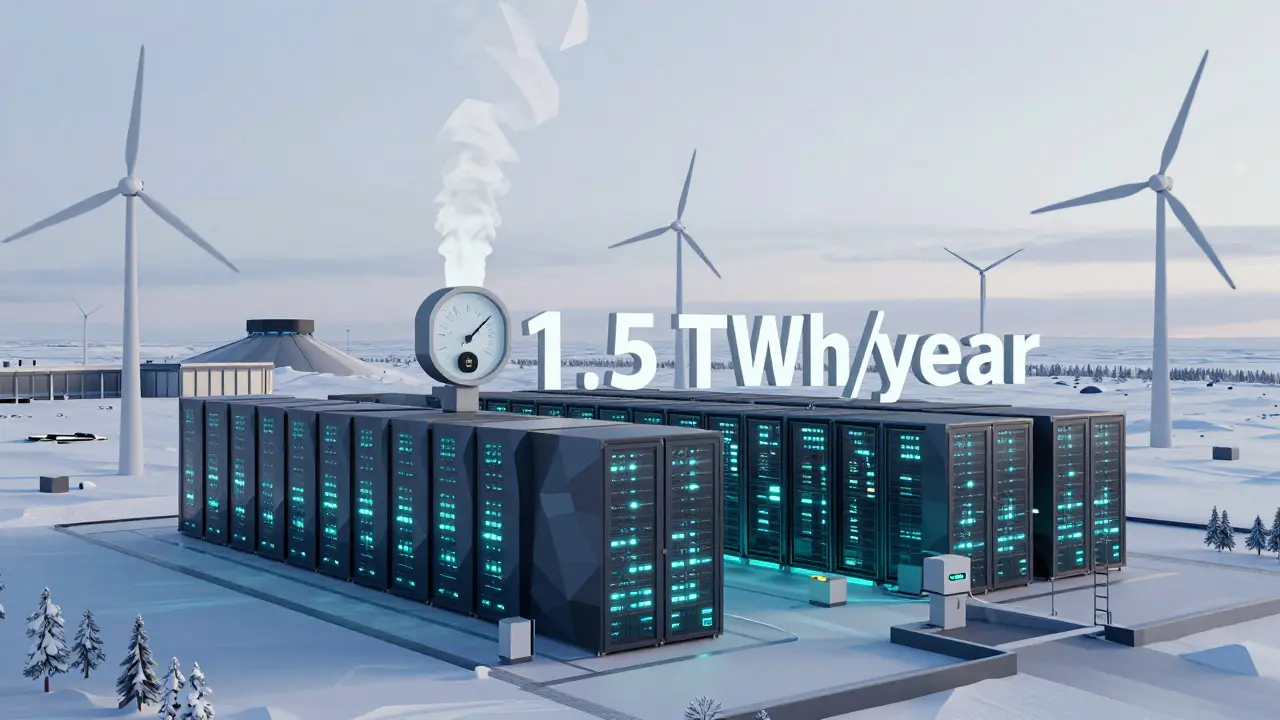
Most European nations treat crypto mining like any other business. Germany registers operators. France asks for compliance reports. Norway and Iceland welcome miners because they have cheap, clean power. Sweden? It’s different. Swedish regulators don’t care if your mining farm runs on wind or hydro. They care about how much total power it uses. And that number keeps rising. In 2022, Bitcoin mining in Sweden jumped from under 300 GWh to over 1 TWh in just four months. That’s enough electricity to power 200,000 homes. The Swedish Energy Agency confirmed this spike wasn’t temporary. Even after the initial rush, mining stayed at 1-1.5 TWh per year-equivalent to the annual output of two large nuclear reactors. Meanwhile, global Bitcoin mining now consumes 143 TWh annually, more than entire countries like Sweden and Norway combined. The Swedish Financial Supervisory Authority (FI) doesn’t mince words. Erik Thedéen, its director general, called Bitcoin’s energy use a direct contradiction of Sweden’s climate targets. He pointed out that one Bitcoin transaction uses 707 kWh. One Visa transaction? 0.0023 kWh. That’s over 300,000 times more energy.The Ban That Wasn’t
In 2023, Sweden pushed for an EU-wide ban on proof-of-work mining. The idea didn’t stick. Other countries balked. The EU’s Markets in Crypto-Assets (MiCA) regulation ended up requiring transparency-not prohibition. Miners must now disclose their environmental impact in public white papers. Sweden didn’t get its ban. But it got something almost as strict: its own law. In January 2025, Sweden passed the Crypto-Asset Environmental Transparency Act. Now, any mining operation larger than 0.5 MW must publish real-time data on energy consumption and source. No hiding. No guessing. The public can see exactly how much power your rig is using, and whether it’s coming from hydro, nuclear, or fossil backups. Local governments added their own rules. Boden caps new mining facilities at 5 MW. Kiruna demands 90% renewable energy verification. The Swedish Energy Agency even launched a 150 million SEK ($13.8 million USD) fund to help miners switch to proof-of-stake or reuse waste heat for district heating. In Luleå, a pilot project recovered 65% of the heat generated by mining rigs-enough to warm hundreds of homes.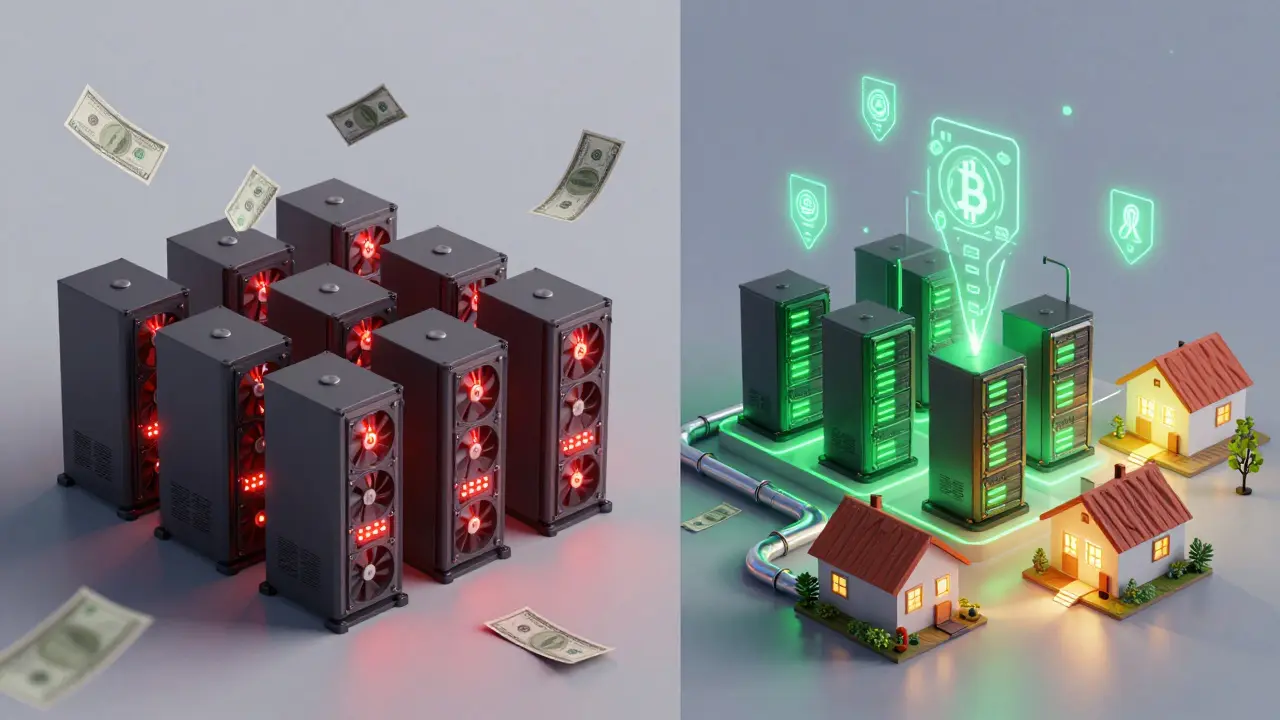
Who’s Getting Pushed Out
The pressure isn’t theoretical. Crypto businesses are leaving. A 2024 survey of 47 Swedish mining companies showed 68% plan to relocate by 2026. Norway is the top choice-42% of operators are moving there. Germany and the U.S. follow. Meanwhile, 22% are trying to switch entirely to proof-of-stake, the far less energy-intensive alternative. One Stockholm startup, EcoChain, cut its energy use by 99.95% after switching. It’s still profitable. Just not the way it used to be. Banking is another problem. Reddit users in r/Sweden report banks cutting off accounts with no explanation. One miner in Norrbotten lost access to his business account in January 2025-even though his entire operation ran on 100% hydroelectric power. The message is clear: if you’re mining Bitcoin, you’re a risk, regardless of your energy source. Trustpilot ratings for Swedish crypto exchanges have dropped from 4.2 in 2022 to 2.8 in early 2025. Complaints? Slow withdrawals, overly strict KYC, sudden limits. People aren’t just frustrated-they’re leaving.
What’s Left Standing
It’s not all doom for crypto in Sweden. The country still leads in blockchain innovation-just not the energy-hungry kind. Stockholm’s Kista Science City hosts 120 blockchain companies. Over a third of all Nordic blockchain startups are based here. But they’re not mining Bitcoin. They’re building supply chain trackers, digital identity systems, and enterprise ledgers. These use proof-of-stake or private blockchains. They don’t need massive power. They don’t need cooling towers. And Sweden supports them. The Swedish government allocated 200 million SEK ($18.4 million USD) in its 2025 budget to research waste heat reuse and low-energy consensus models. The European Central Bank is doing the same, investing 1.2 billion euros across the EU to find alternatives to proof-of-work. The shift is happening. Ethereum’s move to proof-of-stake in 2022 slashed its energy use by nearly 99.95%. That’s the future Sweden is betting on. Not more rigs. Not bigger data centers. Better tech.Is Sweden’s Approach Working?
Sweden’s crypto mining capacity has dropped 40% since 2022. Its share of the Nordic crypto market fell from 38% to 27%. In global regulatory rankings, it dropped from 12th to 23rd place. Critics say it’s killing innovation. Supporters say it’s protecting the planet. The numbers tell a story. By 2025, mining energy use is projected to fall below 0.8 TWh-down from 1.5 TWh just three years ago. That’s not because miners are getting more efficient. It’s because they’re leaving-or switching. Sweden’s model isn’t about banning technology. It’s about forcing a choice: keep using massive amounts of power, or adapt. Most miners are choosing to adapt-or go elsewhere. The country isn’t anti-blockchain. It’s anti-waste. And in a world racing toward net-zero, that’s a line more nations may soon be forced to draw.Why is Sweden targeting crypto mining when it uses renewable energy?
Sweden doesn’t care if the energy is renewable-it cares about total consumption. Even clean energy has environmental costs: land use, water for cooling, grid strain, and manufacturing impacts from building more infrastructure. Sweden’s goal is to reduce overall energy demand, not just switch sources. Adding 1.5 TWh of demand-even from wind or hydro-still contradicts its climate targets.
Is Bitcoin mining illegal in Sweden?
No, it’s not illegal. But it’s heavily regulated. Any mining operation over 0.5 MW must register with the Swedish Financial Supervisory Authority, submit quarterly environmental reports, and publish real-time energy data. Many banks now refuse to serve miners, making operations harder to run.
What’s the difference between proof-of-work and proof-of-stake?
Proof-of-work requires miners to solve complex math problems using powerful computers, consuming huge amounts of electricity. Proof-of-stake selects validators based on how much cryptocurrency they hold and are willing to "stake" as collateral. It uses less than 0.1% of the energy. Ethereum switched to proof-of-stake in 2022 and cut its energy use by 99.95%.
Can I still mine crypto in Sweden legally?
Yes, but only under strict conditions. You must register with the Financial Supervisory Authority, prove your energy source, report consumption quarterly, and keep your facility under local municipal caps. Most small-scale miners have shut down or moved. Large operations are either switching to proof-of-stake or relocating to Norway or the U.S.
Why are Swedish banks refusing to serve crypto miners?
Banks are following guidance from the Swedish Financial Supervisory Authority, which classifies crypto mining as a high-risk activity due to its environmental impact and potential for money laundering. Even miners using 100% renewable power have had accounts closed without explanation. The risk of reputational damage outweighs the profit for many banks.
What’s next for Sweden’s crypto policy?
Sweden is moving away from outright bans and toward market-based tools like carbon pricing for energy-intensive crypto operations. Starting July 2025, all crypto firms must fully comply with the EU’s MiCA sustainability disclosure rules. The focus is shifting to incentivizing low-energy blockchain applications-not punishing mining. By 2027, experts predict Sweden will adopt a Switzerland-style approach: technology-neutral, outcome-focused, but still environmentally strict.
Rishav Ranjan
December 23, 2025 AT 17:43Sweden’s just being extra.
Dusty Rogers
December 24, 2025 AT 11:13I get it. Even renewable energy has a footprint. Building wind turbines, maintaining grids, cooling rigs-it all adds up. Sweden’s not anti-tech, they’re anti-waste. And honestly? That’s smarter than pretending green energy means zero cost.
Melissa Black
December 25, 2025 AT 23:28The energy intensity of proof-of-work is a systemic externality. It externalizes planetary costs onto future generations while internalizing profit. This isn't regulation-it's restitution. The metric isn't source-it's scale. And scale is the problem.
Mmathapelo Ndlovu
December 26, 2025 AT 19:28I love how Sweden’s not banning it but making it *hard* to be irresponsible 😊. Like, if you wanna use that much power, prove it’s worth it. And hey-heat reuse? That’s genius 🌍🔥
Tyler Porter
December 27, 2025 AT 09:31Look, I’m not against crypto, but come on. 707 kWh for one transaction? That’s insane. And banks cutting people off? Honestly, I don’t blame them. It’s just too risky. Too messy. Too much trouble.
Steve B
December 28, 2025 AT 18:37One must question the underlying assumption that environmental stewardship is the sole criterion for technological legitimacy. Is not economic sovereignty also a moral imperative? Sweden’s policy, while well-intentioned, may inadvertently reinforce a technocratic hegemony.
Brian Martitsch
December 30, 2025 AT 11:33Bitcoin miners are digital coal barons. Get over it. If you’re using that much power just to ‘secure’ a ledger, you’re not a pioneer-you’re a relic.
Rebecca F
January 1, 2026 AT 10:36They’re not banning it they’re just making it so annoying that everyone leaves and then they get to say ‘see we did it’ while sipping organic lattes in Stockholm
Lloyd Yang
January 2, 2026 AT 09:55Sweden’s doing the right thing. The rest of the world is just pretending they care about climate change. Meanwhile, mining farms are still popping up like mushrooms after rain. Someone had to draw the line.
Zavier McGuire
January 4, 2026 AT 08:28Why do people think they deserve to mine crypto like it’s a right? You want to burn power? Go live in Iceland. Don’t make the rest of us pay for your hobby.
Sybille Wernheim
January 5, 2026 AT 12:29So cool that Sweden’s turning waste heat into home heating! That’s the kind of innovation I can get behind. Tech that helps people, not just wallets 😊
Cathy Bounchareune
January 6, 2026 AT 08:09It’s wild how the same country that invented IKEA flat-pack furniture is now flat-packing the future of energy. No excess. No waste. Just smart, clean, efficient systems. I wish more places thought like this.
Jordan Renaud
January 6, 2026 AT 21:31It’s not about killing Bitcoin. It’s about making sure the future doesn’t get bought by the loudest noise. If a technology can’t exist without draining entire grids, maybe it’s not the future-it’s just a phase.
Ellen Sales
January 8, 2026 AT 16:34Sweden’s got the vibe of a librarian who just saw someone using a blowtorch to light a candle. ‘We don’t stop you… but we’re gonna stare. And take notes.’
Sheila Ayu
January 9, 2026 AT 16:53Wait, so you’re saying that if you use 100% renewable energy, you still shouldn’t mine? That’s not environmentalism-that’s moralizing under the guise of policy. What’s next? Banning solar panels because they take up space?