

FATF Blacklist: Why Iran, North Korea, and Myanmar Are Banned from Crypto Markets
 Dec, 14 2025
FATF Blacklist Transaction Risk Checker
Transaction Risk Assessment Tool
Check if your crypto transaction poses a risk related to FATF blacklisted countries: Iran, North Korea, and Myanmar.
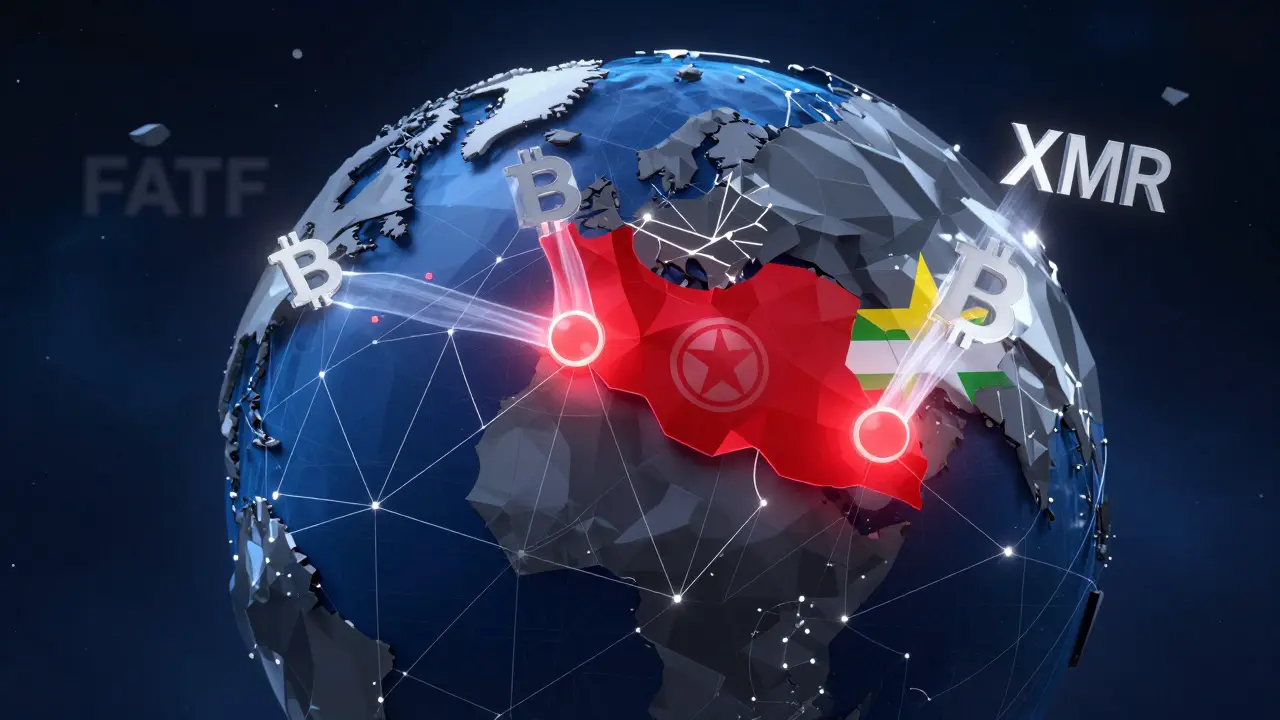
When you hear about crypto being used for illegal activity, it’s not just random hackers or shady dark web markets. The biggest threats come from three countries officially blacklisted by the global financial watchdog: Iran, North Korea, and Myanmar. These aren’t just vague warnings-they’re active, state-backed operations moving billions in cryptocurrency every year, bypassing sanctions, and draining exchanges dry.
What the FATF Blacklist Actually Means
The Financial Action Task Force (FATF) isn’t a law enforcement agency. It doesn’t arrest anyone. But it holds the power to tell every bank, exchange, and financial institution in the world: “Don’t do business with these places.” As of June 2025, only three countries sit on its highest-risk blacklist: Iran, North Korea, and Myanmar. That’s it. Out of nearly 200 nations, these are the only ones deemed too dangerous to engage with financially. For Iran and North Korea, FATF doesn’t just ask for caution-it demands countermeasures. That means banks must treat transactions to or from these countries as high-risk by default. Many have cut off access entirely. For Myanmar, the rules are slightly less strict, but financial institutions still need to apply extra scrutiny-doubling down on identity checks and transaction monitoring. The reason? Cryptocurrency has become the new weapon of choice for sanctioned regimes. It’s fast, borderless, and hard to trace. And these three countries are using it to survive, fund weapons programs, and bypass international isolation.North Korea: The World’s Most Dangerous Crypto Hacker
North Korea doesn’t just use crypto-it runs a state-sponsored hacking empire built around it. The regime’s Lazarus Group, backed by its military intelligence unit, has stolen more than $3 billion in cryptocurrency since 2017. In February 2025 alone, they pulled off the largest single heist in crypto history: $1.5 billion from ByBit, one of the world’s top exchanges. This isn’t a one-time hack. It’s a systematic operation. North Korean hackers target exchange employees, exploit software vulnerabilities, and even create fake crypto projects to lure investors. They then launder the stolen funds through mixers, decentralized exchanges, and privacy coins like Monero to erase the trail. Chainalysis data shows that in 2024, sanctioned countries received $15.8 billion in crypto-almost 40% of all illicit crypto transactions globally. North Korea accounted for more than half of that. Their cyber units now operate like Wall Street hedge funds, with dedicated teams analyzing market trends, timing thefts, and optimizing money flows. The U.S. Treasury has responded by freezing over 13 crypto addresses linked to North Korean entities in 2024-the second-highest number in seven years. But the damage is already done. The regime uses these funds to buy missile parts, pay spies, and fund its nuclear program. Crypto isn’t just a side hustle for Pyongyang-it’s a lifeline.Iran: Crypto as a Survival Tool
Iran’s situation is different. There’s no evidence of state-run hacking like North Korea’s. Instead, Iranians are turning to crypto because they have no other choice. Decades of U.S. and EU sanctions have crippled Iran’s banking system. Foreign banks refuse to process transactions. Domestic banks are frozen. Inflation hit 50% in 2024. The rial lost 80% of its value since 2020. So millions of Iranians are using Bitcoin and stablecoins to buy food, send money to family abroad, and protect their savings. Iranian exchanges like Hamyar and Parsian saw transaction volumes jump 300% in 2024. People aren’t speculating-they’re fleeing. A single seed phrase can hold a lifetime’s savings. No bank can seize it. No government can block it. If you need to leave the country, you don’t need a passport-you need your private key. But here’s the catch: while most Iranians use crypto for survival, the regime has quietly exploited the same system. The Islamic Revolutionary Guard Corps (IRGC) runs its own crypto mining operations and uses peer-to-peer platforms to sell oil for Bitcoin. The Iranian government even created its own digital currency, the e-rial, but it’s useless outside the country. Crypto, in contrast, works everywhere. The U.S. has cracked down on Iranian crypto addresses, but enforcement is messy. When a regular citizen sends $500 in USDT to a relative in Turkey, is that terrorism financing-or a mother feeding her child? The line is blurry. That’s why FATF is caught between two goals: stopping criminals and protecting ordinary people.
Myanmar: A Military Junta’s Digital Cash Machine
Myanmar’s case is the quietest but no less dangerous. After the 2021 military coup, the junta lost access to international banking. So they turned to crypto. Unlike North Korea, they’re not hacking exchanges. Instead, they’re using crypto to launder money from illegal timber, jade, and drug trafficking. The military controls mining farms in remote regions, running them on stolen electricity. They use local crypto traders as middlemen, converting illicit cash into Bitcoin or Ethereum. Then they move it out through neighboring countries like Thailand and Laos, where regulations are weak. FATF doesn’t call for full countermeasures against Myanmar yet-because the country’s financial system is still too small to trigger global panic. But the risk is growing fast. In 2024, crypto inflows into Myanmar jumped 220% year-over-year. Local exchanges are now required to collect KYC data, but enforcement is spotty. Many operate under the radar, funded by military-linked investors. The international community is watching. The U.S. and EU have started designating Myanmar-based crypto platforms as sanctions targets. But without a functioning central bank or transparent financial system, it’s like trying to plug a leak with duct tape.Why the World Can’t Ignore This Anymore
The problem isn’t just these three countries. It’s the global system that lets them slip through. As of April 2024, 75% of countries in the FATF network were either noncompliant or only partially compliant with rules for regulating crypto exchanges. That means most places don’t even know who their customers are. Mixers, privacy coins, and decentralized platforms make it easy to hide. A hacker in North Korea can send $100 million to a mixer in Turkey, then split it into thousands of tiny transfers to wallets in Nigeria, Indonesia, and Colombia-all before anyone notices. The U.S. Financial Crimes Enforcement Network (FinCEN) has tried to close the gaps. They’ve proposed designating crypto mixing services like Huione as primary money laundering threats. They’ve trained police forces in Southeast Asia to track crypto flows. But without global cooperation, it’s a losing battle. Meanwhile, Bitcoin’s design makes it perfect for this chaos. It doesn’t need a bank. It doesn’t need permission. It just needs an internet connection. That’s why, in war zones, economic collapses, and police states, it’s becoming the default financial system.
What This Means for You
If you’re a regular crypto user, you might wonder: “Does this affect me?” Yes. Many exchanges now block users from Iran, North Korea, and Myanmar entirely. If you’re using a wallet that’s ever interacted with a blacklisted address-even accidentally-you could get flagged. Your account might be frozen. Your funds could be locked. Even if you’re not in those countries, you’re still part of the system. Every time you trade on a platform that doesn’t check for sanctions, you’re helping the cycle continue. The same tools that give people in Iran freedom also give North Korea weapons. The solution isn’t to ban crypto. It’s to fix the system. Exchanges need better screening. Regulators need real-time data sharing. Countries need to stop treating crypto as a loophole and start treating it as a financial infrastructure. Until then, the FATF blacklist will stay the same: three countries, one message. Crypto isn’t the problem. The lack of global rules is.What’s Next?
FATF’s next review is in October 2025. The British Virgin Islands and Bolivia were added to the “increased monitoring” list this year. Croatia, Mali, and Tanzania were removed. That’s progress-but Iran, North Korea, and Myanmar remain unchanged. The pressure is mounting. The U.S. is pushing for mandatory crypto transaction reporting across all member states. The EU is drafting rules to require real-time monitoring of wallet-to-wallet transfers. China is exploring blockchain-based sanctions tracking. But without buy-in from every country-even the ones with weak institutions-these efforts will keep failing. The truth? Crypto is here to stay. The question isn’t whether we should regulate it. It’s whether we’re smart enough to do it before it’s too late.Why are Iran, North Korea, and Myanmar still on the FATF blacklist?
They remain on the list because they’ve failed to meet international anti-money laundering and counter-terrorism financing standards. Iran and North Korea are under active countermeasures due to state-backed crypto theft and sanctions evasion. Myanmar is under enhanced scrutiny for military-linked crypto laundering. All three lack transparent financial systems and have been given years to reform without full compliance.
Can I still use crypto if I live in one of these countries?
Technically, yes-but it’s risky. Most global exchanges block users from these countries. Local exchanges may still work, but they’re often unregulated and vulnerable to shutdowns. If you’re using crypto for personal survival (like sending money or saving against inflation), you’re not breaking the law-but you’re operating in a legal gray zone. Be aware that your transactions could be flagged, and your funds could be frozen if you later move to a regulated jurisdiction.
Is Bitcoin illegal in these countries?
No, Bitcoin isn’t officially banned in Iran, North Korea, or Myanmar. In fact, it’s widely used. Iran’s government doesn’t outlaw crypto-it just doesn’t regulate it properly. North Korea uses it to fund its weapons program. Myanmar’s military exploits it to launder drug money. The issue isn’t legality-it’s control. These governments don’t want outside oversight of their financial flows, so they tolerate crypto even as they abuse it.
How much crypto has North Korea stolen?
According to Chainalysis and U.S. Treasury reports, North Korea’s cyber units have stolen over $3 billion in cryptocurrency since 2017. The largest single theft was $1.5 billion from ByBit in February 2025. Their operations are now highly organized, with teams dedicated to finding vulnerabilities, executing hacks, and laundering funds through mixers and privacy coins.
Are crypto mixers legal?
In most countries, crypto mixers are either banned or heavily restricted because they’re used to hide the origin of funds. The U.S. FinCEN has targeted major mixers like Huione as primary money laundering threats. While some argue mixers protect privacy, regulators say they enable criminals-especially state actors-to launder stolen crypto. Using a mixer to hide funds from sanctioned countries is a direct violation of international sanctions.
What happens if I accidentally send crypto to a blacklisted address?
If you accidentally send crypto to a blacklisted address, your transaction will likely be flagged by your exchange or wallet provider. Your account may be frozen while they investigate. In some cases, funds may be seized if regulators determine the transaction supported illicit activity. Always check addresses before sending. Use tools like Chainalysis Reactor or Elliptic’s risk scoring to screen addresses before transacting.
Can FATF remove a country from the blacklist?
Yes-but only if the country fully implements FATF’s 40 recommendations on anti-money laundering and counter-terrorism financing. This includes creating a financial intelligence unit, regulating crypto exchanges, tracking cross-border transfers, and prosecuting financial crimes. No blacklisted country has fully met these standards yet. Croatia, Mali, and Tanzania were removed in 2025 because they made real progress. Iran, North Korea, and Myanmar have not.
Sammy Tam
December 15, 2025 AT 09:06Man, this post hit different. I used to think crypto was just for degens and tech bros, but now I see it’s literally the only thing keeping families alive in places like Iran. It’s wild how the same tool that lets a mom send $500 to her sister in Turkey is also funding nukes. No wonder FATF is stuck between a rock and a hard place.
Also, North Korea’s hacker squad operating like a Wall Street hedge fund? That’s next-level. They’ve got risk analysts, portfolio managers, and liquidity teams-all for stealing crypto. I’m not even mad, I’m impressed. 😅
Jonny Cena
December 15, 2025 AT 19:24This is such an important breakdown. So many people treat crypto as this abstract tech thing, but it’s really just money-human money, with all the pain and hope and desperation that comes with it.
For folks in Iran, Bitcoin isn’t an investment. It’s a lifeline. And yeah, the regime abuses it too-but punishing ordinary people because their government is corrupt? That’s not justice. It’s collateral damage.
We need smarter rules, not blanket bans.
George Cheetham
December 17, 2025 AT 18:04There’s a deeper philosophical tension here, isn’t there? Crypto was born as a tool of liberation-from banks, from states, from control. And now it’s being weaponized by the very regimes it was meant to undermine.
It’s like fire: can warm your home or burn down your village. The tool doesn’t care. Only the hands using it.
So the real question isn’t whether crypto should be regulated-it’s whether we’re willing to regulate power, not just technology. And that’s a lot harder.
Sue Bumgarner
December 19, 2025 AT 09:19Oh please. Don’t act like Iranians are some innocent victims. Their government is a theocratic dictatorship that tortures people, executes protesters, and sponsors terrorists-and now you want us to feel bad because they’re using crypto to dodge sanctions? No. They’re not ‘surviving.’ They’re thriving off stolen Western tech and oil money.
And don’t even get me started on North Korea. You think those hackers are just ‘hacking’? They’re stealing from retirees’ retirement funds. That’s not tech-it’s crime. And we should treat it like war.
Kayla Murphy
December 19, 2025 AT 20:13Just wanted to say-this post made me cry. Not because of the politics, but because of the human side. Imagine having to choose between feeding your kid and keeping your savings safe from hyperinflation. Crypto isn’t glamorous here-it’s survival.
Let’s not forget the people behind the addresses. They’re not enemies. They’re just trying to live.
Dionne Wilkinson
December 21, 2025 AT 16:06It’s weird how something so simple-a string of numbers and letters-can hold so much meaning. For some, it’s freedom. For others, it’s a weapon. For most, it’s just… money.
Maybe we’re asking the wrong question. Instead of ‘how do we stop bad actors?’ maybe we should ask ‘how do we let good people use it safely?’
It’s not black and white. It’s just… messy.
Amy Copeland
December 21, 2025 AT 20:35Oh wow, another ‘crypto is a human right’ essay. Did you write this in your undergrad philosophy class? ‘Crypto isn’t the problem, the system is’-congrats, you just won the 2025 Reddit Nobel Prize for Vague Wisdom.
Meanwhile, real people are losing millions because some ‘survivor’ in Tehran sent USDT to a mixer that was later flagged. Guess what? Their bank froze their account. They’re not a philosopher. They’re just broke.
Stop romanticizing financial anarchy.
Abby Daguindal
December 22, 2025 AT 14:42You people are so naive. You think the Iranian government doesn’t know how to trace wallets? Of course they do. They monitor every transaction. They tax crypto miners. They force people to use their own ‘e-rial’ while secretly hoarding Bitcoin.
Calling them ‘victims’ is just propaganda. They’re not oppressed-they’re opportunistic. And you’re helping them by pretending otherwise.
Patricia Amarante
December 23, 2025 AT 16:48My aunt in Tehran uses USDT to buy insulin. She doesn’t know what a mixer is. She just knows her rial won’t buy a loaf of bread anymore.
Don’t punish her because her government is evil.
Mark Cook
December 24, 2025 AT 07:12lol who even cares about FATF? they're just a bunch of bankers in suits trying to control the future. crypto is decentralized for a reason. if you want to track me, you gotta catch me first 😎
Jack Daniels
December 24, 2025 AT 11:27i just lost $20k because my exchange froze my account after i sent some btc to a friend in iran. they said it was a 'sanctions risk'. but my friend is a teacher. he just wanted to pay his rent. now he’s scared to even open his wallet. what kind of world is this?
why does everyone have to suffer because of a few bad actors?
Greg Knapp
December 25, 2025 AT 11:20why do people keep acting like crypto is magic? it’s just code on a server. the problem isn’t crypto it’s that no one can agree on what rules to follow. one country says it’s illegal another says it’s money another says it’s a weapon. nobody wins. we’re all just stuck in this mess
and now my wallet is flagged for no reason. great job everyone
Shruti Sinha
December 26, 2025 AT 15:47Excellent breakdown. The distinction between state-sponsored theft and civilian survival is critical and often blurred in Western media. Iran’s crypto adoption is a grassroots response to systemic collapse, not an act of aggression. North Korea’s operations are predatory. Myanmar’s are exploitative. These are three entirely different phenomena wrapped in the same technology.
Regulation must reflect that nuance, not apply a one-size-fits-all sledgehammer.
Sean Kerr
December 28, 2025 AT 06:52bro this is so deep 😭 i didn't even know half this stuff! i thought crypto was just for buying memes and mooning lol
but now i get it-people are using it to survive and bad guys are using it to kill. it's like a double-edged sword??
we need better filters, not bans. maybe AI can help?? 🤖💡