

How to Create and Sell NFT Art in 2025: A Practical Guide for Artists
 Dec, 5 2025
NFT Earnings Calculator
Estimate your potential earnings from selling NFT art in 2025 based on realistic market conditions.
Your Potential Earnings
Creating and selling NFT art isn’t about getting rich overnight. It’s about turning your digital creativity into something real-something that can be owned, collected, and valued in a world where digital copies are endless. If you’ve ever made a digital painting, animation, or generative piece and wondered, “How do I make this mine?”, then this guide is for you. The NFT market has changed since 2022. It’s quieter now, but also more real. Artists aren’t just gambling on hype-they’re building careers.
What Exactly Is an NFT?
An NFT, or non-fungible token, is a digital certificate of ownership stored on a blockchain. Think of it like a deed for a house, but for a digital file. It doesn’t store the image itself-just proof that you own the original version. That’s why you can screenshot a Bored Ape and still not own the NFT. The blockchain records who created it, who bought it, and who owns it now. Every sale, every transfer, is permanent and public.
The most common blockchain for NFT art is Ethereum, especially since it switched from energy-heavy mining to a cleaner system called proof-of-stake in 2022. Today, Ethereum handles nearly half of all NFT transactions. But other chains like Solana, Base, and Polygon are gaining ground because they’re faster and cheaper. Solana, for example, can process a transaction for less than a penny, while Ethereum might cost a few dollars depending on network traffic.
Step 1: Set Up a Web3 Wallet
You can’t sell NFTs without a wallet. This is your digital pocket for crypto and NFTs. The most popular choice is MetaMask-it’s used by over 80% of creators. It works as a browser extension or a mobile app. You’ll need to create a password and back up a 12- or 24-word recovery phrase. Write it down. Keep it offline. Lose it, and you lose everything.
If you’re on Solana, use Phantom instead. It’s faster, cheaper, and built for that chain. Coinbase Wallet is another solid option if you already use Coinbase for crypto. Don’t use an exchange wallet like Binance or Kraken to hold your NFTs. Those are for trading, not collecting. You need a wallet you control.
Step 2: Fund Your Wallet
Once your wallet is ready, you need crypto to pay for fees. On Ethereum, you’ll need ETH. On Solana, you’ll need SOL. On Base, you’ll need ETH or USDC. The amount you need depends on what you’re doing.
For your first mint, you’ll need about 0.01 to 0.05 ETH-roughly $25 to $125 at current prices. But here’s the trick: don’t fund your wallet during peak hours. Ethereum gas fees spike between 7 AM and 11 AM UTC. Minting then could cost you $15 or more. Wait until 2 AM to 5 AM UTC. Fees drop to under $1.50. Use Etherscan’s gas tracker to see real-time prices.
On Solana, you only need about 0.1 SOL ($15) to cover hundreds of mints. That’s why many artists are switching. Polygon is also cheap-around $0.02 per transaction-but has less buyer traffic.
Step 3: Prepare Your Artwork
Your art needs to be in the right format. Most platforms accept JPEG, PNG, GIF, SVG, WEBP, MP4, or GLB (for 3D). File size limits vary:
- OpenSea: up to 100MB
- Magic Eden: 35MB
- Foundation: 200MB
Higher resolution doesn’t always mean better. A 1080p PNG looks great on screen and is small enough to load fast. A 4K video might be impressive, but if buyers can’t open it easily, they’ll skip it.
Also, add metadata. That’s the title, description, and properties (like color, style, edition number). This info gets stored on the blockchain and shows up when someone views your NFT. Be clear. Be honest. Don’t say “rare” if you’re making 10,000 copies.
Step 4: Choose a Marketplace
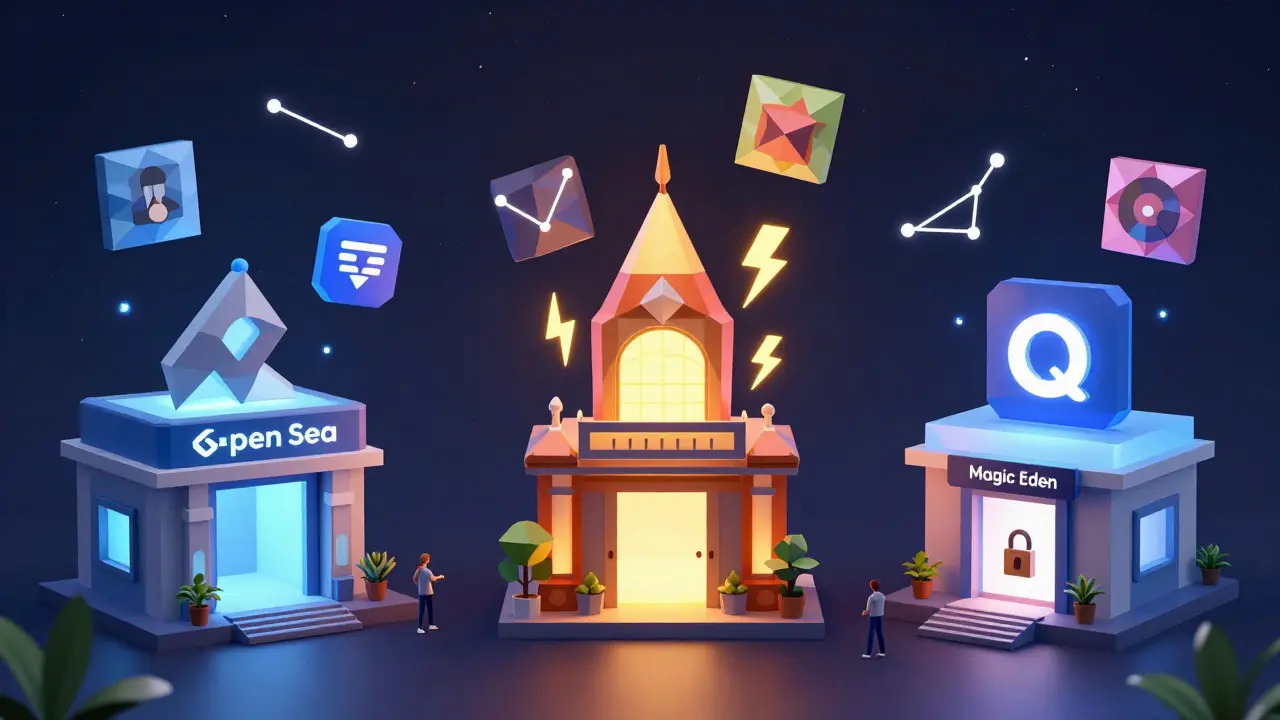
Not all NFT platforms are the same. Here’s what you need to know in 2025:
| Platform | Blockchain | Fee | Approval Time | Best For |
|---|---|---|---|---|
| OpenSea | Base (primary), Ethereum | 2.5% | 24-72 hours | Beginners, broad reach |
| Magic Eden | Solana | 1.5% | Instant | Fast listings, mobile users |
| Blur | Ethereum | 0% | Instant | Professional collectors |
| Foundation | Ethereum | 15% | Invitation-only | Established artists |
| Tensor | Solana | 0% | Instant | Experienced creators with audience |
OpenSea is still the biggest. If you’re new, start here. But it takes days to get your collection approved. Magic Eden is faster and cheaper if you’re on Solana. Blur has no fees, but it’s built for traders, not artists. Foundation is exclusive-you need an invite, and only 14% of applicants get in.
Step 5: Mint and List Your NFT
Once your collection is approved (or if you’re on Magic Eden or Blur), you’re ready to mint. That’s the word for turning your file into an NFT on the blockchain.
You’ll name your collection, upload your art, write a description, and set your royalty. Royalties are your cut every time someone resells your NFT. Most platforms now require at least 2.5%. Some let you go up to 10%. Don’t set it too high-buyers hate paying 10% on every resale. 5% is the sweet spot.
Then choose how to sell:
- Fixed price: Set a price and wait. Simple, but you might leave money on the table.
- Timed auction: Let buyers bid over 24-72 hours. Good for building hype.
- Dutch auction: Price starts high and drops over time. Great for clearing inventory.
Most artists start with fixed price. List your first NFT at $25-$75. Don’t overprice. You want to get noticed, not ignored.
Step 6: Promote Like a Pro
This is where most artists fail. They mint, list, and wait. Nothing happens.
You need to build an audience before you launch. Post your art on Instagram, Twitter (X), and Discord. Share your process-time-lapses, sketches, failed drafts. People don’t buy art. They buy the story behind it.
Join NFT Discord servers. Engage. Don’t just drop your link. Answer questions. Comment on others’ work. Build relationships. The best NFT artists don’t just sell-they host live draws, give away free pieces, and reward loyal followers.
According to a 2025 survey of 500 successful NFT artists, 79% said their biggest mistake was not promoting enough. The ones who posted daily for two weeks before launch sold 6.3x more than those who went silent.
What You’ll Actually Earn
Forget the $2 million NFTs you saw in 2021. The average NFT art sale in 2025 is $142.50. Most sales happen between $25 and $250. That’s not a fortune-but it’s real income.
If you make 10 NFTs and sell them for $100 each, you earn $1,000. If 30% of them get resold later at $150, and you get 5% royalty, that’s another $225. That’s $1,225 from one collection. Do that every month? You’re making $15,000 a year. That’s not side hustle money. That’s a career.
And it’s getting more professional. In 2022, only 12% of NFT artists treated it as their main income. Now, 41% do. Many have formal art training. Many run studios. Many hire marketers. This isn’t a gimmick anymore. It’s a business.
Pitfalls to Avoid
- Gas fee surprises: Always check prices before minting. Use Etherscan or SolanaFM.
- Overpromising: Don’t say your NFT gives “access to a secret club” if you have no plan for it.
- Ignoring royalties: Set them at 5%. Don’t leave them at 0%-you’ll regret it later.
- Posting only on Twitter: Use Instagram, Bluesky, Mastodon, and TikTok. Different audiences, different platforms.
- Waiting for perfection: Launch with 3 pieces. Learn. Improve. Launch again.
Future of NFT Art
The future isn’t just static images. Dynamic NFTs are rising-art that changes based on real-world events. Imagine a painting that turns red when the stock market drops, or a music visualizer that updates with your Spotify playlist. 28% of new collections in late 2025 already use this tech.
Platforms are also merging with traditional art. Magic Eden now partners with Artsy, letting galleries display NFTs next to physical paintings. Christie’s and Sotheby’s sold $185 million in NFT art in 2025. That’s not a trend. That’s integration.
By 2027, experts predict 45% of professional artists will earn part of their income from NFTs. The ones who succeed won’t be the ones chasing viral hits. They’ll be the ones showing up every week, releasing new work, and building real connections.
If you’re ready to start, don’t wait for the perfect moment. Start now. Create one piece. Mint it. List it. Share it. That’s how careers begin.
Do I need to be a professional artist to sell NFT art?
No. Many successful NFT artists started with simple digital drawings or even AI-assisted art. What matters is consistency, authenticity, and how well you tell the story behind your work. You don’t need a degree-you need a voice.
Can I sell the same art as an NFT and as a print?
Yes. In fact, many artists do. The NFT proves digital ownership. The print is a physical product. You can even offer NFT owners an exclusive discount on prints. This hybrid model is growing fast in 2025.
What happens if I lose my wallet seed phrase?
You lose access to your NFTs forever. There is no recovery. No customer service can help you. That’s why blockchain is secure-but also why you must back up your seed phrase in multiple safe places, like a fireproof safe or a locked metal vault.
Are NFTs bad for the environment?
Ethereum, the most popular chain for art, switched to proof-of-stake in 2022 and now uses 99.95% less energy than before. Solana and Polygon are even lighter. Today’s NFTs are as green as most online activities. The environmental concern is mostly outdated.
How do I avoid getting scammed?
Never click random links. Never connect your wallet to a site you didn’t type yourself. Always check the official URL of the marketplace. Beware of fake Discord admins. Legit platforms will never DM you asking for your seed phrase. If it sounds too good to be true-like a free NFT giveaway-it is.
Is it too late to start making NFT art in 2025?
No. The market is more selective now, which means less noise and more room for real talent. The hype is gone, but so are the speculators. The artists who stay consistent, engage with their community, and keep improving are the ones thriving. It’s not about being first. It’s about being steady.
Scott Sơn
December 6, 2025 AT 10:09This guide is basically the bible for digital artists in 2025 - I cried when I read the part about dynamic NFTs changing with Spotify playlists. My last piece just turned blood red during a Fed announcement. Magic.
Martin Hansen
December 6, 2025 AT 13:03Ugh. Another ‘just mint and you’ll be fine’ post. You think people care about your 1080p PNG when the real artists are doing generative AI-orchestrated fractal symphonies on Arbitrum? You’re not an artist - you’re a digital janitor.
Frank Cronin
December 7, 2025 AT 14:05Oh wow. So we’re pretending that NFTs aren’t just glorified JPEGs with a blockchain sticker on them? You call this ‘building a career’? I’ve seen toddlers with better taste and zero gas fees. 5% royalty? Try 0% and stop pretending you’re Picasso.
miriam gionfriddo
December 9, 2025 AT 10:59okay so i just minted my first nft and it cost me 17 bucks in gas?? and now im crying in my cat hoodie and i dont even know if my art is good or if i just have bad lighting in my apartment and why does everyone on blur look like they’re in a crypto cult??
Kenneth Ljungström
December 9, 2025 AT 13:04Love this breakdown! Seriously - the part about minting at 2 AM? Game changer. I used to waste $50 a pop until I learned to wait. Also, Discord communities are where the magic happens. Just comment on someone’s sketch, ask about their process - no link dropping. I sold my first piece because someone liked my failed draft. 🙌
Cristal Consulting
December 11, 2025 AT 06:59You don’t need perfection. You need persistence. Start with one piece. Post it. Show up tomorrow. That’s it. The market isn’t dead - it’s just filtering out the noise. You’ve got this.
Tom Van bergen
December 12, 2025 AT 19:03Art is dead long live the blockchain nobody owns anything anymore the deed is a smart contract the soul is metadata the market is a casino and you are the house that got robbed by your own ego
Sandra Lee Beagan
December 14, 2025 AT 09:30In Vancouver, we’ve seen a quiet revolution - local galleries now display NFTs beside oil paintings. The hybrid model is real. One artist I know sells physical prints with QR codes that unlock exclusive behind-the-scenes animations. It’s not about replacing tradition - it’s about expanding it. The blockchain doesn’t erase culture - it archives it.
Ben VanDyk
December 16, 2025 AT 06:59Interesting. But you didn’t mention that OpenSea’s approval process is a black hole. I submitted a collection in March. Still waiting. Also, ‘5% royalty’ is a lie - most buyers just wait for secondary drops. You’re not getting paid. You’re just paying gas for exposure.
ronald dayrit
December 16, 2025 AT 19:31What is ownership in a digital age? If I can screenshot your NFT, does the blockchain really confer value - or just the illusion of exclusivity? The real art isn’t the file. It’s the ritual of minting. The trembling hand clicking ‘confirm transaction.’ The silent pact between creator and collector that says, ‘I see you, and I will remember you.’ That’s the only thing that can’t be copied. The rest? Just code.
Yzak victor
December 17, 2025 AT 15:54Honestly? I started with terrible doodles on Procreate. Didn’t know what a wallet was. Just posted one thing on Twitter. Someone liked it. Then another. Then someone offered $50. I cried. Then I learned. You don’t need to be perfect. You just need to be real. Keep going.
Billye Nipper
December 19, 2025 AT 12:14YES. YES. YES. I just launched my first collection - 3 pieces, $30 each - and I cried when the first sale hit. I didn’t even tell my friends. I just posted a timelapse of me sketching with my cat on my lap. That’s it. The internet showed up. You don’t need a marketing team. You need a heartbeat. ❤️
Roseline Stephen
December 20, 2025 AT 01:40Thanks for the practical advice. I’ve been hesitant to jump in because of the noise. This feels grounded. I’m going to start small. One piece. One week. See what happens.
Mariam Almatrook
December 21, 2025 AT 06:06While I appreciate the technical exposition, one must question the moral underpinnings of commodifying ephemeral digital artifacts through speculative cryptographic ledgers. Is this not the ultimate triumph of neoliberalism over aesthetic integrity? The artist becomes a vendor. The viewer, a transactional entity. And the blockchain - a cold, unfeeling ledger of human vanity.
Chris Mitchell
December 21, 2025 AT 06:40Stop waiting. Start creating. The market rewards consistency, not perfection. You don’t need permission. Just post. Then post again. Then again. That’s the whole game.
rita linda
December 22, 2025 AT 14:02Why are we letting Americans dictate how art should be sold? In China, we have digital galleries with real collectors who pay in yuan, not crypto. This whole NFT thing is just Wall Street’s latest scam dressed in pixel art. You’re not building a career - you’re gambling with your soul.
Stanley Wong
December 22, 2025 AT 21:56I’ve been in this space since 2021 and I’ll tell you this - the real winners aren’t the ones with the most sales. They’re the ones who kept going after everyone else quit. The ones who posted every Tuesday even when no one liked it. That’s the real NFT art. Not the hype. The grind.
Nicole Parker
December 23, 2025 AT 10:23There’s something sacred about knowing your art exists on a public ledger, unchangeable, unerasable. Even if no one buys it, it’s still there. Like a letter you wrote but never sent. It still matters. That’s why I keep creating. Not for the money. For the record.
Brooke Schmalbach
December 23, 2025 AT 14:12Let’s be real - 79% of artists ‘didn’t promote enough’? That’s because 90% of them didn’t have an audience to begin with. You can’t build a career on a Discord server if your art looks like a 12-year-old’s Photoshop experiment. Talent still matters. The market just filters it harder now.
michael cuevas
December 25, 2025 AT 07:24Fixed price at $25? Nah. I did a Dutch auction. Started at $500. Dropped to $50 in 48 hours. Sold 12 pieces. People love a countdown. Also - never say ‘rare’ unless you mean it. I got roasted in a Discord for calling my 10k collection ‘rare.’ Lesson learned.
Nina Meretoile
December 26, 2025 AT 14:15My grandma bought my first NFT. She didn’t know what blockchain meant. She just said, ‘It’s pretty. I like the colors.’ That’s all that matters. Art is for people. Not wallets.