

India's 30% Crypto Tax: What Bitcoin Traders Need to Know in 2026
 Jan, 7 2026
India’s 30% tax on cryptocurrency gains isn’t just high-it’s unlike anything else in the world. If you’re trading Bitcoin or any other digital asset in India, this tax rule changes everything. No matter how long you hold your coins, no matter if you lost money on other trades, you still pay 30% on every profit. And that’s just the start.
How the 30% Crypto Tax Actually Works
The tax comes from Section 115BBH of the Income Tax Act, introduced in April 2022. It applies to all Virtual Digital Assets (VDAs), which includes Bitcoin, Ethereum, NFTs, and even tokens from decentralized apps. The government doesn’t care if you held Bitcoin for one day or five years. Every time you sell, trade, or exchange it for something else, you owe 30% on the profit.Here’s the math: if you bought 1 Bitcoin for ₹30 lakh and sold it for ₹40 lakh, your profit is ₹10 lakh. You pay 30% of that-₹3 lakh-in taxes. That’s it. No deductions. No exceptions.
And here’s the catch: you can’t deduct anything else. Not the fees you paid to the exchange. Not the cost of using a hardware wallet. Not even the money you spent on research or tools. Only the original purchase price counts. That’s stricter than any capital gains tax in the U.S., Europe, or Singapore.
You Can’t Offset Losses-Even If You’re Net Losing
This is where most traders get blindsided.Let’s say you made ₹50,000 on Ethereum but lost ₹70,000 on Solana. In most countries, you’d pay tax only on the net gain-or even get a refund because you lost money overall. In India? You still pay 30% on the ₹50,000 profit. The ₹70,000 loss? Gone. You can’t use it to reduce your tax bill. You can’t carry it forward to next year. It disappears.
That means you could lose ₹2 lakh across your portfolio this year and still owe ₹60,000 in taxes because one trade went up. For active traders, this isn’t just unfair-it’s financially dangerous. Many end up paying taxes on paper profits while their actual portfolio value drops.
The 1% TDS That Slips Under the Radar
On top of the 30%, there’s a 1% Tax Deducted at Source (TDS) under Section 194S. It kicked in on July 1, 2022, and it’s automatic.If you transfer more than ₹50,000 worth of crypto in a year (₹10,000 for certain cases like P2P), the exchange or platform takes 1% right out of your sale amount. So if you sell ₹1 lakh of Bitcoin, ₹1,000 gets pulled out before you even see the money.
Here’s the problem: this 1% doesn’t count as your final tax. It’s just an advance payment. You still have to report the full gain on your income tax return and pay the 30%. If you paid ₹1,000 in TDS but owe ₹30,000 in taxes, you still need to pay the remaining ₹29,000. And if you paid more in TDS than you owe? You can claim a refund-but only if you file your return correctly.
Many traders don’t realize TDS applies to P2P trades too. If you bought Bitcoin from someone on a local app and sold it later, the platform still has to deduct 1%. If they don’t, you’re still legally responsible for paying it yourself.
Now There’s Also 18% GST on Exchange Fees
In July 2025, the government added another layer: 18% GST on crypto exchange services. This means every time you trade, pay a withdrawal fee, or even deposit fiat to buy crypto, the platform charges you GST on its service fee.So if you pay ₹500 to trade on CoinDCX, you’re now paying ₹90 in GST on top of it. That’s not a tax on your profit-it’s a tax on the service you used to make the trade. And it’s non-refundable.
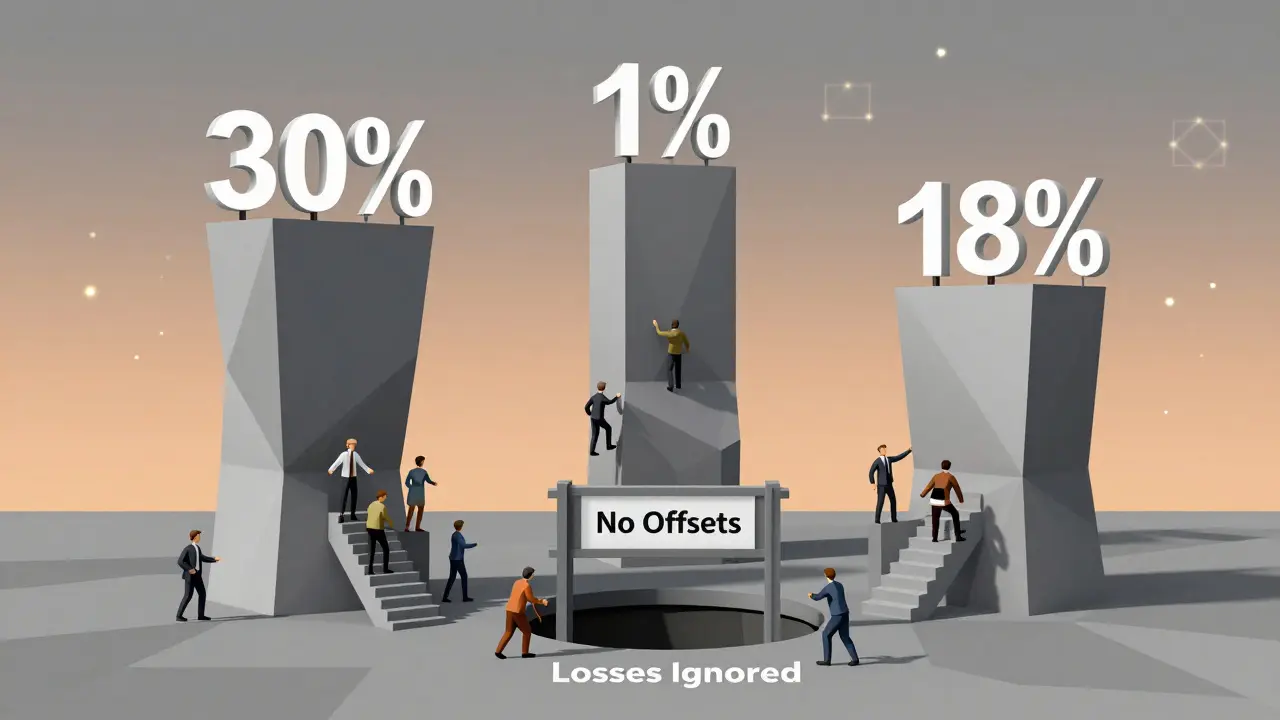
This creates a three-tier tax burden:
- 30% income tax on your gains
- 1% TDS deducted at sale
- 18% GST on platform fees
No other country taxes crypto this way. In the U.S., you pay capital gains tax and maybe a small fee. In Germany, crypto is tax-free after a year. In Singapore, there’s no capital gains tax at all. India’s system is designed to discourage trading-not support it.
What You Must Track (And How)
The Income Tax Department now requires you to report every crypto transaction on Schedule VDA in your annual return. That means you need records for every buy, sell, swap, and gift since April 1, 2022.You need:
- Date and time of each transaction
- Amount of crypto bought or sold
- INR value at the time of transaction (based on exchange rate)
- Wallet addresses involved
- Exchange or platform used
- Transaction IDs
Doing this manually across 10+ trades a month? Impossible. Most active traders use tools like Koinly, ClearTax, or CoinTracker, which now have India-specific modules. These tools pull data from exchanges, calculate your cost basis, and generate the Schedule VDA form automatically.
But even with software, you’re still on the hook for accuracy. If you used a non-Indian exchange like Binance or Kraken, you have to manually import your transaction history. No auto-sync. No magic button. You’re responsible for making sure every transaction is recorded.
Why This Tax Is Hurting India’s Crypto Market
Since the tax landed in 2022, trading volumes on Indian exchanges dropped 40-60%. Retail traders left. Startups pivoted. Many moved their activity to international platforms or P2P networks to avoid TDS.But that creates new problems. If you trade on Binance or Bybit and don’t report it, you’re breaking the law. The government can track wallet addresses now. They’ve started matching blockchain data with bank statements. One trader in Bangalore got a notice last year because his bank showed a ₹25 lakh deposit from a wallet linked to a known crypto exchange.
The result? Most active traders now avoid frequent trading. People hold longer. Fewer new traders join. The market has shifted from speculative trading to long-term holding-exactly what the government didn’t intend. They wanted to capture revenue. Instead, they scared away innovation.

What Experts Are Saying
Tax professionals call it “punitive.” CPA firms like Koinly say the 30% rate applies the same way to someone who bought $100 of Bitcoin as it does to a full-time trader making $1 million. There’s no distinction between casual investor and professional.Legal analysts warn the system is unworkable for real trading. “You can’t run a business under this,” says a Delhi-based crypto tax lawyer. “If you lose money on half your trades, you’re still paying tax on the winners. That’s not taxation-it’s a penalty.”
Even the government’s own data shows declining compliance. Fewer than 40% of crypto traders filed Schedule VDA correctly in FY 2023-24. Many simply didn’t know how. Others gave up.
What Should You Do Now?
If you’re trading in India, here’s what you need to do:- Use a crypto tax tool with India support. Don’t guess.
- Track every transaction-even small ones. A ₹2,000 swap still counts.
- Keep proof of purchase prices. Screenshots, receipts, exchange statements.
- Don’t assume TDS covers your tax. You still owe the 30%.
- File your return on time. Late filings trigger penalties.
- Don’t use offshore platforms to hide trades. The tracking is here.
There’s no legal loophole. No clever trick to avoid the 30%. The only way to reduce your tax is to reduce your gains. Hold longer. Trade less. Accept that India’s system isn’t built for traders-it’s built to discourage them.
Is This Going to Change?
Maybe. But not soon.The government collected ₹8,000 crore in crypto taxes in FY 2024-25. That’s a lot of revenue. There’s no political will to lower the rate. The 1% TDS and 18% GST are locked in. Loss offsetting? Still banned. No official signal of change.
Experts think the system might evolve-perhaps by raising the TDS threshold or adding a small loss carry-forward rule. But don’t count on it. For now, India’s crypto tax is one of the harshest in the world. And if you’re trading here, you’re playing by its rules.
Understand them. Track them. Pay them. Or don’t trade at all.
Is the 30% crypto tax in India on profits or total sales?
It’s on profits only-your selling price minus your original purchase price. You don’t pay tax on the full amount you sell. But you can’t deduct any other costs like fees or wallet expenses. Only the cost of acquisition counts.
Can I offset losses from Bitcoin against gains from Ethereum?
No. India’s tax law treats each cryptocurrency as a separate asset. Losses on one coin cannot be used to reduce gains on another. Even if your total portfolio lost money, you still pay 30% on every individual profit.
Do I pay tax if I swap one crypto for another?
Yes. Swapping Bitcoin for Ethereum is treated as a sale of Bitcoin and a purchase of Ethereum. The profit (or loss) on the Bitcoin side is taxable. Even if you didn’t convert to INR, the transaction triggers a tax event.
What happens if I don’t report my crypto gains?
The Income Tax Department can track your transactions through exchange data, bank statements, and blockchain analysis. If you’re caught, you’ll owe back taxes, 1% TDS interest, and penalties up to 200% of the tax due. In severe cases, this can lead to legal action.
Does the 1% TDS mean I’ve already paid my tax?
No. The 1% TDS is just an advance payment. You still owe 30% on your net gains. When you file your return, the TDS amount is credited against your final tax bill. If you paid more than you owe, you get a refund. If you paid less, you pay the difference.
Can I claim a tax deduction for crypto losses?
No. India does not allow loss carry-forward or loss offsetting for crypto. Any losses you incur cannot be used to reduce future or current tax liability. They are simply ignored by the tax system.
Do I need to pay GST if I buy crypto with INR?
You don’t pay GST on the crypto purchase itself. But if you pay a fee to an exchange-like a trading fee, withdrawal fee, or deposit fee-that fee includes 18% GST. You’re paying GST on the service, not the asset.
Is gifting crypto taxable in India?
Yes. If you gift crypto worth more than ₹50,000 in a year, the recipient must pay income tax on its market value at the time of receipt. The giver doesn’t pay tax, but the receiver does. This is treated as income under Section 56(2)(x).
Tracey Grammer-Porter
January 7, 2026 AT 17:21jim carry
January 8, 2026 AT 13:12Mollie Williams
January 9, 2026 AT 19:53Ritu Singh
January 9, 2026 AT 20:29kris serafin
January 10, 2026 AT 00:28Caitlin Colwell
January 10, 2026 AT 01:23Charlotte Parker
January 11, 2026 AT 10:50Sarbjit Nahl
January 11, 2026 AT 14:04Emily Hipps
January 12, 2026 AT 05:17Frank Heili
January 12, 2026 AT 14:29Natalie Kershaw
January 13, 2026 AT 21:07Jacob Clark
January 14, 2026 AT 06:41Jon Martín
January 16, 2026 AT 04:20Mujibur Rahman
January 18, 2026 AT 03:48Jennah Grant
January 19, 2026 AT 16:11Dennis Mbuthia
January 20, 2026 AT 00:11Dave Lite
January 21, 2026 AT 08:24Becky Chenier
January 22, 2026 AT 08:51Staci Armezzani
January 24, 2026 AT 04:23sathish kumar
January 24, 2026 AT 19:58Don Grissett
January 25, 2026 AT 13:38