

Layer 1 vs Layer 2 Blockchain: What’s the Real Difference in 2025?
 Dec, 4 2025
Layer 1 vs Layer 2 Transaction Cost Calculator
Calculate how much it would cost to process 1,000 transactions on Ethereum Layer 1 versus Layer 2 networks. Based on real Q4 2024 data from the article, Layer 2 solutions like Arbitrum and zkSync reduce costs by 90% or more.
Transaction Cost Comparison
Ethereum Layer 1
$0.00
(15-30 TPS, $1.50-$50 avg fee)
Layer 2 (Arbitrum/zkSync)
$0.00
(2,000-9,000 TPS, $0.01-$0.05 avg fee)
Based on Q4 2024 data: Layer 1 fees average $1.50-$50 per transaction, while Layer 2 fees average $0.01-$0.05 per transaction.
When you send a transaction on Ethereum, it doesn’t just vanish into thin air. It gets bundled, verified, and locked into a block on the main chain-that’s Layer 1. But what if that chain is slow, expensive, and congested? That’s where Layer 2 comes in. It’s not a replacement. It’s a side highway built on top of the main road. And in 2025, most of the action isn’t happening on Layer 1 anymore-it’s happening on Layer 2.
Layer 1: The Foundation, Not the Fast Lane
Layer 1 blockchains are the original networks. They’re the ones that handle consensus, security, and finality all by themselves. Bitcoin and Ethereum are the classic examples. Bitcoin uses Proof-of-Work. Ethereum switched to Proof-of-Stake in 2022. Both have thousands of nodes running globally, making them incredibly hard to attack.
But here’s the catch: they’re slow. Ethereum’s Layer 1 can only process 15 to 30 transactions per second. During peak times in 2021, gas fees hit $200. Even today, during NFT drops or major DeFi events, you’re still fighting for space. That’s not usable for everyday payments or apps with thousands of users.
Some newer Layer 1s like Solana and Core DAO tried to fix this by building faster consensus. Solana claims over 65,000 TPS using Proof-of-History. Core DAO hits 3-second block times with fees under $0.01. But they still rely on their own validator sets. If those validators go down or get compromised, the whole network is at risk. Layer 1s are secure-but they’re not scalable without major upgrades.
Layer 2: Speed, Low Cost, and a Few Hidden Risks
Layer 2 solutions don’t try to rebuild the blockchain. They piggyback on it. They take thousands of transactions off the main chain, process them quickly, then post a single summary back to Layer 1. Think of it like batching your grocery run instead of driving to the store for every single item.
There are three main types:
- State channels (like Bitcoin’s Lightning Network): Two parties open a channel, transact privately, then close it on-chain. Great for micropayments.
- Sidechains (like Polygon PoS): Independent blockchains connected to Ethereum via bridges. Faster, but less secure because they have their own validators.
- Rollups (Arbitrum, Optimism, zkSync): The most popular today. They bundle hundreds of transactions and submit a cryptographic proof to Ethereum. Optimistic Rollups assume transactions are valid unless someone proves otherwise. zk-Rollups use math to prove validity instantly.
The results? Arbitrum and Optimism handle 2,000-4,000 TPS. StarkNet hits 9,000 TPS. Fees? Usually under $0.05. In Q2 2024, Polygon averaged $0.0005 per transaction. That’s not a tweak-it’s a revolution.
Security: Inherited, Not Independent
Layer 1 security comes from decentralization. Bitcoin has over 15,000 public nodes. Ethereum has 835,000+ validators. That’s why it’s nearly impossible to hack.
Layer 2s inherit that security-but only if they do it right. Rollups post data to Ethereum, so even if the Layer 2 operator is dishonest, users can still withdraw their funds. That’s the big win.
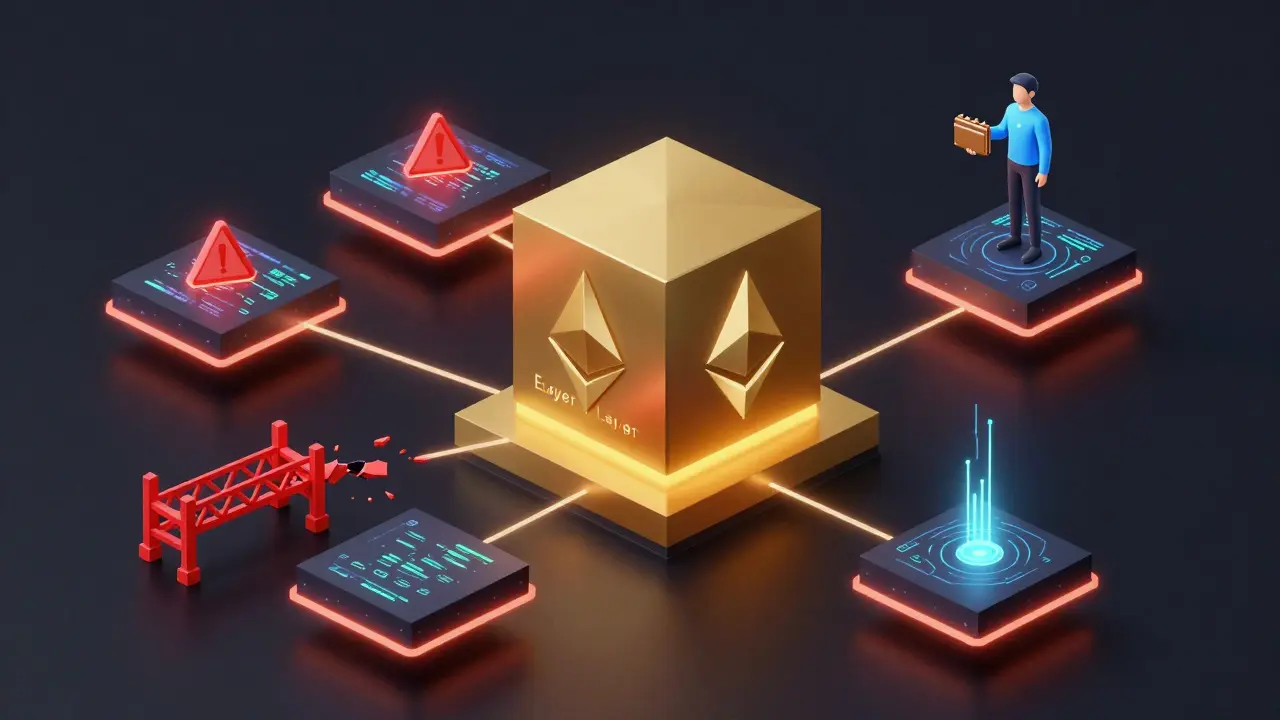
But here’s where things get messy. Most rollups use a single sequencer to order transactions. Until mid-2024, Optimism had just one. That’s a single point of failure. If that sequencer goes offline or gets hacked, transactions stall. Some Layer 2s like Polygon PoS rely on only 100 validators. That’s nowhere near Ethereum’s scale.
And then there’s bridging. Moving assets between Layer 1 and Layer 2 means crossing a bridge. And bridges have been hacked for over $1.5 billion since 2021. The Ronin Bridge ($613M), Wormhole ($320M), Nomad ($625M)-all exploited because they trusted too few validators. Layer 2s are safer than sidechains, but bridges? Still a weak link.

Performance: Layer 2 Wins by a Mile
Let’s compare real numbers from November 2024:
| Feature | Layer 1 (Ethereum) | Layer 2 (Arbitrum) | Layer 2 (zkSync Era) |
|---|---|---|---|
| Transactions per second | 15-30 | 2,000-4,000 | 2,000-3,000 |
| Average fee (USD) | $1.50-$50 | $0.02 | $0.01 |
| Block time | 12-15 seconds | 2 seconds | 1.5 seconds |
| Finality time | 5-10 minutes | 7 days (Optimistic) | 10-60 minutes (zk-Rollup) |
| Decentralization | High (835k+ validators) | Medium (centralized sequencer) | Medium (fewer proving nodes) |
Layer 2s aren’t just faster-they’re cheaper by orders of magnitude. That’s why 58.7 million transactions happened on Ethereum Layer 2s in a single day, compared to just 1.2 million on Layer 1. Most users don’t even touch Layer 1 anymore.
Who Uses What-and Why?
Developers? They’re building on Layer 2s. Why? Because deploying a smart contract on Ethereum costs $15,000 in gas for 1,000 transactions. On Arbitrum? $150. That’s a 99% drop. Most new DeFi apps, NFT platforms, and Web3 games now launch on Layer 2s like Base, Arbitrum, or zkSync.
Enterprises? They use Layer 1 for settlement. Think of it like a bank’s ledger. Final records go on Ethereum. But customer-facing transactions-payments, loyalty points, receipts? Those happen on Polygon or Optimism. Deloitte’s 2024 survey found 62% of companies use Layer 2 for user apps.
Traders? They’re jumping between chains. But they hate delays. Waiting 7 days to withdraw from Optimism during a market crash? That’s a nightmare. One user lost 30% of their portfolio because they couldn’t exit fast enough. zk-Rollups solve this with faster finality, but they’re harder to build on.
The Future: Layer 1.5 and the End of the Divide?
Some people are pushing back. Gavin Wood (Polkadot founder) says we shouldn’t need Layer 2s at all. His vision? Sharded Layer 1s where scalability is built in from day one.
But Ethereum’s roadmap says otherwise. The Dencun upgrade in March 2024 slashed Layer 2 data costs by 90%. That means rollups are getting even cheaper. Ethereum’s next phase, “Surge,” aims for 100,000 TPS by 2027-still relying on Layer 2s to handle most of the load.
Meanwhile, Core DAO introduced something called “Bitcoin-pegged consensus.” It’s not a Layer 2. It’s not a Layer 1. It’s a hybrid-using Bitcoin’s security while running its own fast chain. Some call it Layer 1.5.
That’s the real story in 2025: the lines are blurring. Layer 1s are becoming settlement layers. Layer 2s are becoming the user experience. And the future isn’t about choosing one over the other-it’s about using both together.
What Should You Do?
If you’re a developer: Start on Layer 2. Use Arbitrum, zkSync, or Base. You’ll save money, move faster, and reach more users.
If you’re a trader: Use Layer 2 for daily trades. But keep your main funds on Layer 1. Don’t trust bridges with large sums.
If you’re an investor: Look at Layer 2 ecosystem tokens (like OP, ARB, ZK) as much as you look at ETH. The value is shifting up the stack.
If you’re just starting out: Don’t get lost in the jargon. Use a wallet like MetaMask or Rabby. It handles bridging for you. Just know that if you see a 7-day wait, it’s not a bug-it’s a feature of Optimistic Rollups.
Layer 1 isn’t dead. It’s the bedrock. Layer 2 isn’t a gimmick. It’s the future. And in 2025, you’re already living in it.
Is Layer 2 safer than Layer 1?
Layer 1 is more secure because it has thousands of independent validators and no middlemen. Layer 2 inherits security from Layer 1, but adds trust assumptions-like relying on sequencers or bridge operators. Rollups are safer than sidechains, but bridges remain vulnerable. Overall, Layer 1 is safer for holding large amounts. Layer 2 is safe enough for daily use if you avoid risky bridges.
Why are Layer 2 fees so much lower?
Layer 2s bundle hundreds or thousands of transactions into one single transaction on Layer 1. Instead of paying for each individual transaction on Ethereum, you pay a tiny fraction of the cost. Think of it like sharing a taxi ride instead of calling 10 separate cars. That’s why fees drop from $10 to $0.02.
Can I use Layer 2 without bridging?
No. To use any Layer 2, you must first move assets from Layer 1 (like Ethereum) to the Layer 2 network. This requires a bridge. Some wallets automate this, but you’re still transferring funds across chains. Never send ETH directly to a Layer 2 address without bridging-it will be lost.
Are Layer 2s decentralized?
Most are not fully decentralized yet. Many use a single sequencer to order transactions, which creates centralization risk. Projects like Optimism and Arbitrum are working to decentralize sequencers, but it’s still early. zk-Rollups are more decentralized in verification but rely on fewer proving nodes. Layer 1s like Ethereum and Bitcoin remain the most decentralized.
What’s the difference between Optimistic Rollups and zk-Rollups?
Optimistic Rollups assume transactions are valid and only check them if someone challenges them within a 7-day window. They’re easier to build but have long withdrawal times. zk-Rollups use cryptographic proofs to verify transactions instantly. They’re faster and more secure but require advanced math (zero-knowledge proofs), making them harder to develop for. zk-Rollups are the future, but Optimistic Rollups still dominate in usage.
Will Layer 2s replace Layer 1?
No. Layer 1s will always be the settlement layer-the trusted anchor. Layer 2s handle the volume. Ethereum’s role is shifting from “everything on-chain” to “secure base layer.” Layer 2s can’t exist without Layer 1. They’re partners, not replacements.
Which Layer 2 should I use in 2025?
For most users: Arbitrum or Base. They’re the most mature, have the biggest app ecosystems, and are easy to use. For lower fees and faster finality: zkSync Era or StarkNet. For NFTs: Immutable X. Avoid new or obscure Layer 2s unless you understand their security model. Stick to ones with strong backing, active development, and transparent governance.
Jon Visotzky
December 4, 2025 AT 18:06Also why does everyone still act like rollups are magic? They're just clever accounting with crypto.
Isha Kaur
December 4, 2025 AT 18:19Glenn Jones
December 6, 2025 AT 10:02Tara Marshall
December 7, 2025 AT 00:01Nelson Issangya
December 7, 2025 AT 12:11ronald dayrit
December 9, 2025 AT 01:10Doreen Ochodo
December 9, 2025 AT 17:56Yzak victor
December 11, 2025 AT 12:04Holly Cute
December 13, 2025 AT 10:48Neal Schechter
December 14, 2025 AT 20:57Madison Agado
December 16, 2025 AT 15:06Tisha Berg
December 18, 2025 AT 14:43Billye Nipper
December 19, 2025 AT 09:42Roseline Stephen
December 21, 2025 AT 05:50Thomas Downey
December 23, 2025 AT 03:53Vincent Cameron
December 24, 2025 AT 14:01Krista Hewes
December 25, 2025 AT 00:38Noriko Robinson
December 26, 2025 AT 18:17Josh Rivera
December 28, 2025 AT 06:53Chris Jenny
December 28, 2025 AT 20:58