

WSPP Airdrop: What You Need to Know Before You Claim It
 Jan, 14 2026
There’s a token called WSPP - Wolf Safe Poor People - that’s been popping up in Telegram groups and Twitter threads with a bold promise: "Get free tokens and help end global poverty." Sounds noble, right? But here’s the truth: if you’re thinking about claiming this airdrop, you’re not helping anyone. You’re risking your wallet.
WSPP isn’t a charity project. It’s a classic crypto scam dressed up in humanitarian language. The name sounds like it’s built to make you feel good about participating. But behind the slogan is a token with a price so low it’s practically invisible - $0.0000000000704 per token. That’s not a typo. It’s 7.04e-11 USD. And there are over 13.5 quadrillion of them in circulation. That’s more tokens than there are grains of sand on Earth. The math doesn’t add up for a real currency. It adds up for a pump-and-dump.
How the WSPP "Airdrop" Actually Works
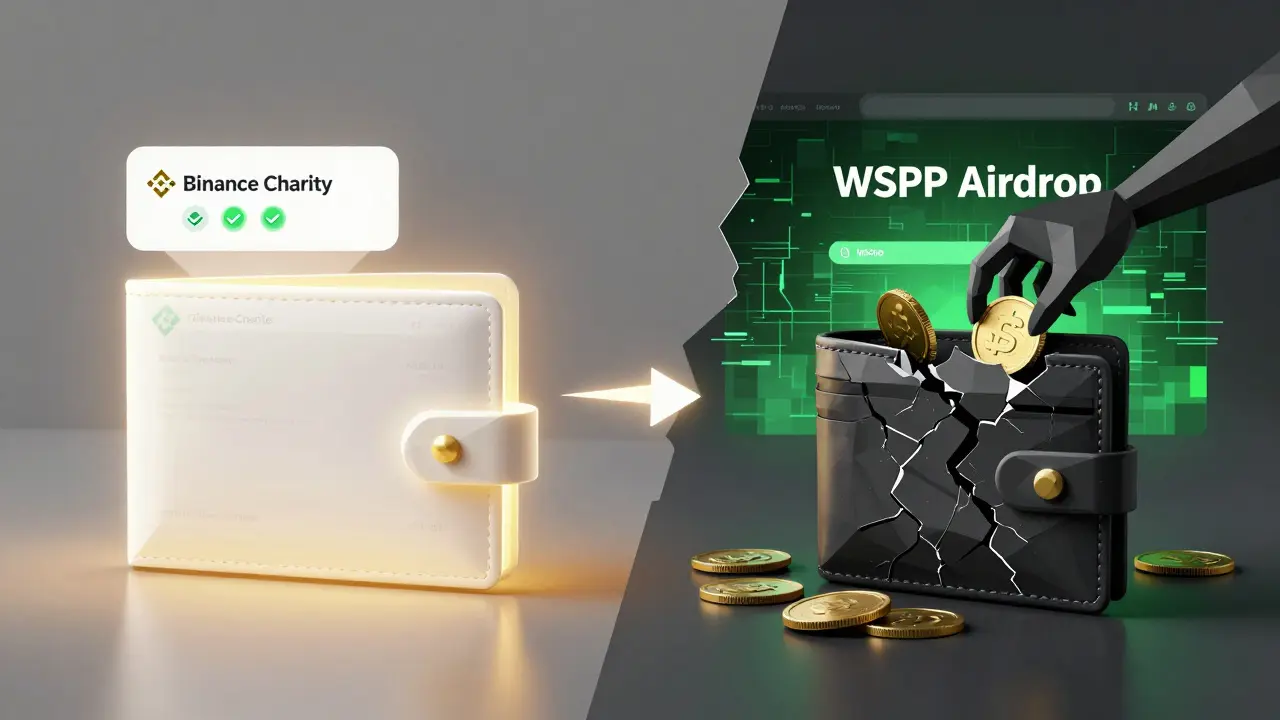
The so-called "airdrop" isn’t a gift. It’s a trap. You’re told to connect your wallet to a website, approve a transaction, and "claim" your free WSPP tokens. What you don’t see is that the contract is rigged. When you approve the transaction, you’re giving the scammer permission to drain your entire wallet - not just the WSPP tokens, but your ETH, BNB, or any other crypto sitting there. This isn’t speculation. It’s documented. Users on Reddit and Binance forums have reported losing everything after clicking "Claim Airdrop."
There’s no official website. No whitepaper. No team. No GitHub repo. No public roadmap. Just a Telegram group - @robowolfproject - with no verified admins, no history of meaningful conversation, and no proof of any real activity. That’s not a community. That’s a ghost town with a sign that says "Free Money Inside."
Why the "Poverty Relief" Claim Is a Lie
The project claims to be "the first currency that reduces world poverty." But where’s the proof? Where are the bank transfers to villages in Kenya? Where are the receipts for food aid in Haiti? Where’s the quarterly report showing how much was raised and distributed?
Real crypto charity projects - like GiveDirectly or Binance Charity - publish everything. They show names of recipients (with consent), transaction IDs, and impact metrics. WSPP? Nothing. Zero. Nada.
And here’s the kicker: even if they *did* donate money, the token’s market cap is under $1 million. That’s less than what a single well-funded NGO spends on office rent in a year. You can’t end global poverty with $953,000. You can’t even feed a small town for a month. The claim isn’t misleading - it’s insulting.
The Technical Red Flags
WSPP exists on Binance Smart Chain and Polygon. That’s not a feature - it’s a tactic. By launching on two chains, scammers make it harder to track. But the real danger is in the contract code.
Multiple users have reverse-engineered the WSPP contract. The sell function has a hidden 95% tax. That means if you buy 1,000,000,000,000 WSPP tokens, and try to sell them, you only get 5% of your original value back. The other 95%? It goes straight to the scammer’s wallet. That’s not a token. That’s a money trap.
Also, the contract was supposedly "audited by Solidity Finance." But if you go to their website and search for "WSPP," you won’t find it. No audit report. No date. No signature. Just a name drop. That’s not an audit. That’s a marketing lie.
Why No Major Exchange Lists It
Binance, Coinbase, Kraken - none of them list WSPP. Why? Because they have compliance teams. They check for scams. They check for rug pulls. They check for tokens that have no real use case and are designed to steal money.
WSPP isn’t just unlisted - it’s flagged. Binance’s own price tracker says "Not listed." That’s their way of saying: "Don’t touch this."
Even CoinMarketCap, which lists nearly every token ever created, gives WSPP a warning label: "Low liquidity, high risk." And with a 24-hour trading volume under $10,000, you can’t even sell your tokens if you want to. There’s no buyer. No market. Just a graveyard of wallets.
Real Airdrops vs. WSPP
Legitimate airdrops - like those from Uniswap, Arbitrum, or Polygon - don’t ask you to approve unlimited spending. They don’t require you to connect your main wallet. They’re distributed to users who already interacted with the protocol. They’re announced on official blogs. They’re tracked on Airdrop Alert and CoinMarketCap’s official airdrop page.
WSPP? It’s not on any of those. It doesn’t show up in any reputable crypto news outlet. No CoinDesk. No The Block. No Messari. Just spam bots and Telegram ads.
If a project doesn’t have a presence on professional platforms, it doesn’t deserve your attention. Period.
What Happens If You Participate
You think you’re getting free tokens. You’re not. You’re giving away control of your wallet.
Here’s what actually happens:
- You click a link: "Claim your 500,000,000,000,000 WSPP tokens for free!"
- You connect your MetaMask or Trust Wallet.
- You approve a transaction that says "Allow infinite spending." You click "Confirm."
- Within seconds, your entire wallet balance - ETH, BNB, USDT, even your NFTs - is drained.
- You check your wallet. Your WSPP tokens are there. But they’re worthless.
- You try to sell them. No one buys. The price drops to zero.
- You realize you lost everything.
This isn’t hypothetical. It’s happened hundreds of times. Chainalysis reported a 41% spike in airdrop-themed scams in Q3 2025. WSPP is one of the biggest.
How to Protect Yourself
If you see "WSPP airdrop" anywhere - on Twitter, Telegram, Reddit, or YouTube - walk away. Don’t click. Don’t even hover over the link.
Here’s your safety checklist:
- Never approve unlimited token spending. Always set limits.
- Never connect your main wallet to unknown sites. Use a burner wallet with $5 or less.
- Check if the project is listed on CoinMarketCap’s official airdrop page. If it’s not, it’s fake.
- Search for the project name + "scam" or "rug pull." If you see more than two reports, leave.
- Never trust claims like "help the poor" or "revolutionary charity" unless there’s verifiable proof.
There are real crypto projects helping people. But they don’t need to trick you into giving up your wallet to do it.
Final Warning
WSPP is not a project. It’s a weapon. It preys on hope. It exploits compassion. It turns the desire to do good into a reason to lose everything.
If you’ve already claimed WSPP tokens - stop. Don’t try to sell them. They’re worthless. And if you’ve connected your wallet, check your balance immediately. If anything is missing, assume your wallet is compromised. Move your funds to a new one - and never use the old one again.
There’s no shortcut to helping the poor. And there’s no free crypto that doesn’t cost you something. In this case, the price is your security.
Is the WSPP airdrop real?
No, the WSPP airdrop is not real. It’s a scam designed to steal crypto from your wallet. There is no official distribution, no verifiable team, and no proof of any poverty relief efforts. Any site asking you to connect your wallet to claim WSPP tokens is malicious.
Can I sell WSPP tokens for profit?
No, you cannot sell WSPP tokens for profit. The token has a hidden 95% sell tax built into its contract, meaning you lose 95% of your value when you try to sell. Even if you could sell, there’s no market - trading volume is under $10,000 per day. The price is effectively zero.
Is WSPP audited by Solidity Finance?
No, there is no public audit report from Solidity Finance for WSPP. The project claims an audit exists, but searching their official website yields no results. This is a common tactic used by scams to appear legitimate without providing actual proof.
Why is WSPP on Binance Smart Chain and Polygon?
Scammers deploy tokens on multiple blockchains to confuse users and evade detection. It makes it harder to track the contract and increases the chances someone will fall for the scam. It doesn’t mean the project is legitimate - it means they’re trying to spread the risk.
What should I do if I already connected my wallet to WSPP?
Immediately check your wallet balance. If funds are missing, your wallet has been drained. Do not interact with any more unknown contracts. Create a new wallet, transfer your remaining funds to it, and never use the compromised wallet again. Report the scam to your wallet provider and local authorities if possible.
Are there any real crypto projects helping the poor?
Yes. Projects like GiveDirectly, Binance Charity, and AidCoin have transparently distributed millions in crypto aid to people in need. They publish receipts, recipient data, and impact reports. They don’t ask you to connect your wallet to claim free tokens. They operate with accountability - not deception.
Josh V
January 14, 2026 AT 10:51Bro just saw this on Telegram and was about to click the link thank god I scrolled down first
Pat G
January 15, 2026 AT 02:48Another socialist crypto scam pretending to be woke
They think poor people are dumb enough to fall for this
Wake up America
Alexandra Heller
January 15, 2026 AT 09:42It’s not just about the token-it’s about the psychology behind it. The language of altruism is the oldest con in the book. They weaponize empathy to bypass rational thought. You don’t need to be a crypto expert to see this. You just need to ask: who benefits? And the answer is never the poor.
Real charity doesn’t need your wallet permissions. It doesn’t need you to approve infinite spending. It doesn’t need you to believe in fairy tales wrapped in blockchain.
This is the same mechanism that sold pyramid schemes as ‘network marketing.’ The same tactic that turned ‘Bitcoin for the people’ into ‘sell your soul for 10,000 worthless tokens.’
We’ve seen this movie before. The credits always roll the same way: wallets emptied, hope crushed, and the scammers gone with their ETH.
And the worst part? The people who fall for this aren’t stupid. They’re kind. They want to believe in something good. That’s why it works.
It’s not a flaw in the system. It’s a flaw in how we’ve been trained to respond to suffering-with quick fixes and digital miracles.
There’s no algorithm that can feed a child. No smart contract that can heal a sick parent. No token that can replace a living wage.
They’re not selling crypto. They’re selling the illusion of moral superiority. And you’re paying with your security.
Don’t be the person who says ‘I just wanted to help.’ Be the person who says ‘I protected myself-and by doing so, I protected others too.’
Because in this game, the only real charity is walking away.
myrna stovel
January 16, 2026 AT 12:50Thank you for writing this so clearly. I’ve seen so many people in my crypto group asking if WSPP is legit. I’ve been sharing your post with them. Please keep calling out these scams. We need more voices like yours.
Also-never connect your main wallet. Always use a burner. Even $5 is better than losing your life savings.
Hannah Campbell
January 17, 2026 AT 13:57Ohhh so now we're supposed to feel bad for not giving our crypto to a Telegram bot named 'RoboWolf'??
Next they'll be selling 'ClimateCoin' that plants trees... by sending you a PDF
LOL
Bryan Muñoz
January 17, 2026 AT 20:42THIS IS A FEMA CRYPTO OPERATION
They’re testing mass wallet draining before the collapse
Watch how fast the price goes to zero after the next election
They want us all hooked before the banks freeze
👁️
Liza Tait-Bailey
January 18, 2026 AT 22:16so i clicked it just to see what happened lol
it asked for my private key so i typed in 'i love cats' and it crashed
then my dog barked and i forgot about it
Chris O'Carroll
January 19, 2026 AT 02:13Let’s be real-this isn’t even a sophisticated scam. It’s lazy. The name alone is a giveaway. Wolf Safe Poor People? Who thought that up? A bot trained on 2017 meme pages?
And the math? 13.5 quadrillion tokens at 7e-11 USD? That’s not a currency, it’s a math joke.
Even the ‘audit’ is a meme. Solidity Finance? Bro, they’ve got more audits than actual clients.
It’s like a high schooler built this in a weekend and threw it on BSC because it was free.
And yet… people still click.
Christina Shrader
January 20, 2026 AT 13:43Just shared this with my mom. She thought crypto was ‘digital money’ and was worried she missed an opportunity. Now she’s safe. Thanks.
Kelly Post
January 20, 2026 AT 21:37What’s wild is how many people still think ‘if it’s on the blockchain, it’s real.’
Blockchain doesn’t make something legitimate. It just makes the scam harder to reverse.
And the fact that CoinMarketCap even lists this with a warning? That’s the problem. They’re monetizing fear.
They’d list a token that says ‘I am a dragon’ if it had a trading pair.
Vinod Dalavai
January 22, 2026 AT 16:20bro i saw this in my india telegram group too
people are sending it like it's a gift from god
they think 'free crypto' means 'free food'
so sad
send this to your uncle in delhi
Anthony Ventresque
January 24, 2026 AT 07:19I appreciate how thorough this breakdown is. I’ve been in crypto since 2017 and I still see new variants of this every month.
It’s not just WSPP-it’s WSP, WSP2, WSP3, WolfSafeDAO, etc.
The script never changes. Only the names.
Maybe the real solution is education. Not just for newbies, but for people who think they ‘know enough’.
Nishakar Rath
January 25, 2026 AT 03:05Who even cares about this trash
Real men mine bitcoin not click some clown link
WSPP is for normies who think crypto is a lottery
the fact you’re even discussing this makes me sad
go touch grass
Jason Zhang
January 25, 2026 AT 17:20That 95% sell tax is brutal. I’ve seen similar tokens on Polygon-some with 98%. It’s not a token, it’s a black hole.
And the ‘poverty relief’ angle? Classic. It’s the same pitch used by every fake charity since the 1990s.
They know compassion is the easiest emotion to exploit.
Katherine Melgarejo
January 26, 2026 AT 17:27So… I’m supposed to trust a post that says ‘don’t trust posts’?
Also why is the title ‘What You Need to Know’ but the whole thing is ‘DON’T DO IT’?
Either way I’m not clicking. But your tone’s kinda smug.
Patricia Chakeres
January 28, 2026 AT 03:51Of course this is a scam. But so is everything else. The Fed prints money. Wall Street rigs markets. Crypto is just the new version of the same game.
Why are you so shocked?
You think this is unique? The system is the scam.
And you’re just mad because you didn’t get to be the one stealing.
Anna Gringhuis
January 28, 2026 AT 14:31I’ve been trying to warn my friends about this for weeks. One of them even said ‘but it says it helps the poor’ and I just… didn’t know how to respond.
This post gave me the exact words I needed.
Thank you.
Lauren Bontje
January 30, 2026 AT 02:24Oh so now you’re the crypto police? Who appointed you?
Maybe the ‘poor’ want to gamble. Maybe they’re tired of being told what’s ‘responsible’.
Who are you to decide what someone should risk their money on?
Free money is free money. If you’re too scared to try, that’s your problem.
Telleen Anderson-Lozano
January 31, 2026 AT 08:57Okay, but let’s pause for a second-
Is it possible that the token’s value is so low because it’s designed to be distributed to millions of people? Maybe the idea is micro-donations? Maybe the 95% tax is meant to prevent speculation, not theft?
And if there’s no whitepaper, maybe it’s because the team is anonymous for safety? They’re in a hostile environment?
And if Binance doesn’t list it, maybe they’re just conservative? Not necessarily right?
I’m not saying it’s legit… but I’m also not ready to call it pure evil.
Maybe… just maybe… it’s a misunderstood experiment?
…I’m still not connecting my wallet. But I’m curious.