

Zcash Shielded Transactions Explained: How Private Blockchain Payments Work
 Dec, 14 2025
Zcash Protocol Speed Calculator
Understand Zcash Protocol Speed Differences
Zcash uses different protocols to process shielded transactions. Each version improves speed and efficiency. This tool calculates transaction times based on your chosen protocol.
Orchard is the current standard (2025), offering 94% faster transactions than Sapling and 98% faster than Sprout.
Transaction Speed Result
Protocol Comparison
Sprout
Original Zcash protocol (2016)
90-120 seconds• Trusted setup required
• High resource consumption
• Obsolete for new transactions
Sapling
Major improvement (2018)
5-10 seconds• Removed trusted setup
• 30x faster than Sprout
• Still resource-intensive
Orchard
Current standard (2022+)
2-5 seconds• 94% faster than Sapling
• Unified Addresses
• Hardware wallet support
• Minimum resource usage
Most blockchains are like open ledgers. Anyone can see who sent what, to whom, and when. Bitcoin? Every transaction is public forever. That’s fine for some uses, but what if you want real privacy-like cash, but digital? That’s where Zcash shielded transactions come in.
What Exactly Are Zcash Shielded Transactions?
Zcash shielded transactions let you send and receive ZEC (Zcash’s native currency) without anyone seeing the sender, receiver, or amount. It’s not hidden by obfuscation or mixing. It’s mathematically encrypted using something called zk-SNARKs-zero-knowledge succinct non-interactive arguments of knowledge.Think of it like this: You hand someone an envelope with a number inside. They can’t see the number, but they can verify it’s correct without opening it. That’s what zk-SNARKs do. The blockchain checks that you didn’t spend money you don’t have, that inputs equal outputs, and that no double-spending happened-all without revealing any details.
Before Zcash, privacy on public blockchains was either weak (like Bitcoin’s coin mixing) or mandatory (like Monero). Zcash flipped the script: privacy is optional. You can choose to use shielded addresses (z-addresses) or transparent ones (t-addresses). Most users still use transparent addresses because they’re simpler. But if you care about financial privacy, shielded is the only way to go.
How Shielded Transactions Work (Without the Jargon)
Every shielded transaction is built around encrypted data called “notes.” These notes hold the amount and recipient address, but they’re locked up with cryptography. Only the person with the right key can decrypt them.Here’s the step-by-step:
- You create a shielded transaction using your z-address (or Unified Address).
- Your wallet encrypts the amount and receiver address into a note.
- The wallet generates a zk-SNARK proof that proves you own the funds and the math adds up-without showing the numbers.
- The proof gets added to the blockchain along with the encrypted note.
- Miners verify the proof. If it’s valid, the transaction is confirmed.
- The receiver uses their private key to decrypt the note and spend the funds later.
Even if you’re sending change back to yourself, it stays hidden. In Bitcoin, if you send $100 and get $70 back, everyone sees you still have $70. In Zcash shielded mode, that change is invisible. No one can link it to you.
The Evolution: Sprout, Sapling, Orchard
Zcash didn’t get it right the first time. The original version, called Sprout, had big problems. It was slow, used a lot of memory, and required a risky “trusted setup” ceremony where keys were generated once and could’ve been compromised.In 2018, Sapling came along. It cut proof generation time from minutes to seconds and removed the need for a trusted setup. Then in November 2022, Orchard arrived-the current standard.
Orchard made shielded transactions 94% faster than Sapling. What used to take 30 seconds now takes under 5 seconds on modern wallets. It also introduced Unified Addresses (UAs), which combine transparent and shielded capabilities into one address. That means you can send to a single address, and the receiver can choose how to receive-shielded or transparent-without you needing to know.
For users, this means less confusion. For exchanges and merchants, it means easier integration. For privacy, it means better performance without compromise.
Why Shielded Transactions Are Different from Other Privacy Coins
Monero makes everything private by default. No choice. That’s great for privacy, but it also makes the blockchain bulkier and harder to verify. Zcash gives you control. You can use transparent addresses when you don’t need privacy-like paying for coffee-and shielded when you do-like sending rent to your landlord.Compared to Dash’s PrivateSend, which mixes coins with other users, Zcash doesn’t rely on anonymity sets. PrivateSend only works if enough people are mixing at once. Zcash’s privacy works even if you’re the only one using it.
And unlike some newer privacy coins that use simpler cryptography, Zcash’s zk-SNARKs are mathematically proven. They’ve been peer-reviewed by top cryptographers. That’s why institutions like the Zcash Foundation and European healthcare providers use them for compliance-ready privacy.
What You Need to Use Shielded Transactions
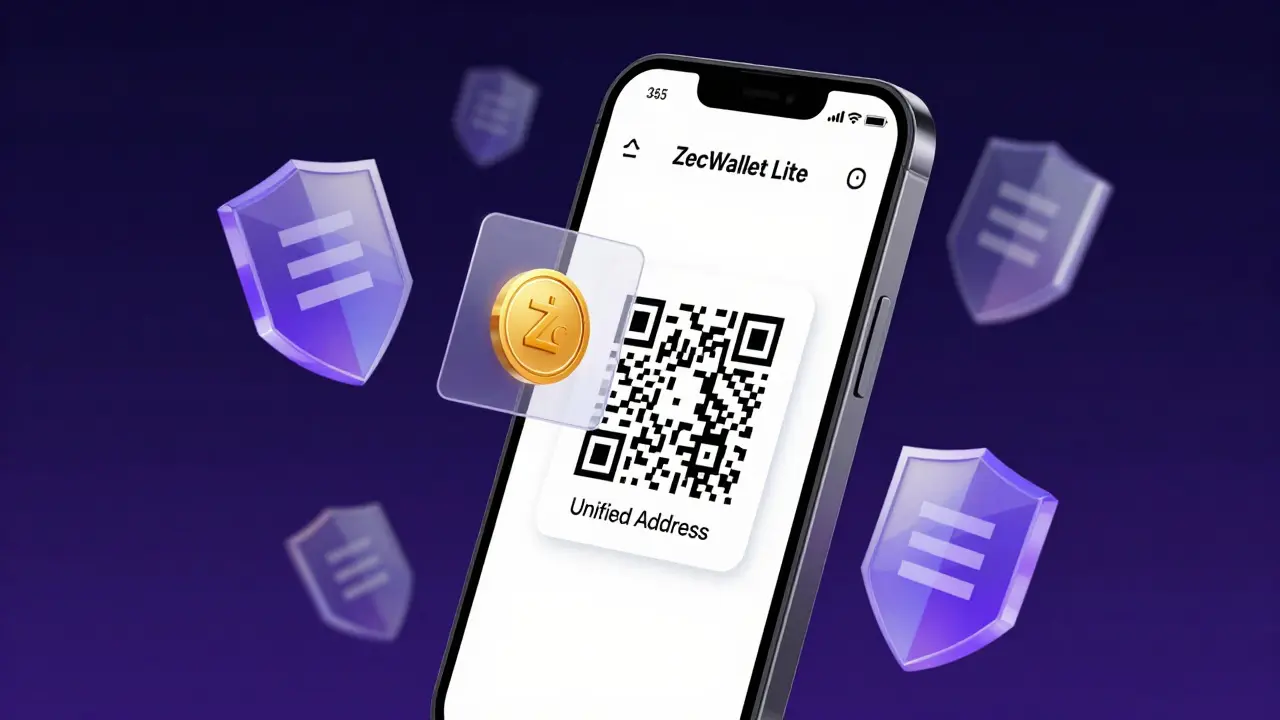
You can’t use shielded transactions with just any wallet. You need one that supports the Orchard protocol. Here are the top options as of 2025:- ZecWallet Lite - Free, open-source, works on mobile and desktop. Best for beginners.
- Nighthawk Wallet - Desktop-only, powerful, great for power users.
- Ledger (firmware 2.0.0+) - Hardware wallet support since March 2023. Secure for long-term storage.
Most exchanges still don’t support shielded deposits. Only about 37 of the top 100 exchanges allow you to withdraw ZEC to a shielded address. If you’re trying to move funds from Binance or Coinbase to a shielded wallet, you might get stuck. Always check the exchange’s withdrawal options first.
Mobile wallets were a bottleneck for years. Orchard fixed that. ZecWallet Lite now runs shielded transactions smoothly on Android and iOS. No more 45-minute waits.
Real-World Use Cases
Zcash shielded transactions aren’t just for speculators. They’re used in real businesses:- A European healthcare provider uses Zcash to process patient payments. No one links medical bills to identities. Zero breaches in 18 months.
- A freelance developer in Germany gets paid in ZEC via shielded address. Clients don’t know how much they’re paying, and the developer doesn’t have to reveal income history to tax authorities unless they choose to.
- A privacy-focused e-commerce store on Reddit reports transaction times dropped from 30 seconds to under 5 seconds after switching to Orchard addresses.
These aren’t theoretical. They’re documented in Zcash Foundation case studies and user reports.
Downsides and Challenges
No system is perfect. Shielded transactions have trade-offs:- Slower than transparent transactions - Even with Orchard, shielded takes 4-6 seconds. Transparent? Under 1 second.
- Higher resource use - Generating proofs uses more CPU and memory. Older phones still struggle.
- Exchange support is limited - Many exchanges don’t allow shielded withdrawals. You might need to use a desktop wallet to move funds out.
- Learning curve - If you’ve never used Zcash before, it takes 3-5 hours to understand the difference between t-addresses and z-addresses.
And then there’s the elephant in the room: regulation. Japan allows Zcash on exchanges but requires monitoring of shielded transactions. Germany says you need “enhanced due diligence.” In the U.S., the IRS treats Zcash like any other cryptocurrency-but if you use shielded addresses, you can’t easily prove your cost basis to them. That’s a problem if you’re audited.
What’s Next for Zcash Shielded Transactions?
The Electric Coin Company has a clear roadmap:- Zebra - A new, faster Zcash node written in Rust, launching in Q2 2024. More efficient, more secure.
- Zebra Shielded - A mobile-focused upgrade aiming to cut resource needs by 90% compared to current versions. That could mean shielded transactions on any phone, anytime.
- Selective disclosure - A feature that lets users prove transaction details to auditors or tax authorities without revealing them to the public. This could be a game-changer for businesses.
Analysts at Gartner predict shielded transaction volume will grow from 12.3% of total Zcash transactions today to 25-30% by 2026. That’s not because everyone will switch-it’s because businesses will start demanding it.
Final Thoughts: Is It Worth It?
If you want true financial privacy on a public blockchain, Zcash shielded transactions are still the gold standard. No other cryptocurrency offers the same balance of cryptographic strength, optional privacy, and real-world usability.But it’s not for everyone. If you’re just buying ZEC to flip it, use a transparent address. It’s faster and cheaper. But if you’re paying rent, sending money to a family member, or running a business that handles sensitive data-then shielded is the only responsible choice.
The technology works. The wallets are getting better. The ecosystem is slowly catching up. The biggest barrier now isn’t the tech-it’s awareness. Most people still think crypto is all public. Zcash proves that doesn’t have to be true.
Are Zcash shielded transactions truly anonymous?
Yes, but only if you use shielded addresses (z-addresses or Unified Addresses). When you send from one shielded address to another, the sender, receiver, and amount are encrypted and cannot be viewed by anyone-not even blockchain explorers. The only thing visible is that a valid transaction occurred. This is enforced by zk-SNARKs, which cryptographically prove the transaction is legitimate without revealing details.
Can I send Zcash from a shielded address to a Bitcoin address?
No. Zcash and Bitcoin are completely separate blockchains. You cannot send ZEC to a Bitcoin address or vice versa. To move between them, you need to use a cryptocurrency exchange. You’d sell ZEC for BTC on the exchange and then withdraw BTC to your Bitcoin wallet. Shielded Zcash addresses only work within the Zcash network.
Why are shielded transactions slower than transparent ones?
Shielded transactions require generating complex zero-knowledge proofs (zk-SNARKs) to verify the transaction without revealing data. This process uses significant CPU power and memory. Transparent transactions are simple transfers that only need to check signatures. Even with Orchard’s 94% improvement over older versions, shielded transactions still take 4-6 seconds, while transparent ones confirm in under a second.
Do I need to use a hardware wallet for shielded transactions?
No, but it’s recommended for long-term storage. You can use software wallets like ZecWallet Lite for daily use. Hardware wallets like Ledger support shielded transactions since firmware version 2.0.0 (March 2023), making them a secure option for holding large amounts of ZEC. The key is ensuring your wallet supports the Orchard protocol, regardless of whether it’s hardware or software.
Can tax authorities track my shielded Zcash transactions?
Not through the blockchain. Shielded transactions hide all details from public view. However, if you buy ZEC on an exchange that requires KYC, they know you bought it. If you later spend ZEC from a shielded address and it’s converted back to fiat, the recipient might report it. Some jurisdictions (like Germany and Japan) require exchanges to monitor shielded transactions. You’re responsible for tracking your own cost basis and reporting gains-shielded addresses don’t remove your tax obligations.
What’s the difference between a z-address and a Unified Address?
A z-address is a traditional shielded address that only accepts shielded transactions. A Unified Address (UA) combines both transparent (t-address) and shielded (z-address) capabilities into one. When someone sends ZEC to your UA, your wallet automatically receives it in the most secure way possible-shielded-if you’re using a modern wallet. It’s designed to make privacy easier and more seamless, especially for merchants and exchanges.
Is Zcash shielded transactions legal?
Yes, in most countries. Zcash is not banned anywhere as of 2025. However, some regulators treat shielded transactions with extra scrutiny. Japan allows them on exchanges with monitoring requirements. Germany requires enhanced due diligence. The U.S. IRS considers Zcash taxable property, but doesn’t prohibit privacy features. As long as you comply with local tax and anti-money laundering rules, using shielded transactions is legal.
Florence Maail
December 15, 2025 AT 10:36Kelsey Stephens
December 15, 2025 AT 19:25Tom Joyner
December 16, 2025 AT 03:17Samantha West
December 17, 2025 AT 02:52Craig Nikonov
December 18, 2025 AT 21:51Donna Goines
December 19, 2025 AT 09:13Greg Knapp
December 21, 2025 AT 00:18Shruti Sinha
December 21, 2025 AT 21:31Cheyenne Cotter
December 22, 2025 AT 19:43Emma Sherwood
December 24, 2025 AT 10:48SeTSUnA Kevin
December 25, 2025 AT 14:14Timothy Slazyk
December 27, 2025 AT 02:53Madhavi Shyam
December 28, 2025 AT 02:26